

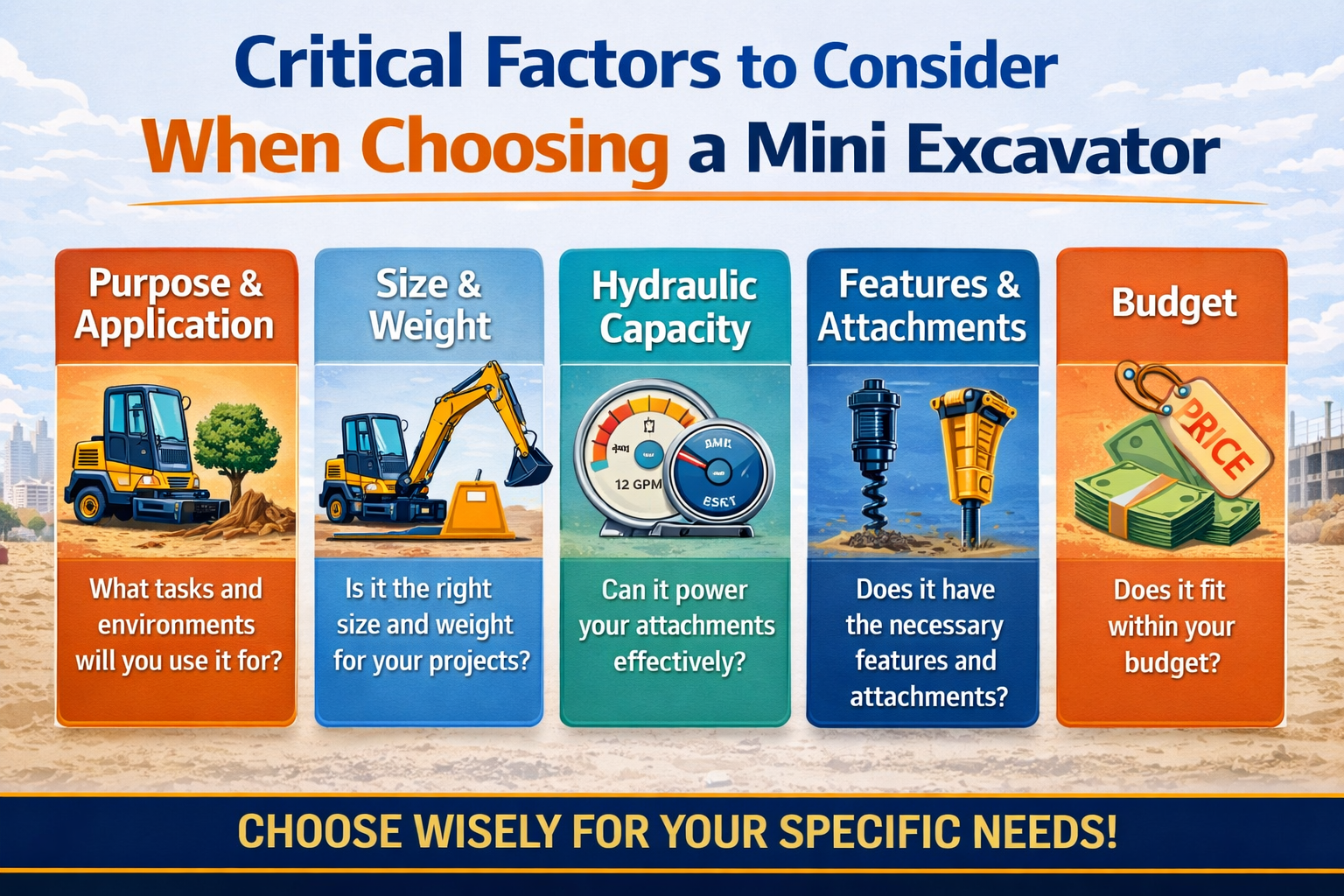
Critical Factors to Consider When Choosing a Mini Excavator
Let’s be honest: buying or long-term leasing a mini excavator is a massive financial pivot point for any business. It’s the difference between a year of high-profit, smooth-running jobs and a year spent wrestling with transport logistics or—worse—watching a machine sit idle because it’s too big to fit through a backyard gate.
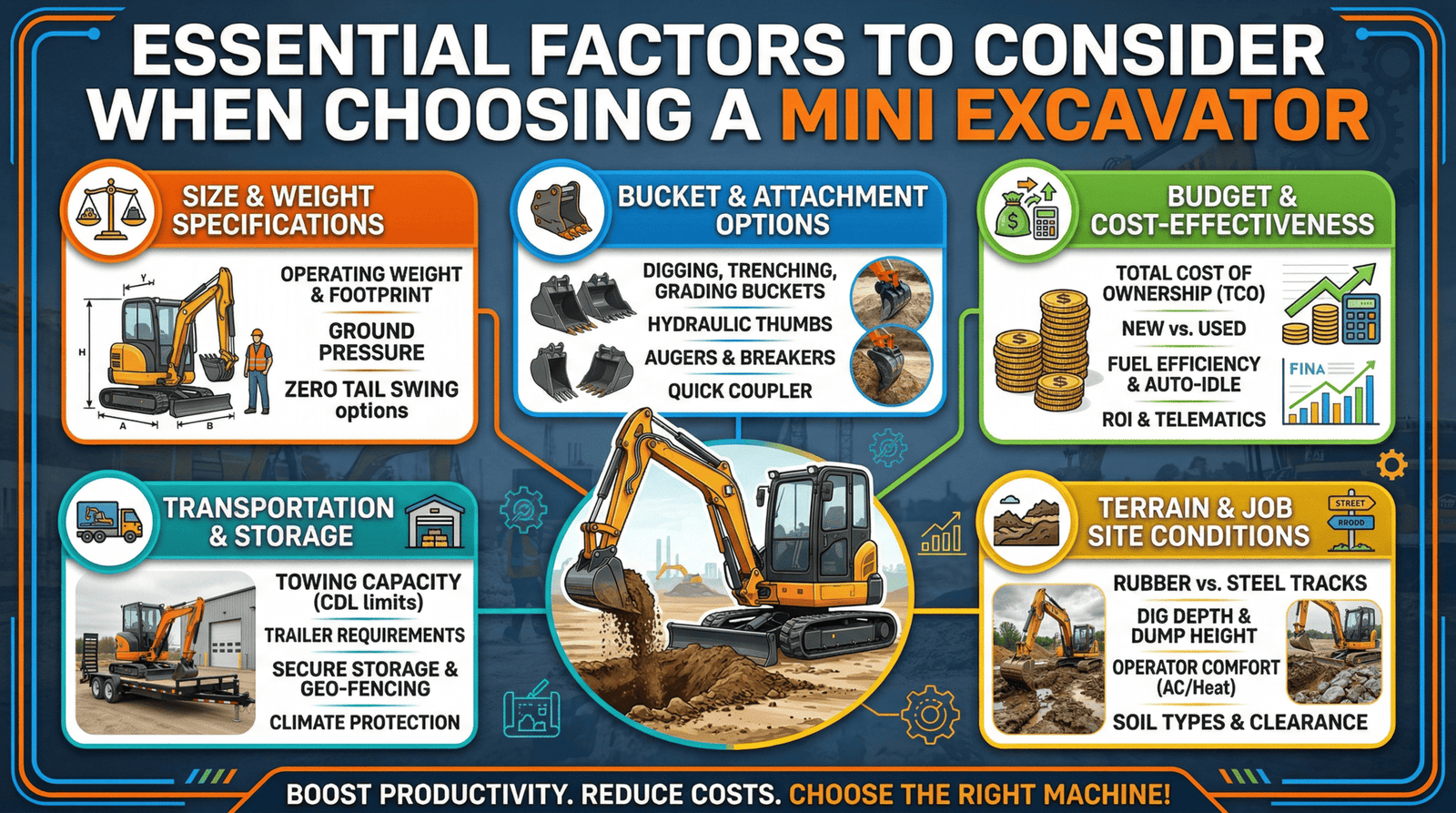
When you sit down to consider when choosing a mini excavator, you have to look past the shiny yellow paint and the salesperson’s pitch. You need a machine that survives the reality of “the mud.” This guide is built from the perspective of someone who has spent thousands of hours in the cab and just as many hours looking at the balance sheets.
1. The Big Problem with Small Machines: Size and Weight Specs
The term “mini” is a bit of a misnomer in our industry. We’re talking about a range that spans from a “micro” machine that can fit through a standard 36-inch garden gate to a 10-ton beast that can tear up a highway.
Why Operating Weight is a Trap
Many guys look at the spec sheet and see “Operating Weight: 8,000 lbs” and think, “Great, my truck can pull that.” But that’s the “dry” or standard weight. By the time you add a heavy-duty hydraulic thumb, a full tank of diesel, a cab full of tools, and a set of buckets, you’ve easily added another 1,500 lbs.
If you’re engaged in residential landscaping, weight can be detrimental. A 5-ton machine will leave “love notes” (ruts) all over a client’s expensive Kentucky Bluegrass. If your work is primarily “rehab” or residential, you should lean toward the 1.5 to 3.5-ton class with wide rubber tracks to keep ground pressure at a minimum.
The Zero Tail Swing (ZTS) Obsession
Is zero tail swing necessary? In 2026, it’s almost become the standard, but it comes with a trade-off.
-
The ZTS Advantage: You can rotate the cab 360 degrees without the “butt” of the machine clipping a fence or a worker. It’s a lifesaver in tight urban corridors.
-
The Conventional Reality: If you don’t need ZTS, a conventional tail swing machine often feels more “planted.” Because the counterweight sits further back, you get better leverage when you’re trying to pry a massive stump out of the ground.
2. Versatility is the Only Way to Stay Profitable: Attachments
If your excavator only has a bucket, you don’t have a multi-tool; you have a shovel that costs $60,000. To make a machine pay for itself, it needs to be the Swiss Army knife of the job site.
The Hydraulic Thumb: The Absolute Essential
Don’t let anyone convince you a mechanical “stiff-arm” thumb is enough. If you’re trying to stack landscape boulders or clear tangled brush, you need a hydraulic thumb. It allows you to adjust your grip on the fly. It’s the difference between picking up a coffee cup with your hand versus trying to do it with two sticks.
The Hidden Value of High-Flow Hydraulics
When you consider when choosing a mini excavator, check the auxiliary hydraulic flow (measured in Gallons Per Minute or GPM).
-
Standard Flow: Fine for thumbs and basic augers.
-
High Flow: Necessary if you plan to run “power-hungry” attachments like brush mulchers, cold planers, or large breakers. If you think you might expand into land clearing or asphalt repair next year, buy the high-flow machine today. Retrofitting a machine later is a financial nightmare.
3. The Cold, Hard Math: Budget and Cost-Effectiveness
We all want the brand-new machine with the new car smell, but the math doesn’t always support it.
The Used Market Minefield
Buying used is a great way to save 40% upfront, but you have to be a detective. I’ve seen machines with 1,500 hours that were treated like royalty, and machines with 500 hours that were “rental specials” and beaten to death.
-
Check the pins: Wiggle the bucket. If there’s a lot of “slop” or play in the joints, the previous owner skipped the grease gun.
-
The Undercarriage: This is the most expensive part to fix. If the sprockets are pointed like shark teeth, you’re looking at a $4,000–$7,000 bill in your first six months.
Telematics: The Silent Money Maker
Modern machines come with GPS and data tracking. Some owners hate “Big Brother” watching their machine, but telematics will tell you if your operator is spending 4 hours a day idling. At current diesel prices, cutting idle time by 20% can save you thousands over a season. It also helps with “GEO” (geographic) tracking—if someone tries to roll your machine off the site at 2:00 AM, you’ll get a text before they reach the highway.
4. The Logistics Nightmare: Transportation and Storage
This is where 50% of first-time buyers get blindsided. They buy the machine and then realize they can’t legally move it.
The 26,000-lb Ghost
In many states, if your truck’s weight rating plus your trailer’s weight rating exceeds 26,000 lbs, you are in CDL (Commercial Driver’s License) territory.
-
Scenario: You have a 1-ton dually (14,000 GVWR) and a heavy-duty gooseneck trailer (14,000 GVWR). Even if the trailer is empty, you are at 28,000 lbs. You now need a CDL driver, DOT numbers, and medical cards. If you don’t want that headache, you have to carefully consider when choosing a mini excavator that falls into the “CDL-exempt” weight class.
Storage and the “Neighbor Factor”
A mini excavator isn’t like a lawnmower. It’s an eyesore to neighbors and a magnet for thieves. Do you have a secure, fenced-in yard? If you’re storing it on a job site, does the machine have a “battery disconnect” switch or a “coded start”? If it doesn’t, someone with a universal key (available on Amazon for $10) can easily drive your investment onto their trailer.
5. Man vs. Machine: Terrain and Job Site Conditions
Not all dirt is created equal. The ground you work on should dictate the shoes your machine wears.
Rubber vs. Steel: The Great Debate
-
Rubber Tracks: Great for 80% of guys. They’re quieter, they don’t vibrate your teeth out on hard ground, and they won’t destroy a client’s driveway. But, they hate jagged rock and rebar. One wrong turn on a demolition site and you’ve got a $2,000 tear in your track.
-
Steel Tracks: If you’re in the woods or doing heavy demo, go steel. They’re nearly indestructible. Just know that you’ll need “street pads” or plywood if you ever have to cross a finished road.
Reach vs. Power
A “Long Arm” option is tempting. Who doesn’t want more reach? But physics is a cruel mistress. The longer the arm, the less “breakout force” you have at the bucket. If you’re digging in hard-pan clay or rocky soil, a standard arm will outperform a long arm every single time.
6. The Human Factor: Why Comfort Isn’t Just a Luxury
If you’re the one sitting in that seat for 10 hours a day, comfort is a productivity metric. If you’re hiring an operator, it’s a retention tool.
The Cab Environment
A ROPS (Roll-Over Protection) canopy is fine for the occasional weekend job. But if you’re working through a July heatwave or a November sleet storm, a climate-controlled cab isn’t a “want”—it’s a “need.” A comfortable operator makes fewer mistakes. Mistakes on a job site lead to broken utility lines or, worse, injuries.
Intuitive Controls
Look for “pattern changers.” Some guys grew up on backhoe controls (John Deere), others on excavator controls (ISO). A machine that can switch between the two with a simple lever will make your life—and your operators’ lives—significantly easier.
7. Maintenance: The Sunday Morning Test
Before you buy, ask the dealer to show you the daily check points.
-
Can you reach the fuel-water separator without a ladder?
-
Is the grease chart clearly labeled?
-
Can you change the oil filter without bathing in used 15W-40?
A machine that is hard to service is a machine that will be neglected. And in the world of compact equipment, neglect is a death sentence.
Final Thoughts: The Decision Matrix
Choosing the right machine isn’t a one-day process. It’s a series of trade-offs.
-
If you’re a “weekend warrior” or doing light landscaping, focus on the 2-ton class with rubber tracks and a canopy.
-
If you’re a utility contractor: Focus on zero tail swing and a high-quality hydraulic breaker attachment.
-
If you’re doing heavy grading/hardscaping: Look at the 5-to-8-ton class with a cab, a high-flow hydraulic system, and a tilt-rotator if your budget allows.
When you truly consider when choosing a mini excavator, you are looking for the “sweet spot” where the machine’s capability meets your transport limits and your bank account’s reality. Don’t buy for the job you hope to have in five years; buy for the jobs you have on the books for the next eighteen months.
