

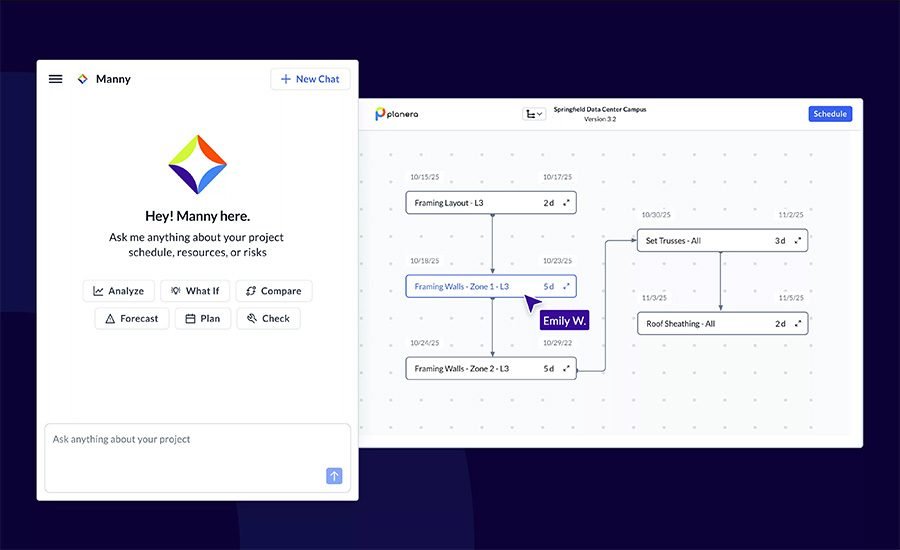

planon April 15, launched “Manny,” an artificial intelligence-based scheduling assistant designed to help construction professionals analyze schedules, understand the impact of delays and changes, and make faster decisions during unforeseen events.
Embedded directly into Planera’s platform, Manny is designed to turn a static calendar into a real-time decision-making tool.
“All the big builders I know often want to run scenarios,” says Nitin Bhandari, CEO and co-founder of Planera. “A problem could have three or four different ways to recover, but it’s hard to manually model those scenarios. AI can model them for you, get you the answers, and then you can make a decision very quickly.”
Schedule analysis can be a slow, manual process limited to estimators, planners, and sometimes project managers. Manual data entry is still the norm for many small and mid-sized contractors. Manny from Planera AI allows users to interact with agenda data using natural language. Teams can ask questions, surface critical path drivers, and run “what if” simulations in minutes.
Bhandari said the AI was trained for years during Planera’s beta testing to understand building concepts like the critical path.
“CPM scheduling is the heartbeat of a project, but traditional tools move too slowly for the modern workplace,” he said. “Manny makes schedule analysis faster, more accessible, and more useful. It doesn’t replace planner expertise. It helps teams use that expertise faster and more effectively.”
RELATED
Trimble acquires Document Crunch, plans to integrate AI Agentic contract review
Looking for quick answers on construction and engineering topics?
Try Ask ENR, our new intelligent AI search tool.
Ask ENR →
DPR uses ConstructivIQ in more than 120 projects
DPR Construction has expanded the deployment of ConstructivIQ, an AI-enabled platform for managing materials, logistics and procurement, to more than 120 projects across its company.
Since signing an enterprise agreement in early 2025, DPR has implemented ConstructivIQ in some of the world’s largest and most complex data center projects, including its hyperscale data center projects in Abilene, Texas and Louisiana, to support enterprise-scale procurement planning.
The use cases for procurement planning and materials tracking that ConstructivIQ now covers span the gamut of SKIDs, Owner Furnished Equipment (OFCI), materials that require field measurements, embedded materials and more, each with different planning and tracking needs.
“The way DPR and others are accelerating data center construction is by using skids, so everything is integrated before shipping,” said Sadanand Sahasrabudhe, CEO of ConstructivIQ, who gained 30 years of software development experience before co-founding the company.
“The scenario you have now is that you have a lot of component materials, electrical transformers and other things that are sent to an integrator,” Sahasrabudhe added. “The integrator is assembling the skid and the skid is sent to the site. You have to track the component materials, because they themselves can [have] long delivery times. You need to track those that come to the integrator. The integrator must put the skid together. Now you have to track the skating. So you have materials that depend on other materials.”
RELATED
Nemetschek to buy HCSS for $2.4 million, expanding reach into software for heavy civil contractors
Atul Khanzode, chief technology officer at DPR Construction, said the platform’s AI capabilities have enabled DPR’s project teams to move from reactive to proactive planning, improving both team efficiency and reducing planning risk across its portfolio.
“What makes it difficult for people [to] Making sense is a lot of data analyzed together,” said Khanzode. “What helps with this incorporation of AI appropriately is which potential programming activities are tied to specific equipment or material acquisitions. As the ConstructivIQ system is processing more and more, this knowledge or materials and equipment for particular construction activities only gets better.”
DPR is expanding its efforts from deployments to standardizing procurement KPIs and best practices across its methodology. It is now establishing business metrics for materials management, improving procurement planning with business partners, and implementing delivery tracking.
Additionally, the company is exploring how this data can help internal supply chain teams advise project teams on equipment lead times, schedule impacts, and alternative materials.
