

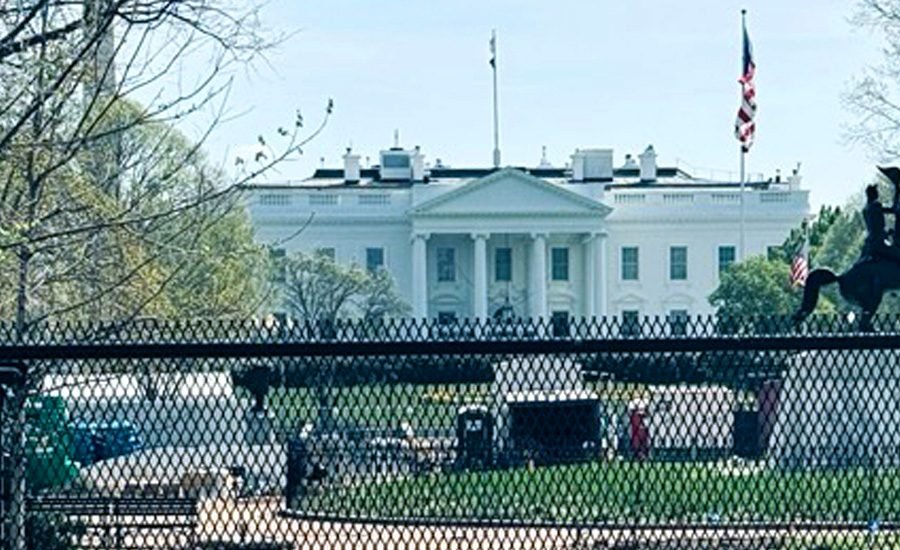

On April 17, a federal appeals court allowed construction on the ballroom planned for President Donald Trump’s White House to continue until early June, administratively staying a district court order issued a day earlier that would have halted work above grade next week.
The order by the U.S. Court of Appeals for the District of Columbia Circuit pauses an April 16 injunction by U.S. District Judge Richard J. Leon while the panel considers the government’s emergency request for a longer stay pending appeal, stressing the move “should in no way be construed as a decision on the merits.”
By upholding the stay request on the merits and establishing an accelerated briefing schedule, the court effectively extends the project’s active construction window while postponing a final decision on whether the ballroom can proceed.
The government’s opening brief is due on May 8, with the National Trust for Historic Preservation’s response on May 27 and a response on June 1. Oral argument is set for June 5 before Judges Patricia A. Millett, Neomi Rao and Bradley N. Garcia.
RELATED
Court forces split the construction road in the White House ballroom
The build window reopens in the critical phase
In its April 11 order, the panel wrote that the record raises “unsettled questions of fact” about whether above-grade construction is necessary to support the project’s underground safety systems, noting that the government had previously told the district court that underground work could proceed independently without blocking the ballroom’s design.
The justices also questioned claims of irreparable harm, pointing to project timelines stretching to 2028 as undermining arguments that a short-term pause would materially increase the safety risk during the appeal.
Looking for quick answers on construction and engineering topics?
Try Ask ENR, our new intelligent AI search tool.
Ask ENR →
The new stay temporarily reverses the immediate effect of León’s April 16 order, which had banned vertical construction, including structural steel and framing, while allowing below-grade work and safety-related activity to continue.
Leon wrote in that ruling that national security “is not a blank check to proceed with illegal activities,” rejecting the administration’s argument that the ballroom and its underground systems must be built as a single, inseparable project.
Distinction is key to project delivery. The foundation systems and below-grade concrete are largely complete, according to previous ENR reports, marking the transition to superstructure work, a phase that requires close coordination of fabrication release, structural steel shop drawings and assembly sequencing in a restricted, high-security campus.
With the court order on hold, the project clears this threshold again, allowing steel fabrication and delivery timelines to continue without immediate disruption and reducing the short-term risk of demobilization, remobilization and protection costs associated with partially completed systems.
Delays at this stage could affect crane scheduling, commercial stacking and site access logistics that are already tightly controlled within the White House complex, raising the risk of another stop-and-start cycle if the panel ultimately reinstates construction limits after its June review.
RELATED
The order halts the White House ballroom at the start of vertical construction
The June ruling sets the stakes for the superstructure
The oral argument on June 5 reaches a decisive construction point. With full substructure and higher-level work resuming during the administrative stay, the project commits to procurement and fabrication sequences that could be difficult and expensive to reverse: structural steel shop drawings, assembly contracts and crane mobilization on a high-security campus where start-up disruption is harder to absorb than on a conventional site.
The roughly $400 million project is being privately financed, separating it from congressional appropriations but not from judicial intervention.
A ruling that resets Leon’s construction limits after June 5 would force a second demobilization in the superstructure phase, the point most sensitive to sequencing and exposed to vertical construction costs, with remobilization deadlines and support costs added to a delivery schedule already shaped by the logistical and security constraints of the White House complex.
The court has explicitly reserved the merits, but the three justices previously wrote that they would not question the administration’s jurisdiction over national security or whether halting construction could jeopardize a critical security modernization.
“This court will not deny the importance of ensuring the safety of the White House, the President, staff and visitors,” they wrote.
What will decide the argument in June is not procedural: it is whether the ballroom goes up.
