

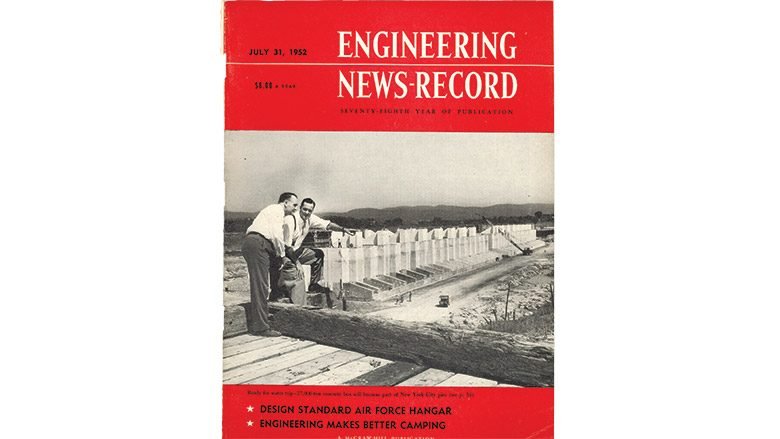

This cover from 1952 shows two huge concrete caissons sitting on a natural dry dock at Stony Point, New York.
Each caisson is 360 x 82 x 32.5 feet and weighs 27,000 tons. Along with a third 367 x 87 x 28-foot, 19,000-ton caisson (not pictured), they were dry-launched into an abandoned clay pit on the west bank of the Hudson River, where seepage had formed a 2,100-foot-long, 650-foot-wide pond running parallel to the river.
After the pond was drained, shovels and draglines were used to remove 150,000 m3 of mud, clay and silt. 5,300 tonnes of reinforcing steel were welded into assemblies, which were placed by gantry cranes ahead of the timber formwork, followed by a series of 36 pours.
The completed watertight caissons were towed 38 miles downriver and placed on piles from the previous wharf (destroyed in a fire in 1947), while their buoyancy supported 90% of the total load.
Dubbed the “SuperPier”, this design was considered innovative as it was fireproof and could not be attacked by offshore borers, both threats that had long plagued waterfront structures.
It was the largest pier in New York City when it opened in 1954, with 633,000 square feet of space on its two floors. Known as Pier 57, it originally served Grace Line ocean liners, and was later used as a bus depot.
From 2023, it houses a Google office space, a roof garden and a dining room.
Looking for quick answers on construction and engineering topics?
Try Ask ENR, our new intelligent AI search tool.
Ask ENR →
