

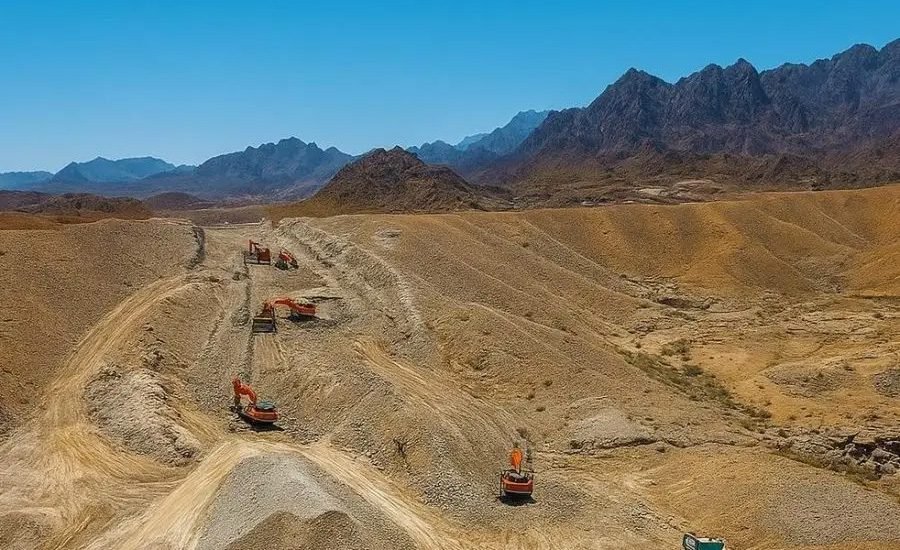
Construction of the first cross-border railway between Oman and the United Arab Emirates has reached 40% completion, with tunnels progressing through the Hajar Mountains and more than 27 million cubic meters of earthmoving completed on the 238km corridor, Hafeet Rail announced on 21 April.
Crews are also advancing 57 bridge structures across mountainous and wadi terrain, reflecting the scale of the structural work being undertaken.
Hafeet Rail is a joint venture between Etihad Rail, Oman Rail and Mubadala Investment Co. The total cost of the program is approximately $2.5 billion, according to Oman’s Ministry of Finance. No end date has been announced; Hafeet Rail said it is working to establish the operational schedule for the project.
“Achieving the 40% completion milestone reflects the strong foundations of this project,” said Ahmed AlMusawa AlHashemi, CEO of Hafeet Rail. “As we move into the next phase of delivery, our focus remains on maintaining momentum, strengthening collaboration between partners and ensuring the project delivers long-term value in line with the highest international standards.”
AlHashemi said the project has recorded 10 million safe working hours without major injuries at all construction sites.
Work is progressing simultaneously in Al Ain, Al Buraimi, Sohar and Wadi Al Jizzi, where the alignment crosses urban, industrial and mountainous terrains that require specialist engineering solutions. To date, more than 100,000 m3 of concrete has been placed, with 80 structures under construction.
Crews have also driven 900 piles and installed 130 culverts, progressing to a total of 881 culverts across the corridor, Hafeet Rail and Oman’s Ministry of Finance reported.
Looking for quick answers on construction and engineering topics?
Try Ask ENR, our new intelligent AI search tool.
Ask ENR →
Ophiolite Geology and Drill and Blast Excavation
The project has entered a critical phase in Oman’s Al Buraimi governorate, where excavation is progressing in tunnels through the Hajar Mountains. Access roads and portal works have been completed ahead of full tunnel drives in a corridor comprising about 2,500 m of total tunnel length.

The map shows the 238 km Oman-UAE Hafeet rail corridor linking the port of Sohar in Oman with the UAE national rail network near Abu Dhabi, including connections via Al Buraimi and Al Ain.
Map courtesy of Hafeet Rail
The Hajar Mountains present complex geological conditions for tunneling, consisting primarily of ophiolite rock formations: elevated oceanic crust composed of ultramafic and mafic materials such as peridotite and gabbro.
Ophiolite formations are often highly fractured and of variable strength, conditions that generally require controlled drill-and-blast excavation, intensive ground support, and continuous geotechnical monitoring.
Project disclosures indicate that excavation and blasting is underway at the tunnel portals, and the complete units are expected to continue sequentially as the access, stabilization and support systems are completed, allowing the tunnel, structural lining and subsequent track installation to progress in gradual progression through the mountain corridor.
The alignment also incorporates 39 underpasses integrated into drainage and access systems, along with flood protection measures designed to maintain operational reliability in a region prone to episodic wadi flooding.
Bridge construction is progressing in parallel, with 57 structures — comprising 36 viaducts and 21 overbridges — underway across the corridor. Some rise to around 34m high, reflecting the complexity of the terrain and hydraulic design requirements.
RELATED
The United Arab Emirates signs the first contract for an $8 million high-speed rail project
Hafeet Rail Civil Contractors, System Integrators and Project Management
The civil works are being executed by an Omani-Emirati consortium led by National Projects Construction, part of Trojan Construction Group, together with Oman’s Galfar Engineering & Contracting.
System delivery is being managed by a joint venture of Siemens Mobility and Hassan Allam Construction, responsible for the design, construction and integration of signaling, telecommunications and power systems.
The scope includes the deployment of the European Level 2 Train Control System, which enables interoperability between the UAE and Oman networks, along with a fiber optic communications backbone.
Systra acts as a project management and engineering consultant, overseeing the delivery of civil and systems packages through commissioning.
“This contract massively increases our footprint in Oman, hopefully opening the door to many more projects there,” said Esmaeil Ghahremani, Oman vice president of Systra DB&I, the firm’s Design, Build and Integration division.
It is expected that the installation of the systems will be after the completion of the main civil works, with the deployment of signaling and communications in parallel with the commissioning of the tracks.
Creating cross-border connectivity
Once completed, the railway will connect the port of Sohar with the UAE’s national rail network at Al Wathba outside Abu Dhabi, creating a continuous corridor linking more than 12 passenger stations and cities, five major ports and more than 15 integrated freight facilities in both countries, according to Hafeet Rail.
The freight trains are designed to operate at speeds of up to 120 km/h and carry more than 15,000 tons of cargo, or approximately 270 standard containers per trip, according to Hafeet Rail. The passenger trains will run at speeds of up to 200 km/h, with a journey time from Sohar to Abu Dhabi expected to be 100 minutes and Sohar to Al Ain in 47 minutes.
The system is designed to standardize tracking, signaling and communications specifications in both countries to enable seamless cross-border operations.
Abdulrahman Al Hatmi, CEO of Asyad Group, Oman’s state-backed logistics provider and Hafeet Rail partner, said the pace of construction reflects a shared commitment to the timely delivery of passenger and freight services, citing the labor capabilities developed through Oman Rail over the past decade.
RELATED
Jordan moves to expand freight rail network as Hormuz disruptions alter supply routes
A regional model
The Oman-UAE link is among the first operational cross-border segments within the Gulf Cooperation Council rail network, a regional framework established in 2009; GCC Secretary General Jassim Al-Budaiwi said in February that connections to the network between countries are expected to begin by 2030. Its progress also comes as the UAE is simultaneously expanding its rail investment model beyond the Gulf by developing the parallel freight corridor.
As ENR previously reported, Jordan and the United Arab Emirates signed a $2.3 billion deal to develop a 360 km freight railway linking Al Shidiya phosphate mines and potash production sites in Ghor Al Safi with the port of Aqaba. The agreement established the UAE-Jordan Railway Co., with Etihad Rail as the executive arm.
Although not physically connected to Hafeet Rail, the Aqaba Corridor reflects the same logistics model: shifting bulk freight from long-haul truck to dedicated freight rail.
Project and government statements framing the deal describe Etihad Rail’s delivery approach as a template for comparable rail developments across the region.
