

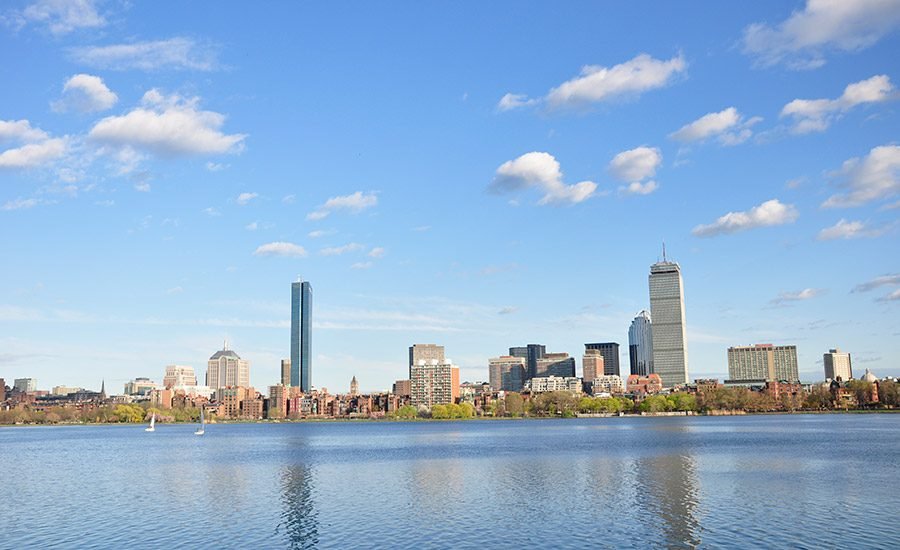
The Mass Clean Energy Center, in partnership with the City of Boston, will provide $500,000 to the Boston Green Ribbon Commission to explore the technical, economic and regulatory feasibility of using clean thermal energy from water in the Boston area to provide heating and cooling to institutions and businesses.
The goal of this year-long Boston Thermal Energy Network (BosTEN) project is to demonstrate that thermal energy networks can reduce pollution, mitigate peaks in gas and electric systems, and deliver long-term cost savings.

The Boston Green Ribbon Commission delegation visits the seawater heat pump system in Esbjerg, Denmark in 2025.
Credit: Green Ribbon Commission
The technology, intended to capture thermal energy from the Charles and Mystic Rivers, Boston Harbor, Fort Point Channel and bedrock beneath the rivers, would be a closed system that circulates heat through sealed infrastructure without drawing water from waterways.
“It’s one that’s been proven and tested on campuses and in suburban areas, but we haven’t deeply investigated this technology for dense urban areas like the city of Boston,” says Peter McPhee, senior director of building decarbonization at MassCEC. “And we haven’t yet studied the feasibility of using water resources like Boston Harbor as a source of energy that could heat or cool these buildings.”
The hope is that “anchor” institutions – such as hospitals, universities and large companies – will connect to the grid and have access to lower cost and cleaner energy. The system is not carbon neutral, but it is much cleaner than the alternative.
“There’s an amount of electricity that’s used for both [buildings’] heat pumps and pumping [water] en,” says McPhee, “but when we look at the math on that, what it says is that even if you do it today, even though some of that electricity comes from fossil fuels, it’s still much cleaner to do that than it is to burn fossil fuels.”
As for the impact of a thermal power system on a river system like the Charles River, McPhee says it could actually have a mitigating effect on the temperature rise caused by global warming.
“By extracting the heat from these bodies of water, we can control it in a way that returns temperatures to pre-global warming temperature profiles,” he says, “which can be very beneficial to the ecology and really mitigate some of the challenges we’re having with warmer temperatures.”

Pipeline installation for Framingham’s geothermal energy grid in 2023.
Credit: Eversource and HEET
The project is timely given the volatility of the global fossil fuel market.
“We’re all very aware of the volatility and the prices of fossil fuels and the supply of fossil fuels, with a lot of what’s going on in the world today,” says McPhee. “And I know many businesses and consumers know this too, and are looking to get more stable, lower-cost energy sources that are good for business and good for your home.”
The Green Ribbon Commission will collect data from buildings from the area’s biggest energy users to inform its analysis of thermal energy use at scale. GRC will also work with government entities, regulated utilities and energy suppliers in the district to address regulatory barriers and underground infrastructure.
GRC is looking for a qualified engineering firm or technical consultant to lead the project. Proposals are due on April 29. The request for proposal can be found at greenribboncommission.org/2026/04/cleanthermalrfp.
