

Every act in the new home of the American Repertory Theater has been built differently than it was built before.
Taking shape in Boston’s Allston neighborhood over the past two years, the Harvard ART project hasn’t offered the team “a lesson learned that can be applied from one area to another because each area has its own use,” says Dan Ryan, senior project manager at Shawmut Design and Construction, the project’s construction manager.
The David E. and Stacey L. Goel Center for Creativity and Performance is an 86,400-square-foot facility designed to foster performance, public gatherings, teaching and international research. The facility with multi-purpose spaces and two performance rooms, including the 700-seat West Stage for large-scale productions and the more intimate 300-seat East Stage, also includes rehearsal studios and teaching spaces, a large public lobby, a cafeteria, dressing rooms, technical shops, administrative offices and an outdoor performance yard.

Substantial completion is scheduled for October and ART plans to open its doors in early 2027.
Courtesy of American Repertory Theater through Haworth Tompkins and ARC/Architectural Resources Cambridge
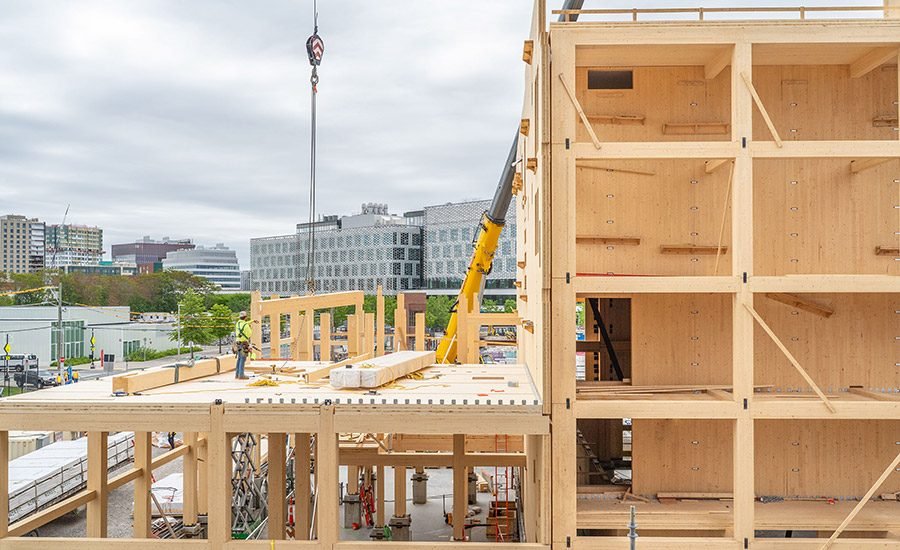
Because each section of the building had its own function, the team could not take the traditional approach of installing concrete cores before building the structure. Instead, the team divided the building into six self-supporting structural sectors, Ryan says, “each sector functioned as a mini-building during construction, allowing the team to erect parts of the structure independently before joining them into the complete installation.”
This strategic approach “allowed the team to prioritize areas in the project’s critical path, such as the West Stage, which is the most complex part of the building and needed to start early to maintain the overall schedule,” he notes.

The ART project is the sum of more than 2,300 individual pieces that make up the structure of the building.
Courtesy of Harvard University Planning and Design
The crews erected each sector sequentially using 1,480 prefabricated glulam members for columns, beams and wind girders, and 890 CLT panels for walls, floors and roofs, sequencing the work as if following Lego instructions. To keep the building structurally sound, you have to “build in that sequence because of the way the loads are transferred,” adds Ryan.
Once the six sectors were completed, the team “tied them together to form the one American Repertory Theater installation,” says Ryan.
Substantial completion is scheduled for October, and ART plans to open its doors as planned in early 2027.
.jpg "wooden structural elements")
Crews installed massive timber structural members around the steel flyover tower above the west stage in April 2025.
Courtesy of Shawmut Design and Construction
Massive wooden erection
Harvard’s original plan to modernize ART’s existing home, the Loeb Drama Center in Cambridge, morphed into building a new facility when the university received a $100 million gift from the Goels in 2019, says Susan Malaab, senior director of projects at Harvard.
Haworth Tompkins, the architect and design lead, and Architectural Resources Cambridge, the architect of record, spent six years designing and planning alongside theater and acoustics consultant Charcoalblue. Designing to achieve the International Living Future Institute’s Living Building Challenge core accreditation, the team deployed cross-laminated timber, reclaimed brick, and cedar siding while embracing openness, artistic flexibility, and regenerative design that seeks to redress ecological imbalances created by human development, a concept developed by John T. Lyle, professor of landscape architecture at California Polytech University.
.jpg "Fifteen massive trusses")
As part of the theater structure, 15 massive trusses were installed, each averaging 70 feet long, 10 feet high by 10 feet high, and weighing 30,000 pounds. LeMessurier designed the trusses, including the tensile architectural elements.
Courtesy of Shawmut Design and Construction
A few months after construction began in 2024, the team began erecting the fly tower above the west stage, a steel structure that houses the rigging system that raises the back stage, lights and other scenic elements during productions. The team built structural shear walls, elevator cores, and stair cores with cross-laminated timber to resist wind and seismic forces.
“These CLT shear walls were highly loaded and required careful detailing to manage the forces while still working with the architectural and constructional constraints of the building,” says Simon Gallagher, project manager at Montreal-based Nordic Structures, which designed all the connections and fabricated and installed all the solid wood material.

The ART is designed with enormous height in many spaces, including wide openings without columns. LeMessurier designed the trusses, including tensile architectural elements.
Courtesy of American Repertory Theater through Haworth Tompkins and ARC/Architectural Resources Cambridge
Theatrical acoustics
Unlike traditional concrete or masonry construction, the lighter, less rigid mass of wood allows for the transmission of low-frequency sound more easily. “Wood is not an acoustically forgiving material,” says Malaab.
To achieve sound separation between spaces, the Charcoalblue team collaborated with structural engineer, LeMessurier, to find a solution for a more rigid structure in a reliable way, says Eric Magloire, director of design and acoustics at Charcoalblue. LeMessurier recommended a shorter structural grid than is typically possible with solid wood floor panels to limit vibration and deflection.
The team standardized on a structural design of glulam columns and beams on a 12-foot grid, an advantageous spacing for the CLT spans given the strict live load and vibration criteria required for studio and rehearsal spaces designed for music and rhythmic dance activities, says Aaron Malone, director of LeMessurier.
“In the lobby and performance spaces, where longer spans were required, various hybrid timber and steel truss configurations were used to achieve the necessary lights while maintaining sufficient stiffness to meet floor deflection and vibration criteria,” he says.

Acoustic-structural insulation connections in the acoustic section of the theater provide a bridge between the glulam column and the CLT wall panels.
Image: Aaron Malone, LeMessurier
Around the perimeter of the west stage a sound insulation joint provides structural sound insulation from the first floor to the roof. It provides “full 2-inch structural sound insulation that mitigates structural noise and flanking noise between the west stage and its adjacent spaces,” Magloire says.
Because of space limitations, the team recommended installing “a single line of structure” with acoustic-structural insulation connections between the two structures, Magloire adds.
These connections eliminate rigid structural connections through the acoustic insulation board that separates the West Stage theater from the rest of the building, Malone says. The connections also use “structural elastomeric bearing pads to transfer structural loads through the isolation joint while limiting the transmission of structural noise into the West Stage theater,” explains Malone.
MEP coordination
Because the solid wood is fabricated off-site, the team had to fully coordinate and integrate all MEP penetrations during design so that the components arrived ready for installation, Sheridan says, “turning what is traditionally fieldwork into a precise prefabrication process that improves speed, quality and overall project efficiency.”
The detailed coordination of MEP penetrations for services, lighting and HVAC fixtures, and plumbing through the solid wood system was also critical to the acoustic design, says Magloire.
“In performing arts facilities, sound insulation assemblies rely heavily on maintaining continuous layers of mass and airtightness,” he says.
Accurately coordinating acoustic design with architectural, structural and building services teams is also key to avoiding the risk of intrusions that compromise the acoustic separation between spaces, adds Magloire. “Even relatively small openings can create flanking that significantly reduces the performance of otherwise robust assemblies,” he says.
A sustainability innovation that required extensive MEP coordination involved the installation of natural ventilation. Under the first-floor slab, where “100,000 cubic feet per minute of air must travel from intakes down the west side of our building through concrete air passages through four louvers and up the tower at the top of the project,” says Sheridan.
The complex design uses shoulder stations and “natural heat from the electricity inside the theaters” for heat recovery, he adds.
After MEP coordination, the team was completely locked into the structure and managed a strong start with the MEP systems, he says.
