

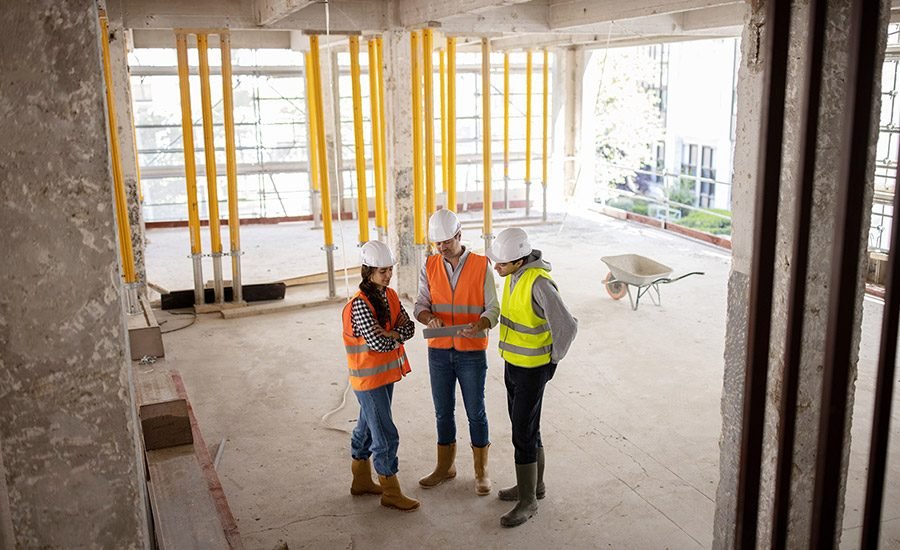

Amid opportunities and questions, the US construction industry continues to evolve in dynamic but sometimes challenging ways.
The first half of the 2020s was a study in contrasts for contractors. As the country and the construction industry emerged from the economic slowdown and turmoil caused by the COVID-19 pandemic, supply chain disruptions drove up costs. Labor shortages sapped the workforce. As a result, many teams expressed concern that profits would fall in the short term, according to Associated Builders and Contractors.
Yet despite these headwinds, real and perceived, the US construction industry remained strong during the first half of the decade, especially compared to other countries. A similar dichotomy exists as the second half begins.
Evolution of interest rates and labor pressures.
One reason for companies’ cautious optimism may be the Federal Reserve’s shift in focus on interest rates. After a rapid acceleration followed by initial cuts in 2024 and 2025, rates have entered a more uncertain phase. Rather than moving in a clear direction, policy has become more measured and data-driven, reflecting current questions about inflation, economic growth and the strength of the labor market. The Fed continues to balance the risk of cutting too quickly and keeping rates higher for longer. For construction companies, this uncertainty has translated into a mixed demand environment, where some projects move forward while others are delayed or reassessed.
Increasing costs by tightening the screws on subcontractors.
Rising material costs, changing tariff policies, unpredictable supply chains and labor shortages will no doubt continue to squeeze the already tight profit margins of contractors and subcontractors, with the latter bearing much of the burden.
Strengthen resilience in an unpredictable market.
Leaving aside factors that are more difficult to control, such as the economy or rates, contractors should focus on a few key areas to strengthen their ability to withstand unpredictability, such as managing bidding and procurement risk to ensure project viability and avoid cost overruns and schedule delays. Cyber security should also remain a priority. More than two in five contractors report experiencing increases in phishing, data breaches and ransomware attacks in the past year.
Technology drives a safer workplace.
Construction involves more than just business risks. Even in the most well-managed workplaces, workers are exposed to many potential physical hazards, from falls to electrocution, and injuries and deaths have remained high for more than a decade. The construction industry accounted for 1,075 workplace fatalities in 2023, the most recent year for which data is available. This is the highest number of annual construction deaths since 2011.
However, companies have a range of new devices and technologies to choose from to give their workers a safer workplace, including monitors, sensors and location geofencing. Developing and maintaining a culture that prioritizes safety over speed and an awareness of corner cutting can reduce accidents by signaling to employees that their well-being comes before profits.
Data center demand meets real-world constraints.
Data center construction remains one of the most watched areas of the industry. Demand linked to cloud computing and artificial intelligence continues to drive investment, but the pace and form of this growth is becoming less predictable. Long-term projections still point to significant expansion. However, in the short term, developers are navigating a more complex environment. Energy availability, land constraints, permitting challenges and rising construction costs are influencing how and where projects move forward. In some cases, these factors have led to delays, cancellations, phased construction, or redesigned projects that better align with available infrastructure.
Energy has become the determining factor. Data centers, especially those supporting AI workloads, require significant and reliable power, and meeting this demand is becoming one of the industry’s biggest challenges. In response, developers and utilities are working to expand generation capacity, improve grid infrastructure, and explore alternative energy strategies to support future growth.
The impact of AI.
As is the case with almost every other industry, AI is also poised to change the way construction companies operate, although to what extent and how quickly is still up for debate. In theory, incorporating AI into day-to-day operations could have many benefits. Construction produces a wealth of data every day, including cost estimates, project schedules, safety reports and material usage. However, deriving truly usable insights from this data is challenging and time-consuming for anyone, let alone someone managing multiple teams across dozens of workplaces. Well-designed algorithms, however, can find patterns in this data and provide actionable insights to increase efficiency and address challenges in everything from cost estimating and site safety to automating contract review.
The M&A drive is accelerating.
M&A activity in the construction industry continues to increase significantly, according to Capstone Partners’ Construction Services Market Update 2025. Driven primarily by the data center boom and pent-up demand for new residential construction, transactions increased for the third year in a row and by a wide margin. These tailwinds contributed to a 33.8% increase in year-over-year deals, with companies ramping up acquisitions of companies that expand market share or expand service capabilities in key end markets.
The case of modular in a tense market.
A modest but growing sector to watch out for is the modular construction sector, which accounted for just over 5% of total construction activity by 2024. Modular construction has a handful of features that make it attractive in today’s economic environment, and explains the Modular Building Institute (MBI) and FMI Consulting’s prediction that the industry will grow at a compound annual growth rate of $5 billion over the next $5 billion. surpassing the construction sector as a whole by 1.3%. The main of these characteristics is the lower cost. Additionally, since the vast majority of a modular construction project occurs indoors, it can also typically be completed much more quickly than a traditional site-built project.
Why 2026 may be a turning point.
Perhaps the best word to describe the state of the construction industry in 2026 is “transition”. While demand for new construction is strong, high material costs, changing policy and economic conditions, and stubborn supply chain complications continue to keep the overall market in check.
For a more detailed analysis of the construction financial forces in 2026, find our full industry report here.
Regardless of the challenges your company faces, and the questions that come with them, you don’t have to face them alone. At Commerce Bank, we’ve been helping businesses of all sizes find the solutions they need since 1865. Because nothing matters more to us than your success. More information at commercebank.com/SolutionsThatMatter.
CommercePayments® solutions are provided by Commerce Bank.
