

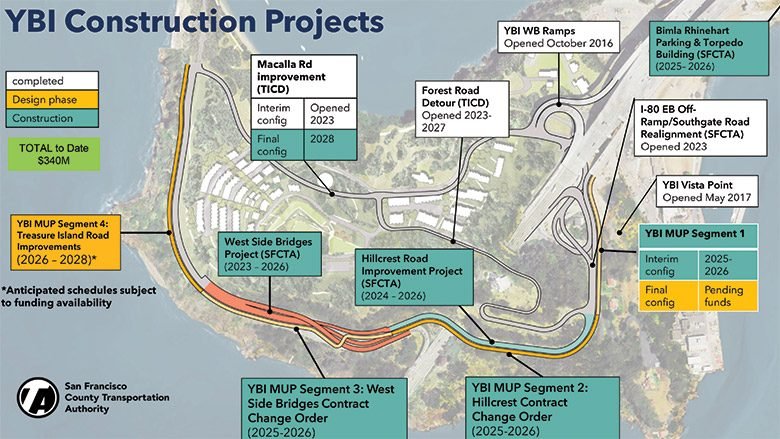

With about 8,000 new housing units and three neighborhoods planned for the middle of the next decade on Treasure Island and Yerba Buena Island, the San Francisco County Transportation Authority is overseeing the construction of several mobility projects. This year, two of them, and another, a multi-use path, are expected to be completed, in different phases of design, bidding or financing.
The program aims to “really prepare [Yerba Buena] Island for massive growth,” says Tilly Chang, the authority’s executive director. In recent years, she oversaw the construction of new I-80 ramps and an interchange and overlook with scenic views and park amenities. Current projects focus more on non-vehicular transportation across the two islands.
“In all, it’s a $350 million portfolio,” says Carl Holmes, deputy director of the capital projects authority. While three of the four segments of a planned multi-use route will be put out to bid this year, funding is still being sought for one segment, he notes. “We’re also trying to see if it’s possible that we can design and maybe build parts of it, because we have half the roads closed right now while we have the two big construction projects going on,” adds Holmes.
The agency announced on its blog in January that the California Strategic Growth Council had awarded a $45 million grant for the construction of affordable housing, bus shelters, and trails and sidewalks that will facilitate the planned completion of the northern segment of the Yerba Buena Multi-Use Trail in the summer of 2028.
A Golden State Bridge-Obayashi joint venture is the general contractor for the construction manager of the approximately $126 million Yerba Buena Island West Side Bridges seismic retrofit project. The scope of the work is to remove eight existing bridges from the 1930s and replace them with six retaining walls, a cut and covered tunnel and more than a quarter-mile of reconstructed roadway, says Robert Coupe, Golden State Bridge vice president.
“They were scary: old, rickety, rusty bridges,” he says. What was even scarier for the project team, initially, was the discovery of old military weapons such as tear gas canisters at the site shortly after the team started in 2023, Coupe notes.
“We shut down the job and got out of the way and let the experts handle it,” he recalls. The shutdown lasted only a few days. “I had worked on the island in the 2000s for the Bay Bridge, and there were live grenades,” adds Coupe. It is more risky to work on steep slopes. Crews carried out about 37,800 cubic meters of excavation, he says. About 25,000 cubic meters of this material goes to the Treasure Island Development Commission for future surcharge.
Looking for quick answers on construction and engineering topics?
Try Ask ENR, our new intelligent AI search tool.
Ask ENR →
The island is a natural rock formation covered in sand. “Some of the walls we’re building are one-sided with soil nail walls and ties,” says Coupe. “We had a hard time building them with the sandy material.” The team devised a solution of 1.5-inch-diameter hollow sealed rods drilled vertically along the walls and bolted to the hill. “As we dug in front of these vertical rods, it held the sand,” he says.
The innovative system was nicknamed the “Sand Prison,” says Rob Reaugh, partnership facilitator at project consultant Org-
metrics “It’s a soil-nail wall approach where as the tube spirals down, concrete is injected, creating columns to hold the sand.”
Reaugh leads a citywide partnership steering committee, originally formed in 2016. “To our knowledge, it’s the only committee of its kind. We talk about partnership, collaboration and project delivery across all six departments in San Francisco.” He adds that the multitude of stakeholders involved in the planned development include state, local and federal agencies as well as developers.
In March, Thompson Builders Corp. completed its approximately $22 million portion of the $38 million Hillcrest Road Improvement Project, which involved a 30,000-square-foot, 30-foot-tall retaining wall, according to a news release. The wall is finished in stained shotcrete and sculpted with artwork by Bay Area artist Muzae Sesay.
A $4 million effort to improve the Treasure Island Ferry Terminal is also due for completion this year.
