

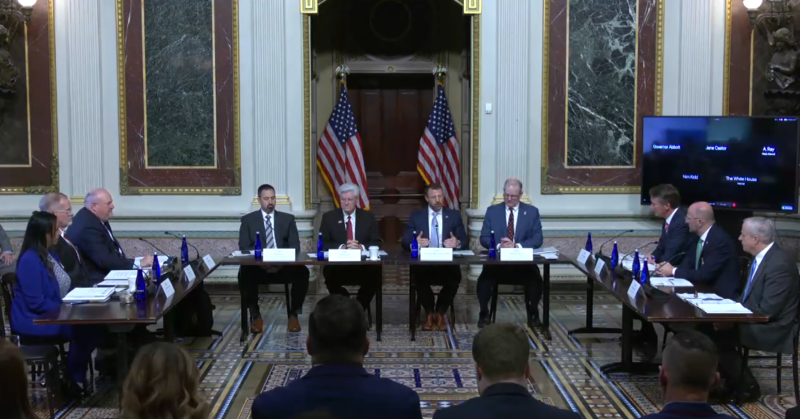

The Trump administration’s long-awaited final report on Federal Emergency Management Agency reforms aims to put states primarily in charge of disaster recovery while tapping the federal agency’s resources for support.
“FEMA is not a first responder, but a force multiplier working shoulder-to-shoulder with states, tribes and local governments to ensure a quick and effective recovery,” Department of Homeland Security Secretary Markwayne Mullin said in a recent statement announcing the May 7 release of the FEMA Review Board’s final report.
The council’s report aligns with repeated calls by President Donald Trump, who initially called for the abolition of FEMA, to put states in the driver’s seat of disaster recovery and makes 10 broad recommendations to do so. Some of the recommendations could be made through executive orders, and others would require congressional action.
The council, which Trump established in January 2025, said it made the suggestions based on more than 12,000 public comments, more than 1,300 responses to a national survey of state and local government emergency management stakeholders; and 16 face-to-face and virtual listening sessions with state and local governments.
“Comments received underscore widespread support for FEMA reform aimed at addressing inefficiencies, reducing bureaucratic barriers, and improving support for disaster survivors and local governments,” the council said in the report.
There are some positives from the report, said Chad Berginnis, executive director of the Association of State Floodplain Managers (ASFPM). These include plans to update hazard and risk information under the National Flood Insurance Plan (NFIP). “We’ve only mapped a third of our flood risk in this country,” he said.
But overall, the report lacks specificity, he said. In some cases, it offers recommendations that wouldn’t necessarily solve the problems listed, and in other cases, it’s unclear what the solution would be, he said. The report, he added, “seems to impose a lot of standards and limits and requirements without showing much assistance and help in doing so.”
Looking for quick answers on construction and engineering topics?
Try Ask ENR, our new intelligent AI search tool.
Ask ENR →
As an example, Berginnis pointed to the council’s recommendations related to the Hazard Mitigation Grant Program (HMGP), a major focus for ASFPM. The report recommends replacing the HMGP with a state-run program under a two-phase funding structure in which project priorities are set nationally and environmental reviews are conducted locally.
Berginnis said he is puzzled as to “why the report focuses on HMGP when it is the only program among three FEMA mitigation programs that does substantially what this administration wants it to do. That is, it is state-led.”
The HMGP is primarily administered by the states, but the report suggests replacing it with one aligned with the federal government’s priorities, “which is strange,” Berginnis said. “They’re sticking the federal nose under the tent and redirecting some of that to federal priorities instead of following state priorities.”
Berginnis also noted the Office of Inspector General’s (OIG) audit report mentions that oversight of HMGP’s property acquisitions lacks consistency across FEMA regions.
“We know of several states (Ohio, for example, is one of them) that have great online tools that track property acquisitions very carefully,” Berginnis said. “So why change an entire program to deal with some states that maybe have poor tracking?”
The report suggests developing what it refers to as a “mitigation fast-track,” which would provide up to 5 percent of the federal government’s contribution to facilitate immediate residential mitigation in the first 30 days of a disaster. It would also implement a “strategic mitigation allocation,” which would provide up to the remaining 10 percent of the federal contribution to improve NFIP performance by mitigating critical properties and infrastructure based on certain priorities.
Berginnis said those are good examples of the report offering solutions that won’t fix the problems.
“Having developed hundreds of mitigation projects in my career, I can say that advancing money in 30 days does nothing for me because HMGP projects, by their nature, tend to be more complex,” he said. Berginnis worked with FEMA for 33 years. “You have a process where you really need to get buy-in from the community and think about some of the mitigation solutions.”
With major disasters, 30 days would not be enough time to complete the requirements of local ordinances to determine whether a building is substantially damaged or what codes it must meet, he added.
The report also addresses concerns that a substantial portion of grant funding is spent on administrative and management costs at the federal, state, and local levels. The recommendation is to reduce these costs by replacing grant programs with direct funding that does not require administrative management.
Another recommendation calls for a review and rebalancing of staffing ratios at FEMA headquarters and field offices in Washington “to reduce the agency’s bureaucratic bloat,” according to the report. The review will take place over two to three years and will depend on the implementation of the council’s report.
The report comes after reports that FEMA has begun hiring in preparation for hurricane season and the World Cup, according to a story in The New York Times. FEMA cut more than 2,000 jobs last year and cut some of its Cadre of On-Call Response/Recovery (CORE) positions earlier this year under then-DHS Secretary Kristi Noem.
Also, on May 11, Trump appointed Cameron Hamilton as the first permanent administrator of FEMA during the president’s second term. Hamilton served as acting head of FEMA from January to May 2025, but was fired after testifying before the House Appropriations subcommittee that he did not believe FEMA should be eliminated.
