

After eight years of complex engineering and major construction delays, the project team potentially faces years of work to untangle liabilities for schedule and cost overruns and final payments. in the California Superior Court in Los Angeles.
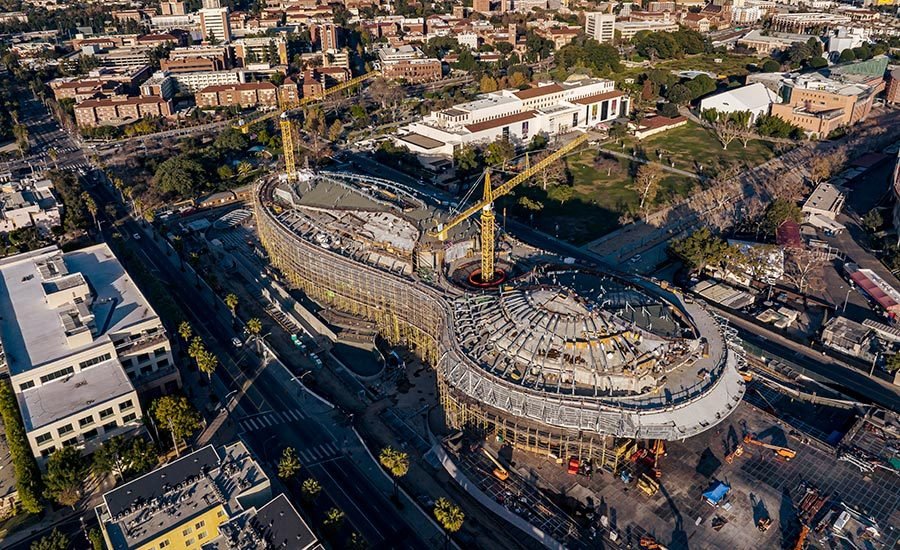
The museum originally began in 2018 with a 36-month construction schedule scheduled for completion in 2021. But the 300,000-square-meter structure, designed by architect Ma Yansong, it did not reach substantial completion until May 2026.
On September 19, Judge Daniel S. Murphy ruled that six separate lawsuits related to the project should be tried together. JR Snyder Electric, a subcontractor to Siemens Industry, had argued that its case belonged in court with Hathaway Dinwiddie’s, but that including four others, as the Lucas Museum had argued, was a stalling tactic that would delay any resolution.
Grouping the six cases together would create an “unimaginably complex litigation quagmire,” JR Snyder Electric argued.
Siemens had a subcontract with prime contractor Hathaway Dinwiddie to build the building automation and control systems and Snyder was Siemens’ fire alarm subcontractor. In its own lawsuit against Hathaway Dinwiddie and the museum, Siemens claimed that work that was originally supposed to be completed in 31 months took 90 months.
Design changes, access limitations and poor coordination added to Siemens’ delays and costs, JR Snyder Electric claimed in its own lawsuit against San Francisco-based Hathaway Dinwiddie. Siemens claimed 12,000 information requests and more than 300 changes were needed required In 2023, Siemens claimed, it received $150,000 from Hathaway Dinwiddie for the additional costs of its Siemenrs, a fraction of what was eventually owed. Then, Siemens claimed, it paid Snyder $200,000 [its own] pocket”.
Lawyers for the Lucas Museum are pushing back. Outside counsel Orin Snyder of the Gibson Dunn law firm downplayed the scope of the litigation.
“This is a dispute between an electrical subcontractor and another subcontractor,” Orin Snyder said. “Lawsuits like this occur in almost every construction project of this magnitude. The Museum denies these allegations and will respond to them in court.”
Representatives for Hathaway Dinwiddie did not respond to requests for comment, and Siemens Industry could not immediately be reached.

Aerial view of the Lucas Museum of Narrative Art in July.
Photo: Weston Hancock / SOPA Images / Sipa USA / Sipa via AP Images
Snyder Electric’s experience was unexpectedly long, exposing the company to increased material and labor costs, the company said.
“The project was supposed to be a three-year project,” Vice President John Snyder said. “We actually finished five years later.”
Union employment rates in 2018 were also substantially lower than those found in 2025 and 2026, when Snyder did most of his work. “What I’m trying to capture is that pay gap,” Snyder says.
As vice president of a certified minority and woman-owned company, John Snyder says the three-year union contracts renegotiated over the eight-year span included an immediate $4-an-hour raise that dramatically increased overhead costs. He adds that prolonged delays forced the 20-person company to file more than 800 certified payroll reports instead of the 150 planned. Snyder also says the company absorbed a 20% to 30% increase after the COVID pandemic in the costs of materials such as wire and steel.
When Snyder tried to get answers about the missing money, he says he was caught in a circle of pointing fingers. “Siemens says, ‘Well, Hathaway [Dinwiddie] you haven’t paid us, so we won’t pay you. Hathaway says, “Okay, Lucas [Museum] You haven’t paid us, so we won’t pay you.”
The turn of public land
Typically, an unpaid subcontractor in a private development protects himself by filing a mechanic’s lien against the property. “That’s the crux of the whole issue: I can’t file a lien on the property because it’s public property,” Snyder said.
To recover the money, Snyder’s legal team is suing the museum, Hathaway Dinwiddie, Siemens and the state-run California Science Center, which handled the lease for the land. The company argues that because the museum obtained a 99-year lease on state-owned land for just $30 a year, the development effectively operates as a public works project, requiring statutory payment obligations.
