
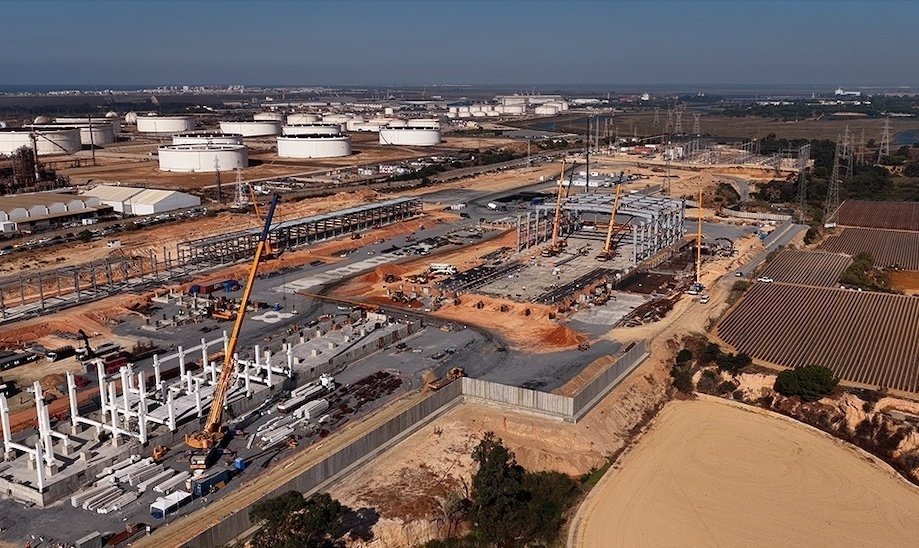

Spain-based energy and chemical conglomerate Moeve has launched the first phase of the $1.2 billion Andalus Green Hydrogen Valley project at a coastal site in the country that would be Europe’s largest hydrogen renewable energy project when operational, expected in 2029.
The estimated $3.3 billion effort aims to develop a total of 2 GW of combined electrolysis capacity to produce up to 300,000 metric tons per year of green hydrogen to be used for decarbonise the chemical, steel, cement, heavy shipping and aviation sectors. It will also help establish the first major maritime green hydrogen corridor connecting southern and northern Europe through the port of Rotterdam.
Moeve, with a majority stake of 51% in the project, will lead the development of the first phase to build a facility with a 300 MW electrolysis capacity that will produce around 45,000 tonnes per year. Hy24, which bills itself as the world’s largest net hydrogen private equity asset manager, and COFIDES, the Spanish public-private finance entity, own a combined 29%, and Spanish renewable gas firm Enagás Renovable and solar developer Alter Enersun have a 20% stake.
Developers say the project will save 250,000 tonnes of annual carbon dioxide emissions and can be scaled up to 405MW. depending on network availability. The cost of the first phase includes the associated infrastructure and a dedicated solar photovoltaic plant as a source of clean energy.
Siemens Energy is leading the lead EPC consortium for the project, partnering with Austrian contractor STRABAG to manage the civil works. Germany-based Thyssenkrupp Nucera has been contracted as the lead technology supplier for large-scale alkaline water electrolysers. Other key suppliers include Swedish heat transfer manufacturer and engineer Alfa Laval and Italy-based energy and wastewater specialist Industrie De Nora SpA.
“We are turning around the green hydrogen pilot projects and moving into the chapter of large-scale construction,” said Moeve CEO Maarten Wetselaar. “We need European energy that is decarbonised and produced by us, and that is exactly what this project provides.”
Spanish Prime Minister Pedro Sánchez said the government aims to create a market for green hydrogen and stimulate demand by introducing targets for reducing emissions and using renewable fuels in transport. “Our goal is to provide investment certainty, expand supply and facilitate the development of industrial projects throughout the country,” he noted. “We have made renewable hydrogen a true national priority.”
Looking for quick answers on construction and engineering topics?
Try Ask ENR, our new intelligent AI search tool.
Ask ENR →
‘Project of Common Interest’
Sanchez said the project will receive more than $335 million in government funds through the European Union’s NextGenerationEU program as a “project of common interest.” European Commission Executive Vice-President Teresa Ribera said the plant “reflects its strategic importance and its contribution to the transformation of our energy system. The energy transition should not be seen as a cost for industry, but as an opportunity to make it stronger, more innovative and more autonomous.”
Moeve is also building a separate $1.3 billion biofuels facility in a joint venture to produce 500,000 metric tons per year of sustainable aviation fuel and renewable diesel from waste vegetable oils and waste. The project is supported by the European Investment Bank, which granted Moeve 462 million dollars loan in the framework of EU programs to reduce European dependence on imported fossil fuels.
The Moeve facilities are two of the four largest industrial projects in Spain currently under construction.
In addition, Spain’s Ministry of Ecological Transition is expediting permits for four key segments of natural gas pipelines to accelerate final investment decisions in green hydrogen construction, including regional production centers in Andalusia, Aragon and the Basque region. Pipeline Technology Journal reported on October 6.
The EU is keen to halt Russian natural gas imports, citing energy independence and security concerns, as well as uncertain and rapidly changing prices and supplies of crude oil and other hydrocarbon products from the Middle East.
