

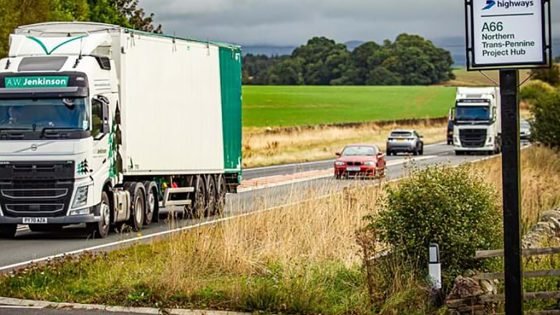
The government has postponed a formal planning decision on the £1.3 billion upgrade to the A66 Northern Trans-Pennine route.
Transport Secretary Mark Harper was due to rule on the future of the scheme, which would see the doubling of the remaining single-lane sections of the 50-mile stretch between Penrith and Scotch Corner, as well as improvements to junctions, this week.
But Transport Minister Huw Merriman announced on Wednesday (November 8) that a decision would be delayed by four months to March 7, partly to allow more time to consider the plan’s impact on the special area of conservation of the North Pennine Moors.
Four contractors were appointed to the project, described as “one of the most critical road improvements in the north of England” in October 2022. However, one of them, Costain, left the project the following June of a “change in recruitment strategy”. Kier, Balfour Beatty and Keltbray remain on the project.
Merriman said in a written statement to Parliament: “The reason for the extension is to allow further consideration of the issues, including those which were not resolved at the time the Secretary of State received the report from the examining authority.
“This will include consideration of information submitted by the applicant about impacts on the North Pennine Moors Special Area of Conservation, to ensure compliance with the Habitats and Species Conservation Regulations 2017.”
The delays come despite the project being designated as a “frontrunner” for Project Speed, a government initiative to deliver infrastructure projects faster.
National Highways, which is expected to publish plans for its third Road Investment Strategy (RIS3) next year, ruled out planning delays.
“We are confident in our proposals and are prepared to deliver these improvements, subject to receiving a positive decision on the development consent order and permission to proceed with construction,” a spokesman said.
According to the agency, the planned upgrade will improve safety, reduce congestion and boost regional and national strategic connectivity, especially for carriers.
HGVs make up a quarter of all road traffic, he argues, and any delays in journeys can have an extremely negative effect on business, including lost working time and missed shipping slots.
However, the environmental campaign group Transport Action Network said the focus should be on improving public transport.
Rebecca Lush, the group’s roads and climate campaigner, said: “It is unsurprising that the Secretary of State is in no rush to approve this controversial and expensive mega-roads plan.
“It will damage beautiful landscapes, damage internationally important habitats, destroy a seven-century-old gypsy horse fair and increase carbon emissions by more than 2.7 million tonnes.
“Instead of progressing with destructive and carbon-intensive road schemes, [the Department for Transport and National Highways] should focus on providing better public transport in the north.”
