

This audio is automatically generated. Please let us know if you have any comments.
When using a virtual reality system, it’s important to consider the strategy and all stakeholders in the technology, a team of contractors told attendees during a panel session at the Design-Build Conference & Expo near of Washington, DC, this month.
“We really needed to get everyone on board quickly and get everyone sold on this concept to move forward,” said Tracy Gordon, director of Boulder Associates.
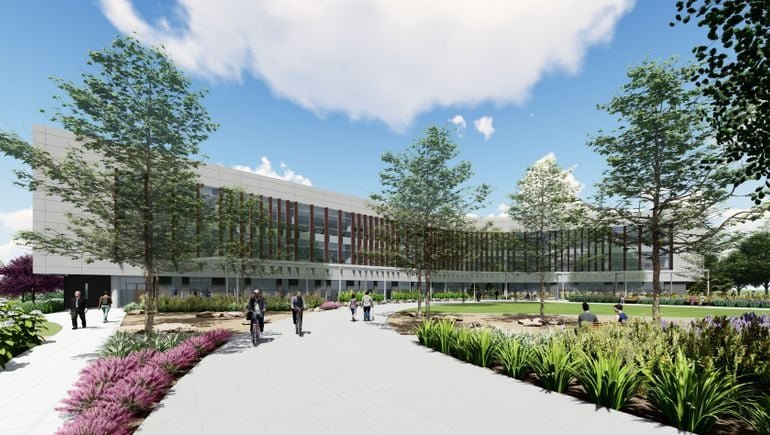
A team from general contractor Rudolph & Sletten, architect Boulder Associates and contract manager Jacobs described best practices they learned on the job for the Folsom Medical Office Building, owned by UC Davis Health in Folsom, California. The project, which spans 114,000 square feet and costs $171 million, according to its information page, is scheduled for completion in the second quarter of 2025.
VR was an important asset during the various phases of construction and in the process of negotiating with the owners and demonstrating the plans and construction to other relevant stakeholders. Especially with the owners, a group that doesn’t have much experience in reading drawings, a visual model went further than any blueprint.
“This was a different level of his comfort,” Gordon said.
The team divided the stakeholders and users into three groups: the internal design team, owners and financiers, and end users such as doctors and nurses. During the panel, each group identified benefits and best practices for builders.
Internal design
Using virtual reality became a strategic decision, Gordon said. The design team and the contractor came to an agreement early before introducing the virtual reality system to anyone.
“[We] It really lined up our team early on,” Gordon said.
Rudolph and Sletten project executive Ryan Ainsworth said one of the challenges was orienting the building throughout the 40-acre complex.
This is where virtual reality came in. Andrew Mittleman, project manager at Jacobs, said the team began the project in 2019 and moved completely virtual in the middle of the procurement process due to the COVID-19 pandemic. This meant that through a large part of the project, they were working together asynchronously with the full project team. With virtual reality, this was not a problem.
The team created a dedicated space in the office for users to collaborate. But remote workers, including a lead designer in Colorado, were also able to provide input.
Jose Vaca, associate director of architecture at Boulder Associates, said technology made work “quicker, easier and faster.”
Contractors often face challenges in describing to owners what the final product will look like. With virtual reality, this process was less painful.
Creating a “real” viewing space.
Jacobs’ Mittleman said the planning team worked with builders and drafters to create a virtual mock-up of the construction. It helped the owners, he said, see what the changes they were requesting would look like in real time — a big help for a fixed-cost project that couldn’t afford many deviations if it wanted to stay under budget.
The team used Enscape, a real-time rendering and virtual reality plugin, to create and generate the model. Virtual reality capabilities came through Oculus headsets and Meta technologies.
Mittleman said once you get a customer into the virtual space and show them the difference between finishes and colors, it was much better for cost matching and the overall budget. He also exceeded the limits on time, in a project where they could not slow down.
A word of caution, however, the construction team shared: discrepancies between the model and the plan can cause problems. The builders said that the plans, in short, were the ones that would be approved, and to avoid the trap of relying on the model.
They also said it was important to manage expectations about the model and prevent people from getting too attached to it, lest something inevitably change.
Demonstrative measures
A key part of the team’s VR experience was demonstrating the facilities to future office workers such as nurses and doctors. To view the virtual model, the team recommended:
- A large meeting room.
- At least two headphones, but three or four would be nice to have.
- Wi-Fi, but especially powerful and fast Internet.
- A powerful laptop or computer to run the program.
Another useful tool, the team said, was a large screen, either a TV or something similar, that could show the view to those in the room who didn’t have headphones on. These were lessons the group learned early.
“The first time we did a roadshow, it was a nightmare,” Vaca said.
Key points for other contractors, they said, were to set set viewing times and schedule long breaks. Running the show is difficult and requires setup time.
Also, consider the users. Some are more experienced than others, and those with limited exposure to VR and headsets may need extra help. Users who feel dizzy can also be a concern.
However, the team also pointed out the other side of it all: some experienced users may require more attention to avoid burning out in different parts of the build.
Boulder Architects’ Gordon said people “really loved it” and compared the VR trips they took to an advertising campaign for the project.
However, keeping people visually on track was a key part of it all.
“Looking at the same thing really enhances the experience,” Vaca said.
