


Steve Wiley
Vice President
HDR
Preserving and sustainably reusing old buildings and creating entertainment/hospitality venues and high-end apartments and hotels are dominant themes in the Chicago market.
“There is a strong movement in Chicago to repurpose existing buildings, primarily vacant office buildings for multifamily residences, hotels and entertainment attractions,” says Wiley.
These conversions “occur primarily in Chicago’s central business district and nearby neighborhoods, as adaptive reuse is key to urban renewal and sustainable development,” he says.
For example, Chicago is looking to revitalize a corridor of aging office buildings along LaSalle Street by converting them from offices to apartments and condos.
The city reported in 2022 that 59% of the buildings on LaSalle Street are pre-1940, that 85% of the properties are for offices, and there is currently no affordable housing on the street.
The goal of the city’s LaSalle Street Reimagined Plan is to create more than 1,000 residential units, with 300 designated as affordable, according to the city. The properties, located on LaSalle Street or adjacent to the street from Wacker Drive south to Jackson Boulevard, are in a tax increment financing district that qualifies them for help covering conversion costs.
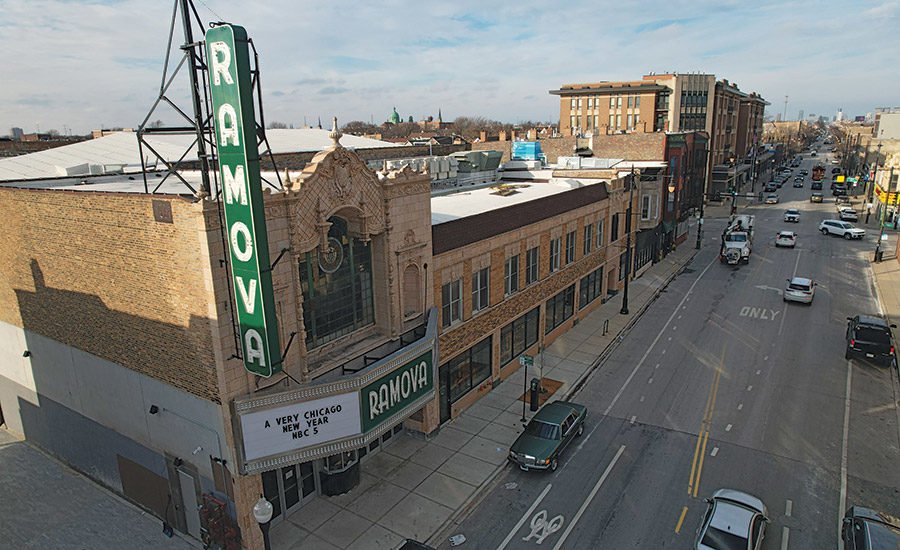
Although not involved in the LaSalle Street program, McHugh has run several adaptive reuse projects of his own. In one such project, the firm revitalized the Ramova Theater, a long-screen movie theater that was built in 1929 in Chicago’s Bridgeport neighborhood. The 36,000 square meter project included the restoration of the theater and the construction of an adjacent space for a brewery and restaurant.
“This live music venue opened in mid-December 2023 and is already attracting culture enthusiasts and once again serving as an anchor for the community,” says Wiley.

In keeping with the theme of preservation, the project required McHugh to restore numerous details while following National Monument restoration guidelines, which included restoring the theater’s existing marquee and its lobby and auditorium to their original courtyard style spanish He also restored the theater’s plaster ceiling and other decorative plaster elements, such as the period box office and the imitation marble and gilded plaster of the interior.
As represented by the Ramova Theatre, interest in leisure and hospitality spaces is another trend. McHugh and his joint venture partner Powers & Sons Construction Co., a minority-owned Midwest general contracting firm, built the $100 million Sable Hotel on Chicago’s Historic Navy Pier. The 223-room, seven-story hotel is part of Hilton’s Curio Collection and is Chicago’s first hotel built “above” Lake Michigan.
Wiley says the project included many challenges. For example, McHugh/Powers oversaw the installation of 51 new rock-embedded micropiles to support the southern half of the hotel. Instead of large caissons, these high-capacity, small-diameter piles were drilled through the South Pier in the 1960s and under Lake Michigan before finally being embedded in 2 feet of rock.
“With a load capacity of 530,000 pounds per pile, these are some of the largest micropiles ever approved for use in the city of Chicago,” says Wiley.
In addition to luxury hotels, there is still room in Chicago for luxury apartments. One project McHugh Construction is currently building is 1000M, a 73-story luxury rental tower designed by the late Helmut Jahn at 1000 S. Michigan Ave. The building features a glass facade and a negative slope that flies over the neighboring building. Opening in 2024, 1000M will offer 738 apartments, ranging from studios to four-bedroom penthouses, and will feature more than 80,000 square meters of amenity space, including Chicago’s highest terrace on the 73rd floor.
Looking ahead to the rest of 2024, Wiley expects his company to continue to focus on restoration/renovation projects.
“We will continue at McHugh to focus more on adaptive reuse, which is a pillar of our portfolio, as our customers respond to the demand for these types of products in the multifamily and hospitality markets.”
For the market at large, expect more attention to be paid to the use of sustainable building materials and processes such as geothermal systems.
