


Although the United States’ interstate highway system is commonly taken for granted, it had a long gestation period before coming to fruition beginning in the mid-20th century.
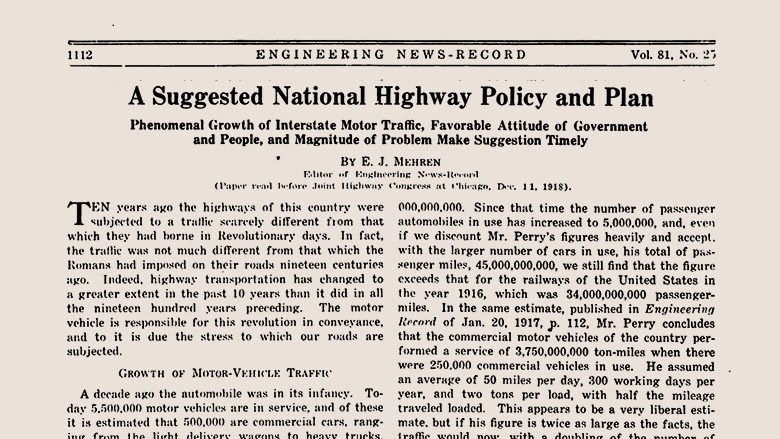
Until the 1930s, most American roads were made of dirt. Road construction was primarily the jurisdiction of municipal and county officials, and the federal Bureau of Public Highways was a small division of the US Department of Agriculture, focused primarily on improving farm-to-market roads. An early proponent of a national highway system was Edward J. Mehren, a civil engineer and editor of the Engineering News-Record.
In a speech advocating a “suggested national highway policy and plan” delivered before a joint meeting of the American Association of State Highway Officials and the Highway Industries Association, Mehren called for the creation of a Federal Highway Commission to build a national network of approximately 50,000 miles of highways, consisting of five east-west and 10 north-south routes.
Mehren, who concurrently served as vice president of the highway industry group, noted how counties had replaced cities in managing highway construction and operation. “Now comes the question whether another step should not be taken … in favor of the construction and maintenance by the federal government of a highway system that will transcend state lines,” he said.
While the group, made up of suppliers of cement, crushed stone, road machinery, strongly endorsed his idea, state highway officials did not. They were still in the process of consolidating their power over city and county officials and resented the subtle but close oversight of state highway plans by federal highway engineers through the disbursement of federal aid funds.
World War I cooled the fledgling push to match federal funds to states for highway construction. Advocates of long-haul roads lost out to those who still favored rural farm-to-market roads in the 1920s.
The arrival of the Great Depression brought New Deal federal programs with funding that led to an increase in road construction. But the roads built at the time weren’t perfect: they included stop signs, traffic lights and railroad crossings.
There was a brief moment in the late 1930s when the tide seemed to turn. Thomas MacDonald, head of the Bureau of Public Roads from 1919 to 1953, was a powerful bureaucrat. President Franklin Roosevelt summoned him to the Oval Office in 1938, handed him a hand-drawn map with three north-south and three east-west routes and asked him to explore the feasibility of its construction. Roosevelt also proposed the creation of a new agency to seize private property needed for rights-of-way, an idea the Republican National Committee labeled socialism.
With the advent of World War II, it took two more titanic battles on Capitol Hill before the system was born.
President Dwight Eisenhower’s initial proposal in 1954 called for a network financed by tolls or increased gas taxes. Many governors were outraged, as they considered highway construction their exclusive domain. Congressional reform legislation in 1955 was revoked due to antipathy to public debt.
The following year, the American Highway Builders Association presented a compromise plan on tire taxes. The revised federal bill established the Highway Trust Fund, a pay plan with funds from a fuel tax, truck and bus excise taxes and an annual registration fee for trucks. It passed both houses of Congress with large majorities.
