


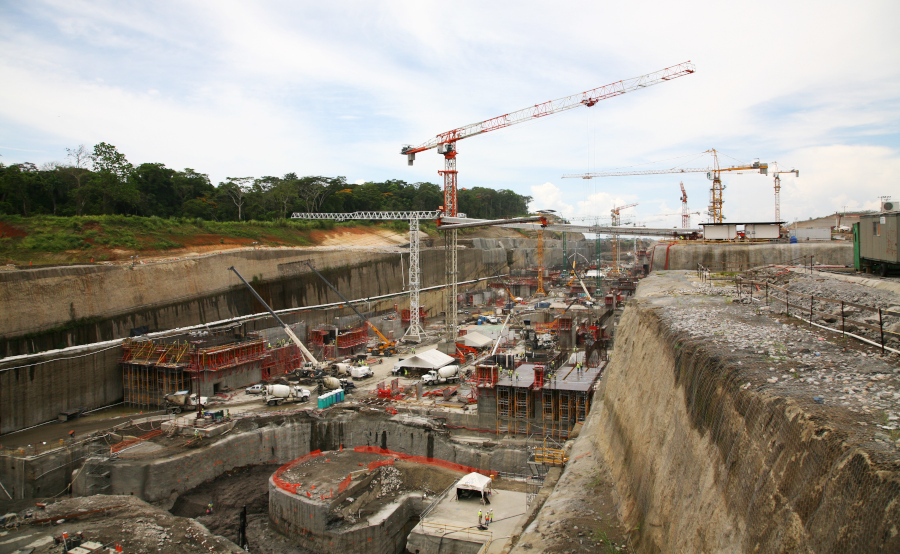
A long-running legal battle over the concrete used in the construction of the Panama Canal’s third lane expansion locks has reached its conclusion in US courts, with the US Supreme Court on March 26 upholding a award of $271.8 million to the project owner, the Panama Canal. Authority, against its group of contractors, Grupo Unidos por el Canal.
The high court accepted a ruling by the federal appeals court in Atlanta that denied the contractors’ request to set aside the award issued by an arbitral tribunal in 2020. The consortium consisted of the contractor Spain’s Sacyr Vallehermoso SA, Italy’s Impregilo SpA (now WeBuild). ), the Belgian Jan De Nui NV and Constructora Urbana SA from Panama.
The new sets of locks on the waterway were initially slated for completion in 2014, but the final opening was delayed years due to construction delays and contract-related work stoppages. The new locks began operating in June 2016, and the authority put the cost of the entire third lane expansion at $5.4 billion.
The dispute between the canal authority and Grupo Unidos centered on concrete standards required for the new locks, materials data provided to the contractor and a nine-month delay in obtaining approvals for new concrete mixes. In total, more than 177 million cubic feet of concrete were needed to construct the new locks.
The Miami-based International Court of Arbitration for the International Chamber of Commerce ruled in favor of the owner in 2020 on most of the claims. As part of the contract for the locks, the contractors agreed that arbitration would be the forum for resolving any contractual disputes. So far, the court has ruled on four claims, while a fifth remains pending.
The contractors paid damages for the specific claims in full, but later filed suit to vacate the award, citing conflicts of interest among members of the arbitration board. The contractor consortium alleged that the three arbitrators previously served on panels related to unrelated disputes that also included representatives involved in the canal case.
A US district court ruled against the contractors in November 2021, and the appeals court upheld that decision last year. “We decline to grant vacatur simply because these individuals worked together elsewhere,” wrote U.S. Court of Appeals Judge Stanley Marcus.
Both authority officials and prime contractor Sacyr declined to be interviewed.
A history of disputes
The contractor group was awarded the design-build contract to build the locks in 2009 after submitting a winning bid of $3.23 billion. Of three teams that participated in the procurement, the team’s bid was the only one below the authority’s assigned cost of $3.48 billion. A team led by Bechtel International offered $4.2 billion for the work, and Spain’s ACS Servicios, Comunicaciones y Energía, SL, submitted a bid of nearly $6 billion.
The low bid alarmed some senior Panamanian officials at the time, who were concerned about the consortium’s ability to meet the project’s financial requirements.
The group of contractors halted work on the project for two months in 2014, citing cost overruns of more than $1.63 billion. A financial settlement between it and the canal authority allowed work to continue, but claims associated with overflows continued during the arbitration process.
In addition to the specific litigation and ordering of the repayment of the loan for the 2014 work stoppage, two other claims have been completed before the arbitral tribunal.
- In 2017, the court denied the contractor group’s request for $194 million and a 247-day deadline extension for the excavation of temporary formwork on the Pacific side of the locks.
- A $671 billion claim by contractors for added costs in building the lock gates was denied in May 2023. Two of the four labor claims associated with the matter found in favor of the contractors, although the consortium was ordered to pay legal costs.
A fifth arbitration handled by the court is a $3.567 billion delay and disruption claim originally filed in 2017. The contractor group’s formal claims were filed in 2021, and the canal authority responded last January by allowing the ‘arbitration continued. A procedural calendar was established last July, and substantive hearings are scheduled to take place in 2025.
In the canal authority’s 2023 annual report, the agency noted that no funds had been set aside to account for the outage claim.
“[The authority] believes it has meritorious defenses to all of these claims and intends to vigorously defend itself,” the report states.
In addition to the claims handled by the court, Sacyr has filed a separate claim against the country of Panama with the World Bank’s International Center for the Settlement of Investment Disputes and it remains pending.
Filed in 2018, the claim alleges that Panama, acting through the canal authority, had provided incomplete information as part of the bidding process and then imposed abusive conditions on the consortium of contractors, leading to the destruction of your investment and additional losses.
“The cash flow profile of the project was substantially negative, i [the consortium] was forced to provide significant financing to keep the project going, contrary to Panama’s representations during the bidding phase,” Sacyr said in the complaint.
According to the filing, the contractor group put the cost of the completed lock works at $8 billion, of which $4.3 billion remained outstanding and disputed by the owner.
The court ruled in 2022 that the authority’s actions could be attributed to the Panamanian government, allowing the claim to proceed.
