

As the water utility for more than 1.5 million people in Colorado’s largest metro area, Denver Water is responsible for 20 intakes, what will soon be four treatment plants, 3,000 miles of distribution pipelines and other infrastructures. Maintaining all of this, replacing lead service pipes, and meeting the current and future needs of their customers is a major undertaking, with over $1 billion of work now under contract.
Robert Mahoney, Denver Water’s chief engineer, says the utility uses a 10-year infrastructure master plan to help prioritize projects. The utility also uses several different project delivery methods: design-bid-build, design-build, construction manager at risk, and construction manager/general contractor, depending on the complexity of the work and how much the prime contractor will do by himself
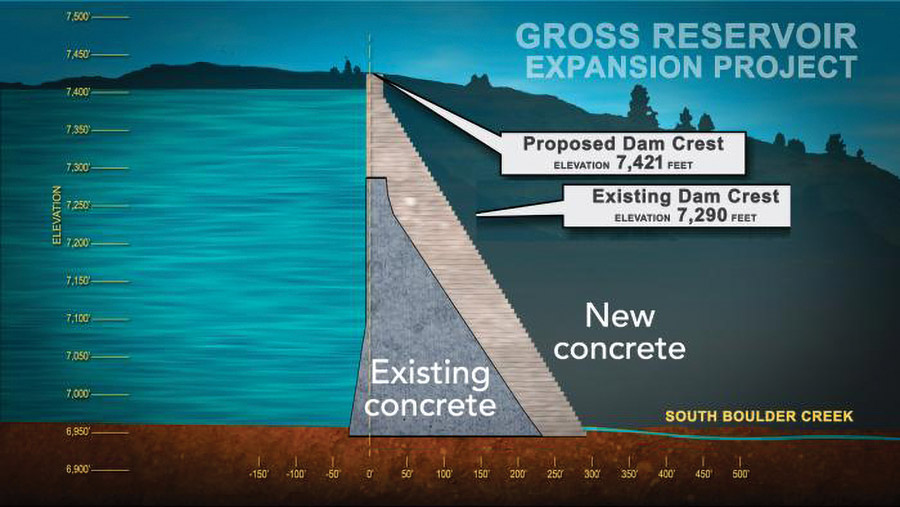
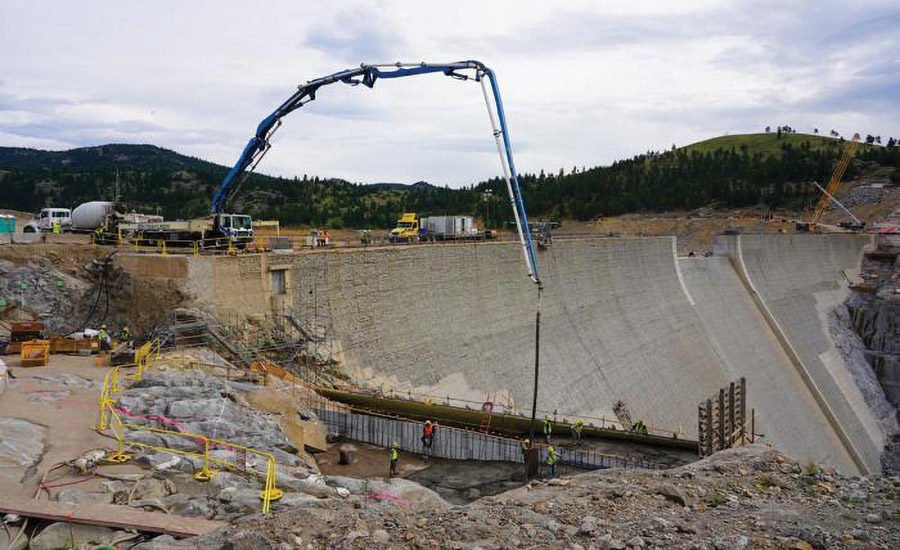
The crude dam had been designed with future expansion in mind, but the 131-foot height increase is even greater than the original engineers envisioned.
Denver Water has also found design cost and time savings by publishing its engineering and construction standards for capital projects online. The move has helped reduce design books, which included a lot of standardized material that was unnecessarily redesigned. According to Mahoney, breaking down project-specific plans and specifications saved 1 million sheets of paper in the first year. The utility’s standards have been used in 47 states and 23 countries, he adds.
“If you’re going to pour a thrust block into a pipe, you don’t have to redesign it every time,” he says.
Careful planning has helped Denver Water achieve an order change rate of less than 1 percent based on contract value, Mahoney says, but that doesn’t mean contractors can’t stop eating unexpected costs that arise during a project The key is to “get ugly early” when a problem is discovered, he adds, addressing any potential problems as soon as possible.
Mahoney stresses the importance of partnering with contractors. He stays involved with his projects, using what he calls a “half-minute meeting” to check the scope, schedule and budget of each one.
“When we negotiate contracts, we say, ‘This is where you’re going to make money on this margin.’ You’re not going to have individual profit centers, like branding your trucks or whatever,” Mahoney says. “So we say, ‘Let’s agree on where you’re going to make money and where you’re not.’
The approach ensures that contractors “don’t have hidden profit centers and don’t try to take one out of us,” he notes. “What we want to do is preserve the opportunity to profit in a fair way.”
That attitude has helped advance projects like Denver Water’s renovation of its northern system, one of its two raw water sources and a key piece of ensuring the system’s resilience and meeting future demand.
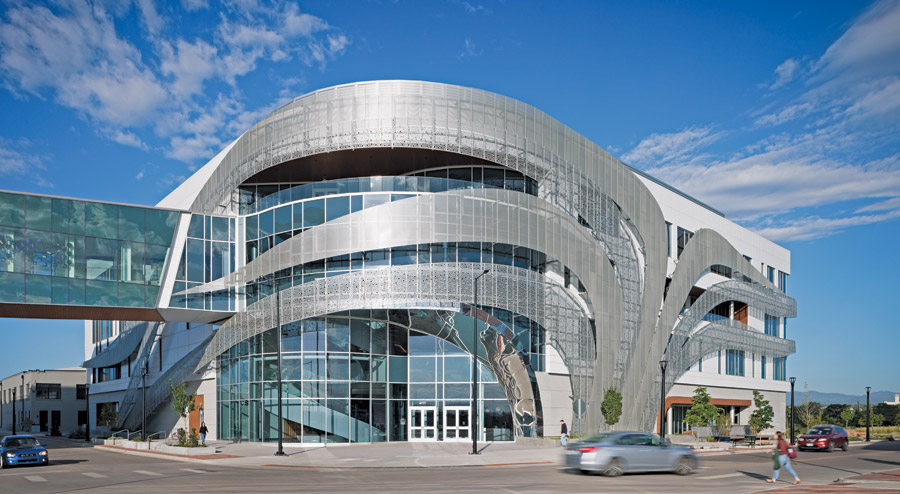
Denver Water partnered with Colorado State University on the Hydro Building on the Spur Campus. The structure houses a water quality laboratory.
Photo courtesy of Denver Water
Northern water treatment station
The biggest part of the renewal of the northern system is the construction of the $520 million northern water treatment plant to largely replace a facility built in the 1930s, according to Peter McCormick, program director of the plant The new plant will be operational this spring with an expected capacity to treat 75 million gallons of water per day, about 20 percent of Denver Water’s average annual drinking water use, he says.
The plant includes its own hydroelectric power thanks to nearby Ralston Reservoir, and was designed to be off-grid, although Denver Water eventually decided to connect to the grid, allowing it to be a net producer of ‘energy, says Mahoney. Air conditioning and electrical loads are reduced by undergrounding the buildings. The plant received Envision Gold certification.
Part of what’s unique (and fun) about Denver Water, he adds, is how it makes important decisions through the lens of current service agreement requirements while building in flexibility for future decision makers. Northwater was designed to allow adding or expanding sustainability features.
“We try to offer as much flexibility as possible to future decision makers.”
—Peter McCormick, Plant Program Manager, Denver Water
“We try to give as much flexibility as possible to future decision makers,” says McCormick.
The geological conditions of the site offered some surprises for the project team. The area’s bedrock is tilted 90° in places, and at one point an old coal mine was discovered in the planned project area, McCormick says. These conditions were found soon enough to redesign the layout and location of the facilities. The team has also faced long lead times for some equipment and continued to work during the height of the COVID-19 pandemic without any outbreaks or site delays. The project is under budget and on schedule.
Travis Baumgartner, project manager for the treatment plant at risk construction manager Kiewit Corp., says Mahoney “set the stage early that it would take a true partnership to make a job like this successful.” When it came to obstacles, there was an unusually high level of collaboration.
“Working through these issues, as a partner, along with everyone else, really allowed us to overcome them with minimal impact,” Baumgartner says.
McCormick attributes the project staying on schedule to Mahoney’s leadership and the willingness of Denver Water’s contractors to partner for success.
“The goal is really to make sure that outside companies want to work with us,” he says. “The nature of the work they will be doing is generally unique in terms of the infrastructure we have and the scale of it in the region.”
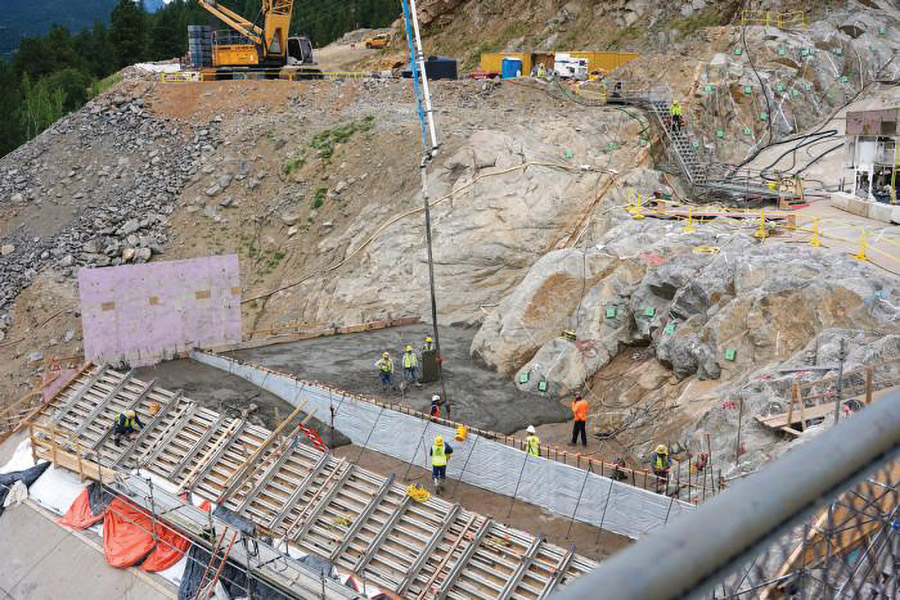
Crews excavated and reinforced the areas where the elevated dam will sit.
Photo courtesy of Denver Water
Gross expansion of the deposit
Kiewit is also working for Denver Water in a CM-GC joint venture with contractor Barnard on the $531 million gross reservoir expansion project. Chris Loeffler, Kiewit’s project manager for this job, says Mahoney and the Denver Water team took the partnership seriously from the beginning with honesty and transparency.
“I think they’ve done a really good job of aligning the risk with the client and the contractor,” he says. “The spirit of this model is partnership.”
The project is raising the height of the 1950s dirt dam from 340 feet to 471 feet with an elevation of the downstream abutment. It is the largest dam in the world to use roller compacted concrete, about 725,000 cubic meters, which would make it the tallest dam in Colorado.
The history of Denver Water’s forward planning goes back far enough that the dam’s original engineers designed it to allow for expansion, even though the 131-foot rise is greater than they had anticipated.
The higher dam would nearly triple Gross Reservoir’s capacity to 119,000 acre-ft of water from 41,000 acre-ft. The project is important because Denver Water’s northern system, of which the reservoir is a part, is only 10 percent of its storage capacity. Jeff Martin, Gross Reservoir expansion program manager, says the added capacity will help improve the system’s resilience to climate change and future demand.
Felipe Garcia, a senior director at Stantec, the engineer of record on the project, says Denver Water used a “zipper plan” in which each technical lead on the design team had a counterpart from the owner.
“It really helped disseminate our engineering decisions deeper into the Denver Water organization,” he says. “Because they had a chance to digest it early on, as we were going through the analysis and design process, they were completely up to speed.”
Work began in 2022 and has so far focused on preparing the existing dam and surrounding area for placement of the roller compacted concrete (RCC) structure downstream and on top of the current ridge. Hydrodemolition was used to roughen the surface of the dam for better adhesion to the new concrete. About 250,000 cubic meters of rock was “surgically removed” by blasting 30 to 40 feet from the dam and 500 feet above the cliffs for the future footprint, Martin says, adding that the base was grouted with a slurry of water and cement to do it. it is less permeable, ensures no water seeps under the dam and reduces hydrostatic uplift pressure.
Martin says the team discovered some surprises in the rock along the way, but planned ahead for different alternatives to use depending on the conditions.
“Our team really tried to minimize any wasted time or downtime by having a menu of options,” he says.
The next stage of the work is the placing of the concrete. The team recently celebrated the completion of the first stage. Mahoney says that taking time to set milestones on a project of this magnitude helps keep workers committed to the bigger challenges at hand.
“Now they are reactivated,” he says. “Because it’s a 24-hour push coming up.”
Starting in May, the plan is to begin 24/7 RCC work to raise the new section 300 feet this construction season. The team installed an on-site concrete batching plant along with a conveyor system to move the new concrete to the crest of the landfill.
24/7 placement will be required for quality. While “fast” and “quality” don’t usually go together, Martin says that’s the case when using RCC.
“The faster we put it in place, the more quality we get,” he says.
Work will continue until a time in the fall when nighttime temperatures are too cold to work with concrete.
