

A new IMAX film called Cities of the Future, famed IMAX director Greg MacGillivray’s second collaboration with the American Society of Civil Engineers, has just opened in theaters nationwide. The film, which is now showing in 18 cities across the US, is another ASCE highlight Cities of the Future, this one called Mega City 2070. In 2019, ASCE unveiled its first such “future city”. a floating city based on the sea.
David Odeh, principal of Odeh Engineers/WSP, a member of the technical team advising the director on the engineering reality underlying the film’s computer-generated imagery, is helping to bring ASCE to life. Vision of the future of the world program He sees the film as a “call to action about how we can deal with a very uncertain future.” He believes construction professionals can have a “tremendous influence” by designing and building structures that are “future-ready.”
One way structures can be “future-ready” is for designers and contractors to build them so they can be easily moved, Odeh says. The engineer discussed the concept at two recent industry events, March 19 at the ENR Emerging Leaders Forum in Chicago and the ASCE Structural Engineering Institute Structures Congress in San Antonio the same week.
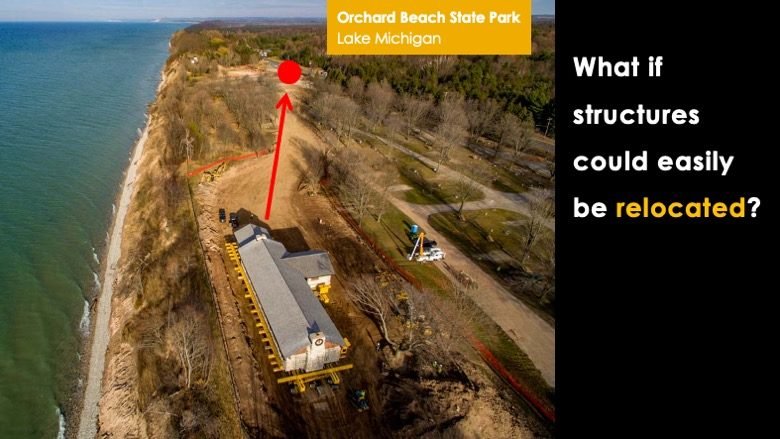
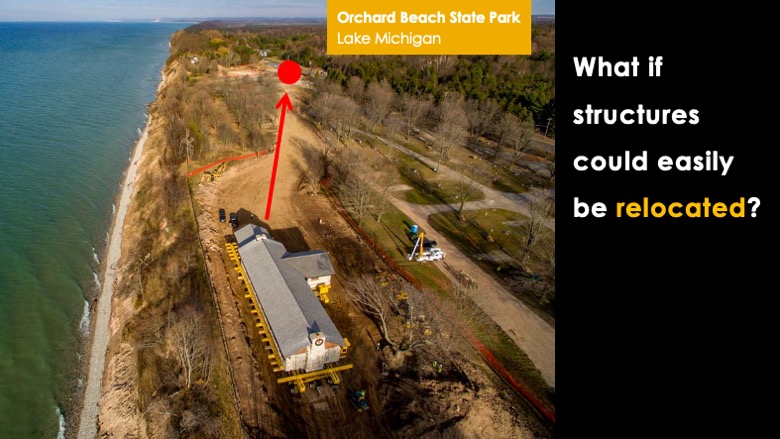
Odeh explained that a recent project at Orchard Beach State Park in northern Michigan led the design team to conceptualize the structures as inherently mobile. The project involved the rescue of a historic building threatened by a coastline that was collapsing due to excessive rainfall, moving the structure about 100 meters inland. “That got us thinking,” he said. “What if it was inherent in the original design that a building could be adapted or moved in the future?”
Testing the concept, Odeh Engineers/WSP is designing a waterfront structure off the coast of Massachusetts that will be built “right on a beach with notoriously unstable and shifting dunes and (be) subject to all kinds of uncertain conditions, from rising sea levels to changing coastal erosion,” he says.
For example, the building is being designed with flexible utilities that would allow the entire structure to be raised using piers that can be raised on demand. Also, in the event of extreme events, the building is being designed so that it can be lifted off its foundation and moved, even removing the foundation and reusing it at a new location. “We hope this new coastal building will be a model for future coastal development,” Odeh says.
Odeh connects this to the Future World Vision program, explaining that it extrapolates concepts like this over 50 years and asks: What are the potential outcomes of trends over a 50-year period? And what would it mean for our infrastructure?
