

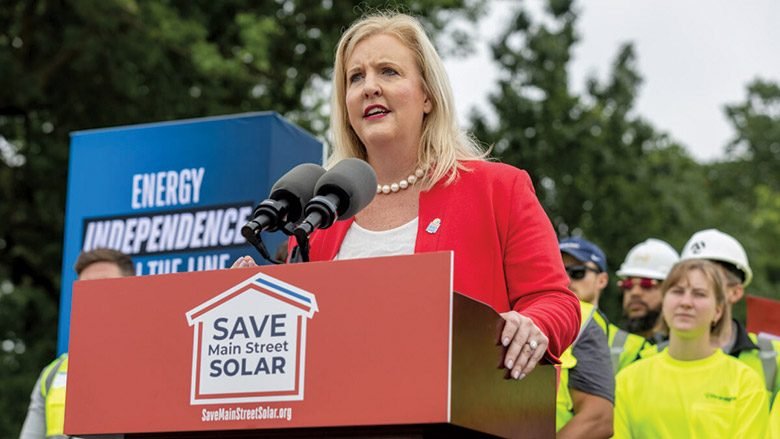

Abigail Ross Hopper, outgoing president and CEO of the Solar Energy Industries Association, also known as SEIA, has been the face and voice of the influential clean energy advocacy group since taking on the top role in 2017, and widely recognized for the industry’s tremendous growth over nearly a decade.
In announcing its exit on January 30, the group touts statistics such as the increase in solar power to more than 255 GW of installed capacity from 36 GW a decade ago; annual investment increased to $70 billion from $16 billion; and the United States is now third among countries in solar manufacturing, up from 14th, with more than 60 GW of domestic solar module production capacity, a 37% increase from 2024.
“This growth is a testament to the power of American innovation,” said Hopper, “We’re building factories, hiring American workers and proving that solar energy means energy made in America.” In a podcast, Hopper noted her “incredible opportunities to work in an incredibly exciting space,” saying she was drawn to the “entrepreneurial spirit.” [and] amazed by the companies I work with, the CEOs I engage with, the solar industry professionals who are always thinking about how to make products better, faster, smarter, cheaper and [who] compete like crazy with each other. I find it exciting to be around.”
Companies that have experienced this growth tout their role in making it happen. “Abby Hopper’s leadership at SEIA has been nothing short of transformational,” says George Hershman, chairman from 2020 to 2023 and board director since 2012 of the group founded in 1974. He is also a former Swinerton Construction executive who led the spin-off of its renewables units into a private equity firm of 202. he is CEO. The San Diego-based contractor says it has built more than 20 GW of solar capacity in about 30 states and is ranked No. 66 on ENR’s Top 400 Contractors list, with revenue of $1.89 billion by 2024.
The association now has more than 1,200 company members, including Tesla, Siemens and Brookfield Renewables, as well as contractors Mortenson Co., McCarthy Building Cos., Rosendin Electric, Blattner Co. and Mastic
In nine years, Hopper guided the solar sector “through unprecedented growth and complex challenges, from commercial disputes to major policy victories,” Hershman notes. “His ability to unify diverse stakeholders … strengthened our collective voice and positioned solar and storage as cornerstones of America’s energy future.” “Hopper’s clarity, resilience and collaborative approach consistently delivered results, whether advancing tax incentives or advocating for workforce equity initiatives,” he adds.
A lawyer by training, Hopper’s energy career includes roles as a state regulator, director of the Maryland Energy Administration and energy adviser to former state Gov. Martin O’Malley (D). He also led the U.S. Department of the Interior unit that oversaw oil and gas permitting and new offshore wind projects in the Obama administration.
Hopper fought President Joe Biden’s administration over tariffs on needed components of the U.S. solar project from China, but he also made big funding gains for the industry with the two giant infrastructure bills he signed into law. It has been named among the hill’Top lobbyists since 2020 for their advocacy efforts, which included solar recognition as an “essential service” during the pandemic. Hopper also led new initiatives on supply chain traceability, recycling, land use and consumer protection. SEIA was named Top Workplace by The Washington Post the years 2023 and 2024.
Hopper described 2025 as “one of the most challenging periods in the history of our industry,” with the Trump administration’s hostility to clean energy shared by the majority of the Republican Congress. They added hurdles to the project from the end of federal tax incentives to new permitting and other approval rules. SEIA has named Darren Van’t Hof, who succeeded Hershman as president, as interim CEO effective Jan. 20, until a permanent successor is chosen. Hopper says, “Our industry has the talent, the technology, the market mandate and the moral clarity to finish the job we set out to do.”
