


As the transportation industry waits for a new federal funding bill as money available from the Jobs and Infrastructure Investment Act of 2021 begins to trickle down, state Department of Transportation officials and other industry leaders continue to look for ways to build and maintain infrastructure more efficiently and economically while managing talent shortages and fostering collaboration.
To help train staff in niche skills such as property relocations related to highway projects, the Ohio Department of Transportation created an “AI-assisted scenario-based training game,” said Drew Gilmore, its real estate manager, speaking on a panel at the Transportation Research Board in Washington, D.C., Jan. 11-15.
Other training tools being developed include flashcards, AI-generated podcasts and videos, and virtual notebooks on topics related to the environmental permitting process, he added.
Nick Fields, utility administrator for the Georgia Department of Transportation, said the agency is working with technology company 4M to create a unified digital utility map for the projects. Existing data from public records, construction, permits, satellite imagery, GIS and visual observations are merged into the map, to be used for conceptual reviews and ultimately construction, he said.
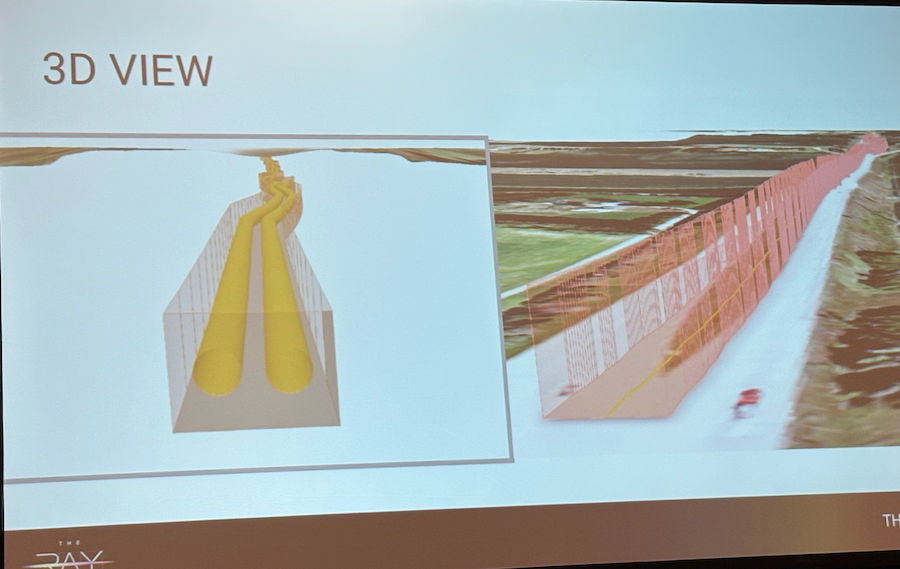
Allie Kelly, executive director of The Ray, a nonprofit dedicated to transportation innovation, noted that several states, including Georgia, Maine, Florida, Pennsylvania and Missouri, are involved in projects to co-locate energy infrastructure such as transmission lines and solar panels within highway rights-of-ways. Given the increased energy needs created by the data center boom, “we need to maximize the value of public lands,” he said.
State DOTs and toll authorities could earn royalties and fees from utilities that locate infrastructure within their road alignments, even paying for improvements and maintenance of those roads, he added.
Ray has developed modeling tools to help identify which road alignments would be suitable for energy infrastructure placement, produce cost estimates, determine what type of construction is needed and provide common ground for both industries. “Transportation and energy speak different languages,” Kelly said.
Collaboration between different groups, even within the same agency, was a common theme.
The Arizona Department of Transportation’s biology and noise departments are working together to more efficiently monitor Mexican spotted owl habitats to inform the permitting process for a highway project, said Ivan Racic, senior director of the environmental program. The study aims to identify areas and construction activities that may affect the breeding and feeding habits of species at risk.
The Virginia Department of Transportation’s structures and environmental departments are also trying to work together more effectively through a shared dashboard that reports environmental reviews and statuses, and can help maintenance crews work more effectively by knowing which bridge is cleared for construction activity, said Sara Felker, the agency’s environmental specialist. Another goal with the technology is, “Can we predict which structures will be easier or harder to clean up with environmental permitting?” she said.
The state of Virginia’s Permit Transparency System, which began in 2022, has allowed processing times for about 200 types of permits to be reduced by up to 65 percent, “without significant trade-offs” for the environment through a website that lists exactly where a given project is in the pipeline, said Brent Efron, senior director of environmental innovation at the Center for Environmental Policy Innovation. It provides a prediction of when a particular step in the process will be completed. This “opens the black box of a [formerly] opaque process,” he said, adding that it holds staff accountable if they get to act on that step.
New financing approaches
A group of state DOT leaders discussed the legacy of the 2021 infrastructure funding law on their respective programs and how their efforts over the past five years to optimize the use of the measure’s historic $550 billion for transportation systems are expected to favor an equally impactful long-term surface transportation measure that also keeps pace with inflation.
“There’s a lot we can do to build [it]” said Vicki Kramer, director of the Nebraska Department of Transportation, adding that while it will be difficult to secure sufficient long-term funding for many DOT needs, “there are things we can do to be more efficient.”
A panel discussion on public-private partnerships examined the many ways in which the method of project delivery has evolved in the decades since the first interim projects in the 1990s. In addition to being more common in states with enabling legislation, panelists noted that they have grown in scope and complexity, encompassing entire corridor improvement programs rather than stand-alone projects. Along the way, owners, developers and contractors have learned some hard lessons about risk allocation, especially as projects have evolved from mostly greenfield environments to metropolitan areas with often complicated utility issues.
“With de-risking, collaboration and lessons learned, there is a market for contractors and designers who understand the project, are willing to invest and know the project will succeed,” observed Tom Curtin, senior policy advisor at transportation developer Meridiam.
Faizan Habib, director of the Virginia DOT’s public-private partnership office, agreed, adding that a good interface with the private sector has become very valuable.
“We do a lot of probing before the show to see if there’s an appetite for the concept,” Habib said. “It helps us decide whether we should pursue it or not.”
Still, given the high value and long-term nature of public-private partnership programs, early public involvement and transparency throughout the process are essential, Habi said, adding that property owners need “an agile contract” to allow for improvements and to address changing conditions and needs.
“Once you sign a contract, the negotiations don’t stop,” agreed Greg Snider. director of the Texas DOT’s Alternative Delivery Division. “It’s a long-term relationship.”
Driving forward with AV
Autonomous vehicles continue to make small, albeit highly regulated, inroads into the country’s streets and highways. Several conference sessions offered efforts to ensure that the nation’s transportation infrastructure is fully prepared for larger scale deployment. Pavement markings are of particular concern as they play a critical role in helping vehicles make safe and predictable decisions.
An ongoing National Cooperative Highway Research Program study is using field and simulator data to develop recommendations for the design and maintenance of pavement markings, as well as signs, signals and unique situations such as work zones. The final report of the study will be delivered at the end of the year. Other state- and manufacturer-sponsored research is evaluating attributes such as marking width and retroreflectivity, and how future generations of on-board cameras and sensors will affect vehicle detection and response.
Meanwhile, state and local regulators are tackling the challenge of overseeing the continued safe deployment of autonomous vehicles in their jurisdictions, protecting other users of the transportation system without unnecessarily limiting the evolution of the technology. San Francisco, a major center for autonomous vehicle testing and deployment, last year approved a conceptual framework for incremental and performance-based authorization of vehicles to improve transparency and manage public risk in their operation by linking deployment stages to performance of key safety metrics.
