


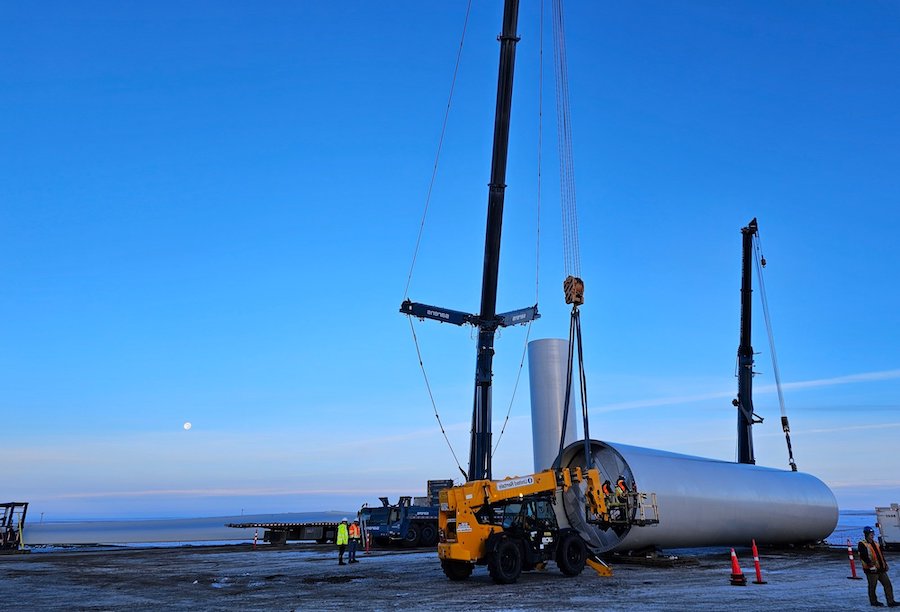
Canada’s largest onshore wind project, the nearly 500 MW Buffalo Plains farm that will be operational later this year in Vulcan County, Alberta, narrowly escaped new provincial law that restricts and until and everything prohibits renewable energy generators near agriculture in the province.
The estimated $642 million project, under development by Copenhagen Infrastructure Partners, is being built by Toronto-based Borea Construction on 17,500 acres of private farmland to include 83 Siemens-Gamesa wind turbines and 55 new roads. It is expected to produce about 1.5 million MW-hours of energy per year. The project received authorization for its transmission interconnection in June 2022.
Amazon agreed last November to buy 415 MW of its output for its local operations, including a data center and delivery operations.
But the prospects of other projects pending approval or planned are in doubt.
Effective March 1, Alberta Premier Danielle Smith has ordered the province’s utilities regulator to adopt her so-called “Agriculture First” approach when reviewing applications for energy projects renewable on private and federally owned land, including buffer zones where new projects will no longer be developed. be allowed The restriction followed a seven-month moratorium on project approvals while officials looked into the shared use of Alberta land for agriculture and renewable energy projects.
Utilities Minister Nathan Neudorf said the new process “has provided the clarity needed for the future” of agriculture, renewable energy companies and investors. Buffer zones of at least 35 kilometers will be established to protect Alberta’s “unspoiled landscapes,” the government said in a news release. In addition, developers will be responsible for reclamation costs paid directly to the province or negotiated with property owners.
Farmers and ranchers have welcomed the changes, with Alberta’s rural municipalities saying they will “reduce conflicts between renewable projects, local land use plans and agricultural land preservation.” But the province has not released details on what is considered “protected areas” or “scenic landscapes.”
With a lack of detail and little discussion up front, Alberta’s renewable energy sector felt “blindsided” by the moratorium, says Jorden Dye, director of the renewables unit at the Pembina Institute think tank, saying the industry has recently experienced “a surge” in project cancellations. “The moratorium really had a chilling effect on the market. You can’t have confidence until the final rules are in,” he says.
Vittoria Bellissimo, president and CEO of the Canadian Renewable Energy Association, adds that “there is significant uncertainty and risk for investors looking to participate in Canada’s hottest renewable energy market.”
The Pembina Institute estimates that between January 2019 and December 31, 2023, 3.26 GW of renewable energy was purchased through corporate power purchase agreements, enabling a total of 4.1 GW of project capacity, 12,400 gigawatt-hours per year of supplied energy and $4.67 billion in capital investment.
But more than $8 billion in renewable energy investments, totaling 6.3 GW of solar and wind capacity, are now at risk, says a Pembina analysis, which points to a total of 111 solar projects and 34 proposed or pending wind farms in Alberta that could “The biggest impact on the Alberta market is not just the government, but real corporations and investors, and that has caused some to start looking at other jurisdictions” . says Dye.
Copenhagen Infrastructure Partners had also developed the 692 MW Travers Solar Farm in operation south of Calgary, which it says is Canada’s largest solar power facility.
The new restrictions also come as Alberta officials begin drafting the design of a restructured global energy market later this year, to take effect in 2027.
“If we have years of market uncertainty for developers with no indication of what the bottom line will be, that could really slow down the transition to net zero,” said a senior Pembina electricity analyst. The Globe and Mail.
