

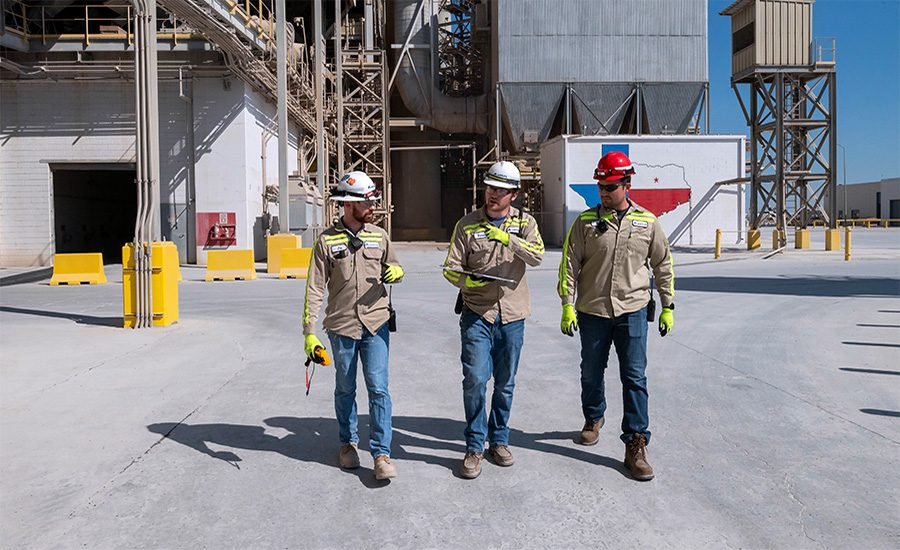
Amrize, the nation’s largest cement producer, is betting $700 million that a new “Made in America” label can do more than spark patriotic appeal.
Launched Nov. 13 at flagship plants in Missouri and Texas, the company says the certification will ensure domestic manufacturing, expand U.S. capacity and help reduce the carbon footprint of one of the most emissions-intensive building materials.

Amrize’s new “Made in America” label certifies that its cement products are made entirely in the USA using domestically sourced materials.
Image courtesy of Amrize.
“We’re seeing demand for infrastructure, data center and manufacturing projects where verified domestic content is now part of the value equation,” said Jaime Hill, president of Amrize Building Materials. “The ‘Made in America’ label helps customers know they’re getting it from a producer that meets American standards from end to end.”
Amrize plans to expand the label to 13 plants in the United States, starting with the facility in Ste. Genevieve, Mo.; Midlothian, Texas; Devil’s Slide, Utah; Holly Hill, SC; and Portland, Colo.
The launch coincides with upgrades that add about 760,000 tons of annual production, including a 660,000-ton expansion at Ste. Genevieve, the largest cement plant in North America, and $50 million in modernization work in Midlothian.
“Our label gives customers confidence that their product meets US performance standards while supporting jobs, community and economic growth,” said Patrick Cleary, Amrize’s senior vice president of North American commercial cement. “We see a clear opportunity to strengthen partnerships that value verified sourcing.”

Amrize’s Ste. The plant in Genevieve, Missouri, the largest cement plant in North America, is undergoing a 660,000-ton expansion as part of the company’s $700 million “Made in America” investment program.
Image courtesy of Amrize.
The U.S. cement and concrete industry contributes more than $130 billion annually to the economy and supports about 600,000 jobs, according to the American Cement Association. Domestic shipments reached approximately 105 million metric tons by 2024, with imports supplying about 23% of total demand, valued at nearly $16 billion.
While the new label echoes the “Buy America” sentiment, the cement itself remains outside the Federal Highway Administration’s domestic content mandates.
FHWA rules that went into effect Oct. 1 begin phasing in U.S. manufacturing and component thresholds for products manufactured under federally funded projects, but cement is not yet covered.
“For the five flagship plants where we are launching the label, we have verified the origin of all raw materials through a full supply review,” Cleary said. “That means, from the quarry to the kiln to the mill, every stage is domestic.”
Hill said the program also carries financial weight. “Every ton we produce locally maintains skilled trade work and reduces dependence on imported clinker,” he said. “We are investing ahead of IIJA-funded demand to ensure reliable supply for public and private builders.”
Several states, including California and Colorado, have adopted Buy Clean standards that account for carbon emissions when purchasing materials. This convergence between sourcing policy and emissions disclosure could give Amrize’s label more traction.
RELATED
The White House’s new America’s Shopping Guide is drawing scrutiny
Supply of materials and carbon footprint
Amrize’s “local to local” logistics model reduces delivery distances, a growing factor in accounting for embodied carbon. This connection between local production and emissions won the cautious approval of Kari Yuers, chair of the Chemical Adhesives Committee of the American Concrete Institute and president of Kryton International.

U.S. cement shipments rose steadily from 2020 to 2024, reaching about 105 million metric tons, while the import share rose to 23.5 percent, according to data from the U.S. Geological Survey.
Graph by ENR
“If you reduce transport distances, you naturally reduce the carbon incorporated,” Yuers told ENR. “But it’s only one piece of the puzzle. We need parallel moves – electrification of transport, alternative fuel kilns, 1 liter cements, carbon capture pilots – to really move the needle.”
He added that verification matters as much as intent. “Labels are valuable if they are verifiable,” he said. “Without transparent data on the intensity of incorporated carbon, a household content label risks becoming just another marketing claim.”
The production of cement clinker by heating limestone and clay in kilns is the most energy-intensive aspect of creating Portland cement. Clinker is the key product where the chemical reaction takes place and is responsible for most of the environmental emissions associated with the production of cement, which is ultimately used in concrete.
Contractors and state transportation agencies can verify domestic content claims and environmental disclosures using the Federal Trade Commission’s labeling rules and ASTM-compliant environmental product declarations.
This documentation is increasingly required in the material procurement scoring frameworks and Buy Clean reports of federal authorities, ACI and other standard-setting bodies.
Decarbonisation and industry prospects
The company’s investment drive includes process efficiency upgrades, digital monitoring and groundwork for low-carbon fuels. It has also begun construction of a fly ash beneficiation plant in Virginia to recover fly ash as supplemental cement material, a key step in offsetting clinker emissions.
Many U.S. concrete producers buy fly ash from abroad because of the lack of coal-fired power plants in the U.S., necessitating imports from Europe or coal-friendly nations. This supply chain was disrupted not only during the pandemic, but also during the most recent shortage of the coal byproduct due to high demand for mission-critical facilities.
“Benefited fly ash and calcined clay can make a real carbon impact, but access and permitting are limiting factors,” Yuers said. “We need regional supply solutions so contractors aren’t waiting months for alternative materials.”
Portland limestone cement, known in industry standards as Type 1L, can reduce CO₂ intensity by 10 to 15 percent without compromising structural performance when mix designs are adjusted properly, Yuers said. “They’re the quickest short-term win,” he said. “They are tested and ready if the market demands them.”
Amrize sees its modernization program as an investment in future flexibility. Each expansion incorporates advanced controls to improve efficiency, with plants being prepared for alternative fuels and low-carbon processes as the technology matures, Cleary said.
Cement manufacturing accounts for approximately 71 million metric tons of CO₂ annually, about 4.4% of US industrial greenhouse gas production, according to data from the EPA and the Clean Air Task Force.
With construction activity expected to increase through 2030, manufacturers face increasing pressure from property owners and transportation departments to document life-cycle carbon reductions through environmental product statements.
“Domestic production and low-carbon production should not be separate goals,” Yuers said. “If companies like Amrize align both, they will redefine what ‘Made in America’ means for the next generation of infrastructure.”
For Amrize, the label positions the company where national sourcing and carbon reduction goals converge.
“We are not changing the terms of trade, but we are strengthening reliability,” Cleary said. “Contractors can plan knowing their material isn’t crossing oceans — it’s produced, certified and delivered by people in their own states.”
Whether the initiative becomes a verified competitive standard, or simply a smart brand, will depend on the data the industry has only begun to measure.
— Jeff Yoders contributed reporting to this story.
