

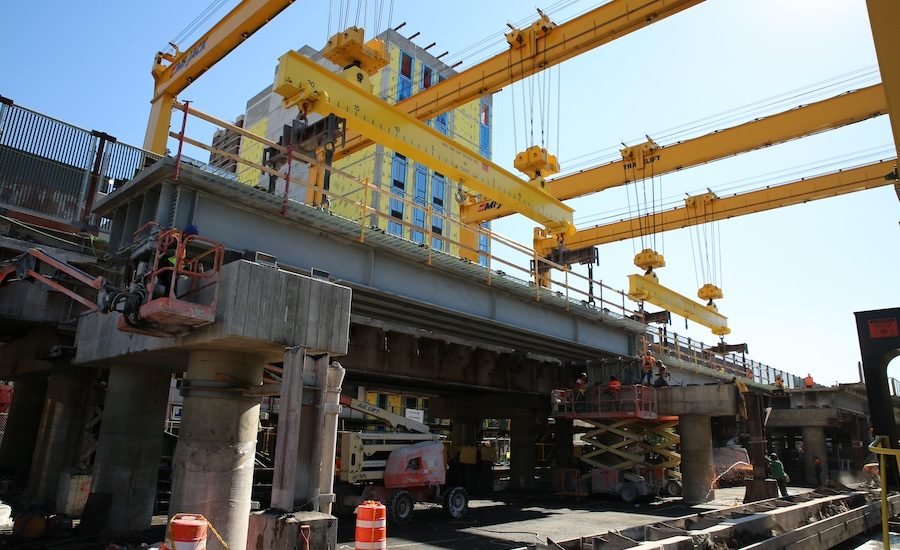

An innovative gantry system that places prefabricated bridge segments into place has allowed the first phase of the $590 million Park Avenue Viaduct replacement project in New York City to wrap up structural work this month. Over 19 weekends, crews performed 128 bridge installations that equate to 8,240 feet of track for the 132-year-old structure, all without disrupting Metro-North service. According to the New York Metropolitan Transportation Authority, the project as a whole is $93 million under budget and 51 months ahead of schedule.
The elevated concrete and steel structure carries four tracks and 98% of all Metro-North trains each day. Phase 1 began in October 2023 to replace the entire substructure and superstructure from East 115th Street to East 123rd Street along Park Avenue in upper Manhattan, as well as installing new track, power, communications and signal systems.
Phase 1 was completed 21 months ahead of its initial schedule. At the same time, crews from the design and construction team led by Halmar International in March 2024 began work on Phase 2, from East 127th Street to mid-block between East 131st Street and East 132nd Street.
On each of the 19 weekends, structural supports were built under the existing viaduct. At the time, two of the viaduct’s four tracks were out of service while train service continued on the other tracks. Using the mobile gantry, crews cut and removed sections of the existing structure. The rest of the structure is supported by a temporary drag system.
The new 190,000-pound precast sections were brought in and attached to the new support structure, with pre-installed rail plinths, track ties, third rail ties, and walkway and rails.
The 200-tonne capacity gantries “are the largest gantries MiJack has ever produced,” says Halmar project manager Nick Altmeter, who is leading the design and construction team on the job. AECOM acts as the main design consultant. Construction included 64 hammerheads and more than 700 16-inch-diameter minipiles averaging 40 feet into the rock.
Crews were limited by the dense urban environment, as sidewalks and crosswalks had to remain open during construction and streetlights had to be turned on their side. Additional work on the systems and track grade will continue over the winter, with Phase 1 expected to be substantially completed in April 2026. Phase 2 is expected to be substantially completed in September 2027.
