

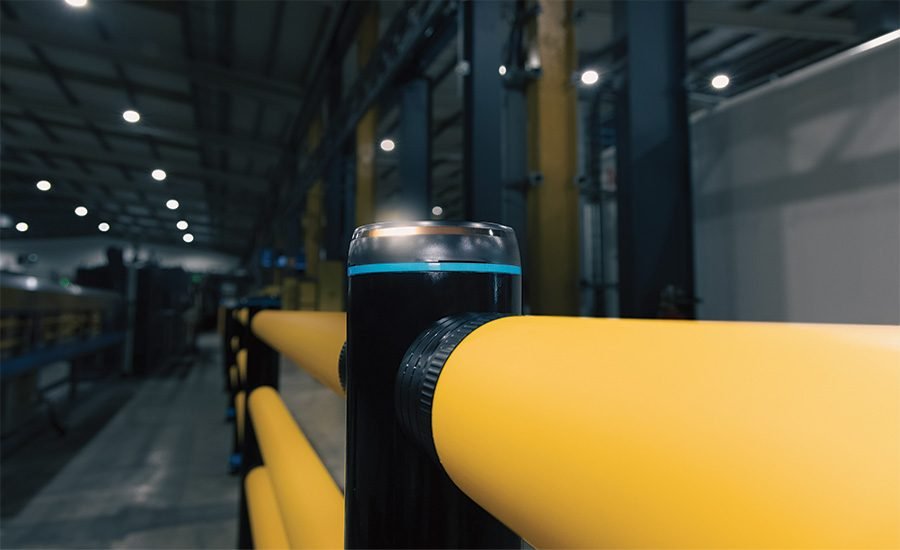
With warehouse aisles getting narrower and equipment moving faster, facility owners and contractors are rethinking a once-static piece of industrial infrastructure: the guardrail.
As motorized industrial trucks, automated mobile robots and dense rack systems converge in high-performance manufacturing and logistics facilities, the consequences of a single impact grow more severe, ranging from rack inventory collapses to slab damage and multi-hour downtime.
RELATED
The Age of AI: How Construction is Harnessing New Technologies to Create a Safer Workplace
Traditional steel guardrails still dominate U.S. installations, but a small set of manufacturers is driving a shift toward flexible polymer systems designed to absorb energy and reduce ground damage. This evolution is gaining attention as employers face increased incident volume and more mixed traffic environments in modern warehouses.
A-Safe, a British company that entered the US market more than a decade ago, pioneered a polymer guardrail design in 2001.
Founded in 1984 in the UK, the company is known for developing the first industrial polymer safety barrier and supplies impact protection systems for warehouses, manufacturing plants, airports and logistics centers worldwide.
In the fourth quarter of 2025, it introduced its fourth-generation barrier system with integrated impact control hardware. Senior Vice President Dave Dalleske said the move reflects a broader shift in the way facility operators view security infrastructure.
“Traditionally, if you walk into any of these environments, you’ll see a steel railing,” he said.

Traditional steel guardrails, like the ones shown here, protect walkways and equipment, but they can bend, transfer impact forces to the floor and require frequent repairs after vehicle impacts. A-Safe’s new multi-layer polymer barriers are designed to flex, absorb energy and return to shape, reducing slab damage and maintenance in high-traffic industrial facilities.
Photo by onlyyouqj/Adobe
Steel or other metal guardrails are typically installed around storage racks, building columns, machinery or walkways, but when a forklift hits it, he added, “it’s a mangled mess. It’s cracked the concrete underneath. You have to replace it,” depending on how the system is anchored to the slab. Metal sleeves are a common alternative to bolted or welded anchors for warehouse construction.
A-Safe’s handrails are extruded from a proprietary multi-layer polymer that flexes on impact and springs back to shape.
The design is intended to dissipate energy through the rail rather than transferring it to the anchors or slab. The company tests its systems against PAS 13, a barrier impact classification code developed in the UK and verified by TÜV Nord, an international company based in Germany that provides testing, inspection, certification and training services.
Although impact ratings vary by configuration, the company’s new barrier line is designed to withstand forklift impacts of up to approximately 25,000 pounds at 6 mph.
The key difference, Dalleske said, is not the impact itself, but what happens afterward. Steel and softer metals such as aluminum deform, while the polymer “re-bends,” eliminating repeated repairs, repainting, and anchor replacement.
For many facilities, he said, that life cycle difference is the economic case. “Some customers have full-time employees whose job it is to paint steel barriers. There’s a cost of maintenance, downtime and floor repair. It’s not unreasonable” for owners to see payback in less than two years.
Passive railings become a data infrastructure
The new generation of A-Safe also incorporates what it calls Active Technology: sensors and wireless communications modules built into select bollards and rails to record impacts by time, location and severity.

Polymer bollards on a manufacturing site flex to absorb forklift impacts without damaging anchors or floors. Facility managers report that these barriers reduce maintenance downtime compared to steel posts that bend or pull out of the slab after repeated impacts.
Image courtesy of A-Safe
The data is transmitted over a private network to a web platform that generates heat maps of high-frequency collision zones.
Dalleske describes it as an incident management tool. “It measures the time, date and intensity of the impact,” he said.
The system can notify staff, generate alerts for inspection and store data that identifies trends, allowing facilities to identify areas of recurring impact and adjust operations. The company previously applied similar tracking to pallet racks through its RackEye product line, which has been adopted by several manufacturers, including Cummins Inc.
“What A-Safe is becoming is a data analytics company to improve that level of operational efficiency,” Dalleske said. “We offer security for free at this time.”
For now, the analytics platform is largely standalone rather than integrated with warehouse management or maintenance software, although broader connectivity is on the company’s roadmap.
At a Midwest facility operated by Cummins, the global maker of engines and power systems, area health, safety and environment leader Andrew Hoene said A-Safe barriers have eliminated a recurring source of downtime associated with bent steel rails and damaged anchors.
With steel, he said, the repeated impacts caused the poles to “start pulling off the ground,” requiring maintenance crews to remove the damaged parts and wait for replacements. In contrast, the polymer system has not required any replacement in two to three years of use.
“There have been many incidents where forklifts have run into the A-Safe and the A-Safe did what it was supposed to do,” Hoene said. “If this was steel, it probably would have damaged the steel barrier quite significantly.”
The site also added tall fall prevention barriers along pedestrian walkways next to vertically stacked inventory. “Since the change, I don’t think anything has fallen,” he said.
Hoene added that internal and external auditors have begun to point to the polymer systems as a best practice compared to other Cummins locations.
RELATED
PwC report warns: accelerating ‘next industrial revolution’
Adoption is still nascent as modifications lead the market
Despite growing interest from e-commerce, automotive and cold storage owners, polymer railings still represent a small part of the market.
“I think the market share of polymer barriers is definitely less than 5 percent of all installations in the U.S.,” Dalleske said, noting that “95 percent plus” of projects default to steel because of familiarity and first cost.
Within A-Safe’s business, about 80% of US revenue comes from retrofits and 20% from new construction. Projects with high collision rates — doors, frame ends, cargo areas — often adopt polymer first, then expand use after seeing performance, he said.
Hoene said early design involvement is the ideal time to specify polymer barriers. Having A-Safe staff measure aisles and clearances “allows us to get the specific size we want” rather than relying on off-the-shelf steel.
Cold storage environments, where forklift operators move quickly in harsh temperatures and visibility is limited, represent a major growth area, Dalleske said.
High-performance distribution centers, food and beverage plants, and automotive and general manufacturing facilities are also active, especially when impacts can halt production or damage process machinery.
Cost and familiarity remain the main obstacles. Hoene said custom polymer systems can lead to longer lead times and higher upfront costs. “Sometimes the cost can be kind of a roadblock,” he said, though his team concluded it’s “worth the time” for a purpose-built system that better protects hallways and workers.
For contractors, Dalleske said the change depends on owner-driven specifications. “With general contractors, it’s generally going to be the lowest-cost product that wins,” he said. Many prescribers also maintain a “this is the way we’ve always done it mentality” with steel.
Still, as warehouses grow more automated and densely configured, the consequences of unreported impacts—equipment downtime, rack failures, and slab damage—continue to mount.
The question for capital project teams, Dalleske said, is whether next-generation logistics centers will treat the rails as expendable steel or as a more durable, data-producing part of the infrastructure.
