


Hurricane Milton and the tornadoes it spawned killed at least five people and knocked out 4 million homes and businesses in Florida. With assessments and rescues still underway, state officials say the damage was not as bad as it could have been.
Milton made landfall near Siesta Key in Sarasota County around 8:30 p.m. on October 9. All five people died in tornadoes in St. Lucie, Gov. Ron DeSantis (R) told reporters. National Weather Service survey teams were working to confirm whether up to 25 tornadoes touched down, and officials estimated that they destroyed scores of homes in central Florida.
The storm weakened from a Category 5 to a Category 3 hurricane by the time it made landfall, and the storm surge peaked at 8-10 feet in some areas, which saw less than saw during Hurricane Helene two weeks earlier. But heavy rains led to more flooding inland.
“The storm was significant, but luckily this wasn’t the worst case scenario,” DeSantis said.
Crews worked around the clock ahead of Milton to remove 3,000 truckloads of debris from Helene as part of preparations. More than 50,000 line workers were in the state restoring power, and the Florida Department of Transportation had more than 300 crews in the field and 150 bridge inspectors dispatched. DeSantis said more than 620 bridges in the state had been inspected as of the afternoon of Oct. 10.
Tampa International Airport said in a statement that its fuel tank lost power, six boarding bridges were damaged and crews were still clearing debris, but it planned to reopen on the morning of 11 October
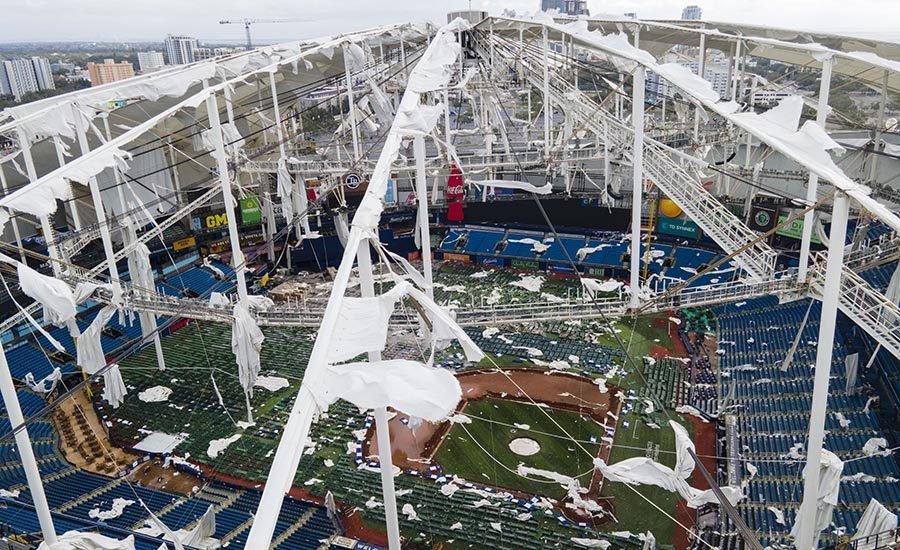
Some of the most notable damage occurred in St. Petersburg, where a tower crane partially collapsed and damaged the roof of the Tropicana Stadium.
Cable supported dome
The 1.1 million square foot stadium, home of Major League Baseball’s Tampa Bay Rays, was completed by Huber, Hunt and Nichols Inc. in 1990 at a cost of $138 million. Designed by HOK Sports Facilities Group and structural engineer Geiger/KKBNA PC, the stadium was constructed of more than 7,000 precast concrete components, including a 688-foot-diameter concrete compression ring supported by 24 columns, they wrote some of the project engineers. PCI magazine in 1990. The columns vary in height, sloping its cable-supported domed roof to a height of 225 feet at second base and 85 feet at the center field wall.
The dome, which was the first cable-supported dome in the US and remains the largest in the world, features a top steel tension ring and four steel wire hoops parallel to the compression ring. Twenty-four radial ridge cables carry loads from the center ring to the perimeter compression ring.
Struts connect the dome structure to the fabric roof material, which consists of Teflon-coated fiberglass. The roof was built to withstand winds of 115 mph, according to the Rays organization. City officials said the highest gust recorded at nearby Albert Whitted Airport during the storm was 101 mph.
Photos and videos show fabric ripped from most of the dome, but the full extent of the damage was not immediately clear. The Rays said a statement to X, formerly Twitter, which would assess the state of the stadium.
“We are fortunate and grateful that no one was injured in the damage to our stadium last night,” they wrote.
The Rays already had plans to replace the stadium with one new $1.3 billion stadium. General contractor Mortenson plans to complete the new stadium in time for the 2028 baseball season.
The tower crane hits the nearby building
A tower crane used on the 400 Central project in downtown St. Petersburg partially collapsed overnight, fire officials said. Photos showed parts of the crane’s broken boom hitting and damaging the nearby Tampa Bay Times office building across the street.
The Times reports No one was working in the office at the time and city officials said no injuries were reported.
Construction on 400 Central, which is expected to be 515 feet tall and 46 stories tall when completed, began in September 2022. General contractor Suffolk Construction Co. Inc. it was scheduled to be completed next year for owner Red Apple Real Estate.
Red Apple founder and director John Catsimatidis said in a statement that 400 Central remained in good condition and that the company was working with the city to determine next steps for the fallen debris.
The collapsed crane was one of three at the site, St. Petersburg building manager Don Tire told the Times. They were rated to withstand winds of 110 mph.
“We are thankful that no one was injured in the area, and that the only damage was to the bricks and not the people.” said Catsimatidis.
He added that the company plans to resume work “as soon as possible.”
