


Water technology company ASTERRA has teamed up with the state of New Mexico to help small community water systems identify leaks in drinking water infrastructure that contribute to the state’s water shortages caused by industrial agricultural overuse, climate change and drought.
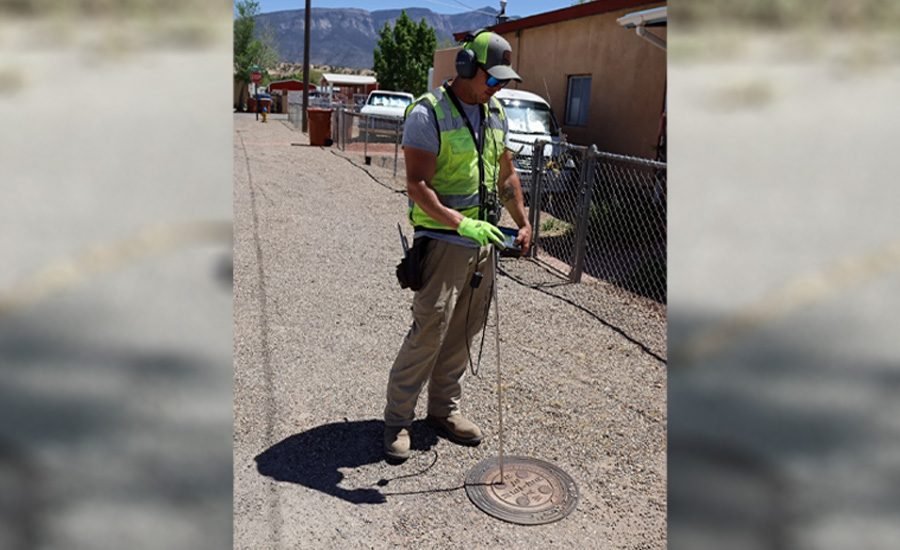
The Israel-based company, which uses satellite imagery and a proprietary AI algorithm to identify where and what types of water is underground at depths of up to 10 feet, entered into a $1 million contract with the state of New Mexico in November after successfully completing a pilot program with the New Mexico State Department of the Environment, McKim and five municipal water systems and field inspectors. The pilot initiative saved an estimated 345,000 gallons of water per day in the first half of 2025, according to ASTERRA, using imagery obtained with L-band Synthetic Aperture Radar (SAR) technology. Once leaks are identified through satellite imagery, they are verified by inspectors on the ground.
Under the contract, ASTERRA will work with five different small water systems across the state annually for the next four years to identify leaks. The cost of ASTERRA’s assistance will be covered by the state, says Meta Hirschl, data and technology manager for the New Mexico State Department of the Environment. The cost of the repairs will have to be paid by utilities, but the state is looking for ways to support communities that have little ability to pay for the repairs themselves.
Water loss due to leaking infrastructure is a real problem in New Mexico, with some utilities reporting losses of up to 40% to 80% annually, according to state officials. They generally haven’t had the resources to conduct a full audit to fix leaky systems, Hirschl says. “Many of our communities are really understaffed in their infrastructure, sometimes even [just] volunteers Maybe they know water is leaking, but they don’t know where,” he told ENR.
While ASTERRA has worked on larger contracts in New Mexico, Texas and elsewhere around the world, either alone or as part of a team, for this particular program, “we would really like to focus. [on communities] “This cannot be avoided,” Eric Trerotola, senior director of sales for North America, ASTERRA, told ENR. The model developed for the pilot could be replicated in other communities that may not even be particularly small, but are under-resourced, added ASTERRA spokesman John Lee.
State water action plan
The ASTERRA initiative is a component of New Mexico Governor Michelle Lujan Mitchell’s 50-year water action plan released last year to address a water shortage that is expected to intensify in the coming years, with an estimated shortage of 750,00 acre feet in total. In the document outlining the plan, the state concludes, “Without action, New Mexico will not have enough water to meet our needs.”
The plan outlines steps state officials can take over the next 50 years to increase local water supplies. Elements of the plan include increased conservation, investments of up to $500 million for new projects, including new desalination and wastewater treatment plants, and cleanup of contaminated groundwater sites.
The partnership with ASTERRA falls under the conservation umbrella, says Andrew Hautzinger, special projects coordinator for the state Department of the Environment. “We think that in a smaller water system, on average, about 40 percent of the water is lost from the time it’s pumped to the time it’s delivered to a business or a resident, which is about 2.5 billion gallons of fresh water that could be recovered if we fixed all the leaks in our 650-plus community water systems in the state,” he told ENR.
ASTERRA’s Trerotola notes that the company’s technology can also distinguish between different types of water based on the water’s dielectric properties. Since the company was established in 2013, ASTERRA has found more than 274,000 leaks worldwide.
State officials are hopeful. “We estimate that within four years … every water system in the state that meets our criteria of less than 20,000 people will have a detailed report that tells them where the water leaks are, and then we’re working on associated programs to support the actual fix of the leaks,” Hautzinger said.
