

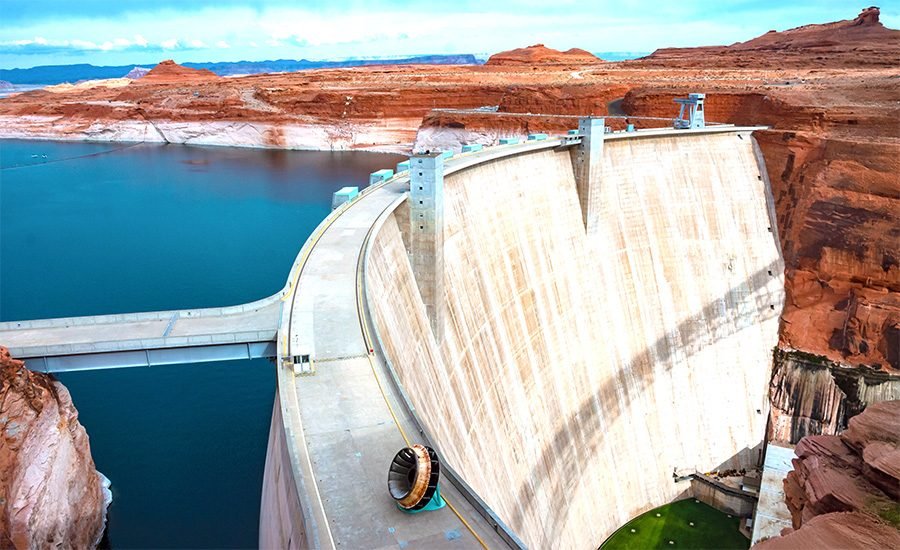
Arizona’s Lake Powell is in trouble. Modeling by the U.S. Bureau of Reclamation shows the reservoir dropped roughly 36 feet between December 2024 and December 2025, a decline that is no longer a warning but an operating condition that engineers are designing for.
The slump is squeezing the margin between routine operations and hard infrastructure limits at Glen Canyon Dam as negotiations over the Colorado River’s post-2026 operating rules remain unresolved.
RELATED
Feds plan unprecedented drought response for Colorado River reservoir
According to a 24-month recovery study, Lake Powell’s end-of-month elevation declined from about 3,572 feet in December 2024 to about 3,536 feet a year later, pushing the reservoir further into scarcity-era operating levels. The result is tighter flexibility for hydropower generation and releases due to physical limits built into the dam, not policy choices. These limits now collide with a governance gap.
Interim operational guidelines adopted in 2007 expire at the end of 2026, and the basin states have yet to agree on replacement rules governing releases, shortages and reservoir protection.
In a November 2025 report, the Congressional Research Service said Reclamation was leading the post-2026 review process, but noted that Upper and Lower Basin stakeholders “have not been able to agree,” instead presenting competing proposals. CRS warned that, in the absence of agreement, the federal government could be forced to propose operating conditions unilaterally.
Reclamation has said in recent planning documents that it must continue to assess operations and infrastructure within existing physical constraints as the post-2026 process continues, stressing that engineering timelines cannot stop while negotiations drag on.

A pronounced white “bathtub ring” along Lake Powell’s sandstone cliffs marks the withdrawal of the reservoir, visually recording how water levels have dropped as engineers plan operations around the reduced banks of Glen Canyon Dam.
Image courtesy of Aerial Film Studio/Adobe
For engineers, owners, and contractors in the Colorado River Basin, this uncertainty is already shaping design assumptions, acquisition strategies, and capital planning.
As Lake Powell’s elevation declines, the margin between normal operations and the minimum power pool continues to narrow, raising questions about turbine performance, cavitation risk, and the flexibility of outlet works.
CRS reported that watershed representatives have asked Reclamation to assess the protection of Lake Powell elevations near 3,490 feet and to study infrastructure modifications that would allow releases below that level. Any such work would represent a new class of climate-driven capital investment in one of the federal government’s most critical water and energy assets.
The consequences of reservoir withdrawal are mounting rapidly. Hydropower production declines sharply as Lake Powell approaches the minimum power pool, increasing operational and revenue risk long before generation is unviable.
Glen Canyon Dam hydropower is more than just an energy concern. Revenue from power generation helps fund basin operations and repayment obligations, making declining production a system-wide financial issue that is already emerging in construction decisions.
RELATED
Trump veto disrupts funding for $1.4 billion Colorado water project already underway
In southeastern Colorado, Reclamation is advancing the Arkansas Valley Conduit, a long-delayed federal water supply project involving more than 100 miles of pipelines, pumping stations and treatment facilities, as previously reported by ENR.
The project, which suffered a financial setback after President Donald Trump vetoed proposed congressional legislation aimed at easing repayment timelines, is authorized for more than $1 billion through a phased delivery plan. This approach commits the federal government to long-term execution under interim scarcity-era assumptions rather than finalized post-2026 operating rules.
Further downstream, the Southern Nevada Water Authority designed and built a third low-lake, catchment pumping station to preserve access to supplies from the Colorado River, even if reservoir elevations fall below levels that would jam the previous infrastructure.
The project, completed at a reported cost of about $522 million, incorporated conservative hydrologic assumptions into permanent infrastructure years before today’s negotiations intensified.
Other agencies are responding to the same signals. Central Arizona Project planning documents show participation in supply augmentation and development studies aimed at compensating for Colorado River shortages, recognizing that existing supplies may be insufficient regardless of how negotiations pan out.
This is not a new story

An aerial view of Australia’s Murray-Darling Basin shows a heavily managed river system shaped by prolonged drought, where intake improvements, expanded metering and staged transport projects were advanced as allocation reforms were delayed, generating billions of dollars in long-term infrastructure investment.
Image courtesy of Flickr
Experience elsewhere shows where this path can lead. In Australia’s Murray-Darling Basin, prolonged drought spurred intake improvement, expanded measurement, and staged transportation projects, while allocation reforms lagged, with federal programs exceeding roughly $9 billion over a decade.
In Brazil’s São Paulo region, emergency transfers and pumping projects totaled about $1.6 billion over several years during the water crisis of the mid-2010s, resulting in higher operating costs being subsequently passed on to customers.
The cost trajectory of the Glen Canyon Dam could be similar. Potential modifications could range from hundreds of millions to several billion dollars, based on comparable federal dam renovations, such as the more than $1 million rehabilitation at Folsom Dam.
Basin-wide monitoring and control upgrades could run into the hundreds of millions, while pumping and conveyance reliability programs routinely exceed $1 billion in scale.
Federal watchdog agencies have warned that advancing capital investments based on tentative assumptions increases contingencies and embeds those assumptions in operations and repayment structures, according to findings by the Government Accountability Office.
As Lake Powell continues to decline and the post-2026 rules remain undefined, the Colorado River is already being reconfigured in real time. International experience suggests that once conservative adjustments (lower congestion, expanded pumping, redundant transportation) are put in place, they tend to shape system performance long after new arrangements are finalized.
For the construction industry, the implication is clear: the watershed’s future will depend less on when an agreement is reached than on which engineering assumptions are funded first, and those decisions are already underway.
