

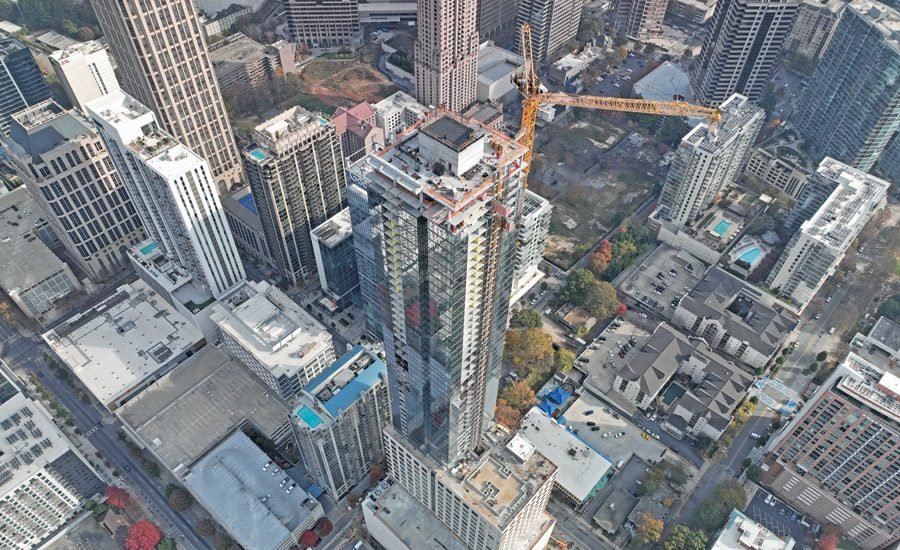
All developers want to make a statement, and with the completion of 1072 West Peachtree in Atlanta, the Rockefeller Group is shouting from the horizon. When completed this spring, the 60-story mixed-use building will be the fifth-tallest skyscraper in the city and the tallest built in Atlanta in more than three decades. With three distinct programs: residential, office and parking, the building challenged the capabilities of the local design and construction teams to create something most had not seen in their professional careers.
Located on a site of just over an acre, the team was able to stack a 40-level “pencil” residential tower on top of 10 levels of offices on a 10-level base of parking with ground floor retail space. “As we looked at the different options, we thought, if we’re going to create an elevated, multifamily, luxury product, why not go high?” says Tony Zang, vice president of design and construction for the Southeast for Rockefeller Group. “With the zoning, we had no height restrictions, so we were able to put just over a million square feet on that acre.”

The tower carpet foundation included a section under the core that was poured 12 feet deep.
Photo courtesy of Turner Construction
Although the residential tower is tall, it is not wide, with a floor plate of 8,500 square meters. The design concept ultimately creates a unique product in Atlanta with nearly every residential unit boasting two cardinal views of the city, says Dave Brown, director of TVS, the project’s designer. He notes that most of the city’s large residential towers have limited views and long hallways with perhaps dozens of neighbors. “It’s a differentiator in the market to have a floor plate where you and seven other neighbors are in one flat,” he adds.
While stacking different programs on top of each other always presents structural challenges, the tower’s tall and thin design created a higher degree of difficulty. Brown says the small floor plate along with its core and shear walls made it impossible to resist wind loads using structural systems that are common in mid-rise buildings. Working with structural engineer Walter P Moore, the team devised an outrigger beam system at levels 39 and 40 that connects the core to the perimeter columns.
At the base of the residential tower, Brown says the systems incorporate columns that slope toward the outer edge of the office footprint. “If you’re on the top five levels of the office, you’ll see these columns coming down your space that have an angle,” he adds.

In November 2023, crews placed approximately 4,500 m3 of concrete during a continuous 24-hour pour.
Photo courtesy of Turner Construction
The place is not only narrow, it is rocky. With bedrock and potential water table problems just below grade, the project was limited to only one basement level. TVS designed this space to primarily house service areas, including the loading dock, as well as some building systems, including the main electrical room.
The entire concrete structure sits on a carpet foundation with caissons, with the foundations under the core poured up to 12 feet thick. With bedrock just below grade, crews led by Turner Construction rock fitted most of the caissons. The matte foundations were created over two pours. In November 2023, crews placed approximately 4,500 m3 of concrete during a continuous 24-hour pour. A month later, the team completed a second carpet base pour of 1,700 cubic meters.
“It’s a differentiator in the market to have a floor plate where you and seven other neighbors are on one floor.”
—Dave Brown, director of TVS
For the larger pour, Turner leveraged three separate batch plants in metro Atlanta to ensure there were no capacity issues. The team was able to get closures on adjacent streets to set up pump trucks and drive by concrete trucks. A nearby private drive was used to set up up to 20 trucks, allowing the team to avoid queuing on city streets. More than 500 truckloads of concrete were used throughout the pour, allowing crews to place approximately 185m per hour.
Because it was a massive dump for the Atlanta area, the local team drew on the expertise of other offices while making sure to involve their own staff. “We ran a bit of an all-points bulletin at Turner’s local Atlanta office, and we had a number of people volunteer from other locations on the project to help guide, manage and manage the work that took place over that 24-hour stretch,” says AJ Bargoti, project executive for Turner’s Atlanta business unit. “It was a really unique experience to have other teammates who weren’t assigned to the project.”

For the facade on the ground floor, the teams installed glass and natural materials such as limestone.
Photo courtesy of The Rockefeller Group
When the structure came off the ground, Turner followed a sequence that allowed about a third of the building on the west side to be built separately. This allowed the team to efficiently build the core in a narrow zero line location, then go back and add the western part.
“We used this western area as a staging area,” says Bargoti. “Eventually, you get to a point where you have to build that expansion for other logistical reasons, like mobilizing cranes. We had a second crane on that job, and ultimately we had to make sure we didn’t have any conflicts there.”
Bargoti says the design of the 750-car parking garage was relatively conventional from a constructability standpoint with some unusual elements, including the addition of some private garages. Above the car park, the office floors had to be built because there was not enough repetition for the shared formwork.
In the tower, unlike the office spaces, the team was able to use a table formwork system as each floor plate was similar. Crews were able to split the floors into two concrete pours and were able to turn one floor every five working days.
Adding the outriggers to the tower required additional planning. “Our structural superintendent looked at these outriggers very early in the project, understanding that we would need to coordinate with our trade partners,” says Dan Cassidy, senior project manager at Turner Construction. “The rebars there are big and you have tie-in materials to allow them to span the full width of the floor. So it’s a dense, heavy operation that had to be built. [below] and flew to his place. In some cases, it was built to levels 39 and 40 because of the amount of reinforcement that had to be put in.”

From the second level to the beginning of the top of the office building, prefabricated panels were installed that complemented natural materials on the ground floor, such as limestone.
Photo courtesy of Turner Construction
As the one-story pours were completed, a system of unified window walls followed to add the tower facade and enclose the floor. Panels were kept relatively similar to maximize repetition and ease of installation. For the facade of the lower levels, the teams added natural materials such as limestone at ground level. From the second level to the beginning of the top of the office building, prefabricated panels were installed that complemented the natural materials below.
As a tall building, crews also had to account for vertical compression. From the window wall system and concrete slabs to the plumbing and even the cabinets, the installers had to take into account the expected future vertical shortening over time. “Where the focus was really on the corners because you might have a corner element that’s closer to the core than another element,” Cassidy says.
“The Atlanta market hasn’t seen a tower like this in over three decades.”
—AJ Bargotu, Project Executive, Turner Construction
The project’s maximum workforce was approximately 325, with approximately 1,800 unique workers. By the end, crews had completed more than 800,000 hours of work. Throughout the project, Turner had to pay special attention to the capabilities of its business partners from the point of view of safety, quality and logistics. “The Atlanta market hasn’t seen a tower like this in over three decades,” says Bargoti. “We put a lot of time and effort into making sure that as the businesses came on board, they bought into the plan 100 percent and understood what was needed, whether it was the vertical means of going up and down the building to parking. Every element.”
When completed, 1072 West Peachtree will offer 224,000 square feet of office space, 357 residential units and 6,300 square feet of ground floor retail. In addition to its office and residential components, the building will offer one acre of indoor and outdoor amenities. The building’s stacked design creates outdoor space; the exposed top of the car park is available as outdoor space for office tenants and the top of the offices can be used by residents. The Sky Garden will feature the largest outdoor deck in Midtown Atlanta, designed with seating areas for collaboration or relaxation. There will also be a flexible use lawn for meeting, playing and hosting events with city views.

When completed, 1072 West Peachtree will offer 224,000 square feet of office space, 357 residential units and 6,300 square feet of ground floor retail. The building’s stacked design creates outdoor spaces, including the largest outdoor deck in Midtown Atlanta.
Courtesy of The Rockefeller Group
“Rockefeller and Turner have been great partners,” says Brown. “I think the three of us make a meeting point every month to talk about how things are going [and] where are the rough spots. It’s been a really nice partnership to have Turner on board so early in the process. It was very collaborative.”
