

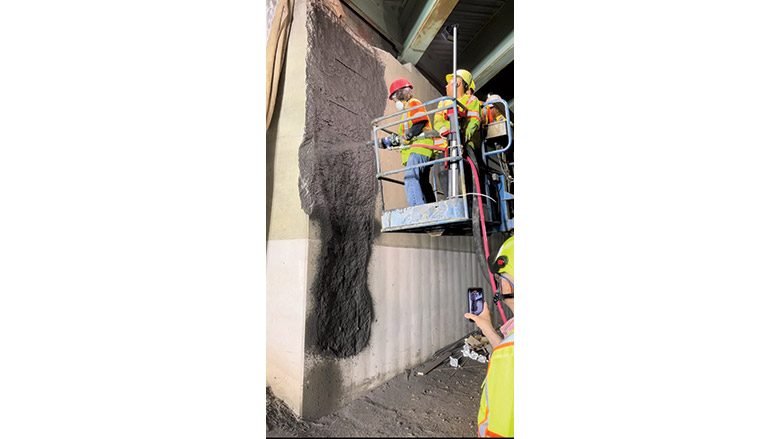

Atorod Azizinamini, director of infrastructure research and innovation at Florida International University, has been instrumental in advancing the use of advanced materials and technologies in bridges and other structures. This includes creating an open-source high-performance concrete (UHPC) mix that delivers the same performance as its proprietary counterparts, but at a significantly lower cost, making advanced maintenance solutions accessible to a wider range of agencies and owners.
Azizinamini has led the development of a spray system for the high-tech material, providing a faster, more efficient and more durable solution to repair corroded walls, columns and beam ends without the need for formwork or other cast-in-situ concrete elements.
He says a sprayed UHPC coating of 1 inch or less can be sufficient for many routine crack and corrosion repairs, compared to 4 to 6 inches for cast-in-place concrete.
A collaboration with the Virginia Department of Transportation in 2024 marked the first time the process was used for a concrete repair project. Approval from other state transportation agencies is pending for similar projects.
Structural engineer Joseph Colaco, a part-time professor of practice at Florida International University and a member of the National Academy of Engineering, says Azizinamini’s initiative to expand the application of pulverized UHPC is “a paradigm shift in the way we approach repairing and upgrading deficient infrastructure.”
Ines Triay, interim dean of the university’s Faculty of Engineering and Computer Science, adds that the promise of Azizinamini’s research lies in the exceptional durability and corrosion resistance of UHPC, qualities critical to extending the life of aging structures.
“By enabling rapid and effective strengthening and repair, sprayable UHPC minimizes disruption, reduces costs and improves safety for both construction workers and the public,” explains Triay, adding that Azizinamini’s research extends to building design, exploring cost-cutting strategies such as reducing steel fiber content that further expands the feasibility of routine and emergency repairs of UHPC.
In addition to advancing materials and construction science, Azizinamini also has a career-long commitment to fostering workforce development and technology transfer.
He and his research team are using a federal grant to form a spin-off company to upgrade and commercialize the sprayable UHPC system, including assembling a mobile unit that houses all the equipment needed to perform concrete repairs. In addition to providing UHPC sprayable services, the mobile unit will be instrumental in conducting workshops across the country for training contractors.
“One of the important lessons we learned from the Virginia DOT project is the importance of team organization to properly run the system,” says Azizinamini. “As we refine the system, we hope to streamline processes, but hands-on experience will still be essential.”
Azizinamini is also a recognized industry leader in the development of innovative systems and the implementation of new concepts in practice. Its patented folded plate girder system provides a cost-effective solution for replacing short-span deficient bridges.
In 2015, he was named a White House Transportation Change Champion, recognized alongside other leaders in transportation advancement and change that benefits the nation’s transportation system.
These successes, says Triay, will have far-reaching effects. “Their vision and commitment are setting new standards for resilience and sustainability, ensuring infrastructure maintenance keeps pace with the demands of modern society,” he notes.
