

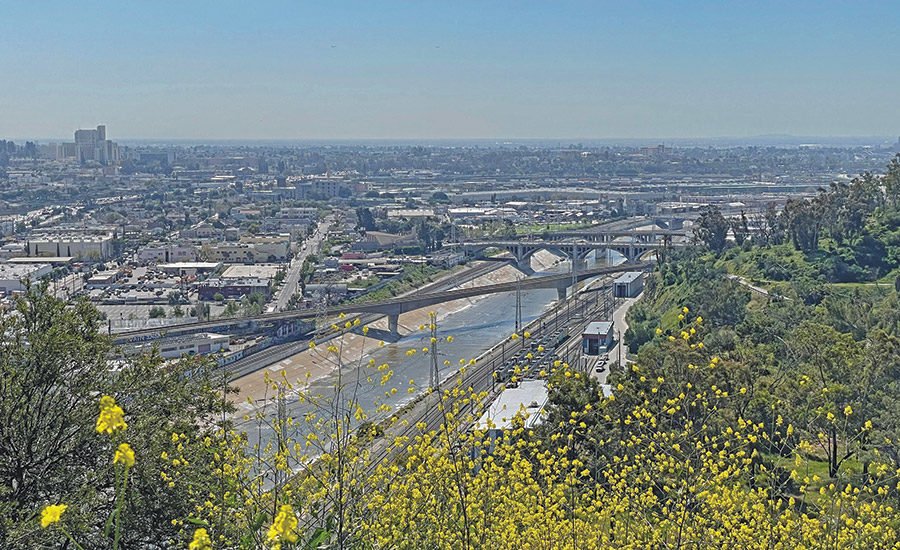
“Our teamwork with the LA County Department of Public Works is one of the biggest factors in our success.”
-Col. Andrew Baker, commander of the US Army Corps of Engineers Los Angeles District
On July 12, the US Army Corps of Engineers Los Angeles District (USACE) announced that there continues to be federal interest in the Los Angeles County Drainage Area (LACDA) project. As a result, a provision could not be recommended, according to a report of the results of a four-year study. This study gives the Corps the authority to evaluate a project that no longer serves its purpose.
The purpose of this study was to determine whether USACE’s continued operation and ownership of LACDA is in the federal interest. The study, which was completed in May, determined that the LACDA project continues to fulfill its authorized purpose and provides meaningful and effective flood risk management for the Greater Los Angeles area, along with significant economic and public
The study was conducted under Section 216 of the Flood Control Act of 1970.
According to the report, the various features of the LACDA project work together as an inseparable and interconnected system to provide flood risk reduction and management benefits to the Greater Los Angeles area. As such, disauthorization of individual LACDA features would affect USACE’s ability to efficiently address emergencies and natural disasters, as well as during routine water management operations.
“The strong relationships we have built over the years with our local and state partners are integral to the mission of the US Army Corps of Engineers in the Los Angeles Area of Operations,” Col. Andrew Baker, US Army Corps of Engineers in Los Angeles. The district commander said in a statement. “Our teamwork with the LA County Department of Public Works is one of the most important factors in our success as we continue to provide flood risk management to ensure the safety of the millions of people who reside here” .
FTA awards $77.5 million to Metro For Clean Transit
The Federal Transit Administration announced on July 11 an award to the Los Angeles County Metropolitan Transportation Authority (Metro) of a $77.5 million grant for the 24th year of low or no emissions
This award is the second largest of 117 projects that FTA selected for funding from among 477 eligible applications. These funds will help the agency purchase dozens of battery electric buses, install new chargers and expand workforce development training at its West Hollywood bus division.
The new electric buses are expected to run on multiple routes throughout Los Angeles County and provide direct access to subway lines.
“Just as LA Metro was at the forefront of introducing the nation’s cleanest bus fleet years ago, we are once again leading the way with zero-emission buses,” said Janice Hahn, Los Angeles County Supervisor and Chairwoman of the Metro Board. statement “This federal funding will help us move one step closer to the zero-emissions future we need here in LA County.”
Metro issued a request in April for the purchase of 260 battery electric buses (BEBs) and 20 hydrogen fuel cell electric buses (FCEBs). The solicitation includes additional purchase options that will allow for the potential procurement of up to 1,980 BEBs and FCEBs.
The planned federal funding for Metro’s zero-emission bus and freight infrastructure project was made possible by the US Department of Transportation’s zero-emissions grant program. This grant will allow Metro to purchase the electric buses and begin the installation of chargers at the West Hollywood bus yard.
$2 million in California transit infrastructure spending to move forward
The California Transportation Commission (CTC) has approved more than $2 billion to improve and maintain the mass transit system that supports the world’s fifth largest economy. This funding, approved June 28, will support the next generation of transportation projects, including bridge maintenance, rail system upgrades and enhanced rail safety features.
According to the CTC, the latest appropriations include more than $483 million from the federal Jobs and Infrastructure Investment Act of 2021 (IIJA) and approximately $443 million from Senate Bill 1, the Repair and Accountability Act of roads in 2017.
The allocations include $103 million for the North Coast Corridor Rail project in San Diego County, $17.8 million to improve Highway 99 and State Route 68 in Tulare County, and $10 million to provide residents from Santa Bárbara buses and electric chargers. Some projects will improve safety at railroad crossings, including a $5.9 million effort that will improve signage, signage and gates at two commuter railroad crossings in the city of Montebello.
Work begins on the Maritime Innovation Center in Seattle

In May, construction began on the long-awaited Maritime Innovation Center at the Port of Seattle Fisherman’s Terminal.
Representation courtesy of Miller Hull Partnership
The Port of Seattle broke ground in late May on the renovation and modernization of the historic Ship Supply Building at the Fishermen’s Terminal. The structure will eventually become a Maritime Innovation Center (MInC) to serve a variety of maritime industry needs.
As a Living Building Challenge certified facility, the MInC will generate its own energy, capture its own water and process its own waste. The MInC will also feature net positive energy, recovered materials, reduced carbon emissions, rainwater harvesting and stormwater treatment.
This adaptive reuse project will maintain and respect the form and mass of a 1918 waterfront building in operation. Most of the building and its century-old structure of heavy wood will be recovered and reused.
“The transformation of the port’s oldest asset […] it symbolizes the port’s recognition of the importance of the maritime industry to the history and future of our region.”
—Fred Felleman, Commissioner, Port of Seattle
The port has partnered with design firm Miller Hull on the project. Miller Hull’s design will enhance the original building’s iconic pitched roof using locally sourced and industrially appropriate materials.
To prepare for the next century of commercial fishing and marine industrial activity at the terminal, the port is committing more than $100 million in new investments as part of a long-term strategic redevelopment plan to maintain the docks for commercial fishermen, improve upland facilities and give emphasis. History and Legacy of Fishermen’s Terminal.
The improvements and investments will ensure the facility continues to support Seattle’s maritime industry and waterfront. The maritime industry and the jobs it creates help anchor the regional economy, with this facility supporting the next century of commercial fishing and maritime industrial activity on one of the most historic waterfront properties in Seattle.
“Today’s news is a celebration of the port’s substantial commitment to supporting innovation as a way to foster the maritime industry’s ability to sustain our region’s blue economy,” said Port Commissioner Seattle Fred Felleman in a statement. “The transformation of the port’s oldest asset into one that can meet the Living Building Challenge symbolizes the port’s recognition of the importance of the maritime industry to the history and future of our region.”
