

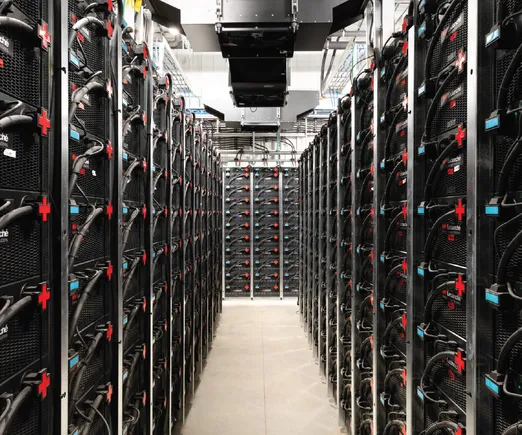
As renewable energy sources expand and demand grows, battery energy storage systems (BESS) are increasingly essential to stabilize power grids. PCL Construction experts provide insight into the strategic deployment of BESS.
Renewable energy generation is on the rise in North America. The Energy Information Administration (EIA) predicts that renewable energy will be produced 42 gigawatts by 2024nearly a quarter of US electricity generation.
With this growth, managing the variability of renewable energy is crucial. Renewable sources often experience fluctuations in output. Walter Schachtschneider, director of engineering for PCL’s solar team, emphasizes the control that BESS offers, saying, “You can’t control the sun, but you can control the batteries.”
Schachtschneider, with decades of experience, has seen significant advances in battery technology. “I once worked with lead-acid batteries the size of mini-fridges that generated just two volts. Now, we use millions of tiny lithium-ion cells,” he explains, highlighting the evolution of chemistry and battery applications.
Efficient in every way
Modern battery energy storage systems typically include multiple containers filled with lithium-ion battery cells, safety mechanisms, heating, ventilation and air conditioning, and connectivity equipment. These units are integrated into larger energy networks that often include renewable energy sources and commercial users.
For example, PCL implemented more than 1,500 solar modules at a major community center in Summerside, Prince Edward Island, Canada. Although the solar installation saves more than $100,000 annually, its 336 kilowatt-hour (kWh) capacity often exceeds the facility’s needs, resulting in an energy surplus.
To manage this excess, a BESS with a capacity of 890 kWh was installed. It stores energy during peak sunlight and provides backup on cloudy days or during outages, essential for Summerside’s grid, which relies heavily on diesel generators and has no connection to the main grids.
BESS complements renewable projects well, offering significant energy storage and release capabilities, beneficial for various business and utility applications. “A typical BESS can store 4,000 kWh, enough to power a shopping mall for hours or manage power during a factory power outage,” explains Schachtschneider.
Demand for electricity is expected to increase sharply, with the The EIA predicts nearly 4.125 billion kWh by 2025 in the US due to population growth and a shift away from fossil fuels. That increase strains the grid, demonstrated by ongoing problems like California’s “duck curve” — a disparity between peak solar output and peak demand.
Schachtschneider notes, “In California, there is potential to store energy from 10 am to 2 pm and use it during the peak hours of 5 to 7 pm.”
BESS can improve grid reliability, help avoid infrastructure upgrades and reduce costs by managing power sales during peak demand. In certain markets, where electricity costs are based on peak demand, BESS can save significant amounts by allowing users to disconnect from the grid during peak hours.
The tipping point is approaching
Peak demand for BESS is probably somewhere in the future. And it might be here sooner than you think. As clean energy capacity continues to increase, so will the need for BESS to manage the push and pull of energy into the grid. and meet economic and climate goals.
Andrew Fleetwood, chief estimator of PCL’s solar team, highlights the growth: “In 2016, my first project was 12 megawatt-hours. Now, we’re seeing demand up to 1,200 megawatt-hours.” He notes that Ontario’s grid operator recently sought proposals for six gigawatts of storage, emphasizing the grid’s growing reliance on these technologies.
Since starting solar projects in 2010, Fleetwood has seen significant drops in PV panel costs and improvements in efficiency. He predicts BESS will follow a similar trajectory, improving efficiency and scale, possibly with new battery technologies that surpass lithium-ion.
Fleetwood colleague Andi Kasapi sees parallels in the evolution of solar energy, where advances and increased competition from suppliers have driven down costs and expanded feasibility. “The market will become more efficient as it develops,” Kasapi predicts.
Recognizing the crucial joints in the development of energy storage, Kasapi and Fleetwood emphasize the importance of expert guidance in navigating these investments. “With our deep experience and industry connections, we help clients manage cost and risk effectively,” says Fleetwood.
About 80% of the costs of the BESS project are attributed to the batteries, according to Fleetwood, underscoring the importance of strategic partnerships with technology providers to reduce costs. It also highlights the systems’ rapid response capabilities, which, while advantageous, require robust risk management strategies due to their potential for industry disruption.
PCL’s extensive experience with critical infrastructure uniquely positions it to support organizations in maximizing their BESS investments and managing associated risks, establishing it as a trusted player in the expanding field of storage renewable energy
