

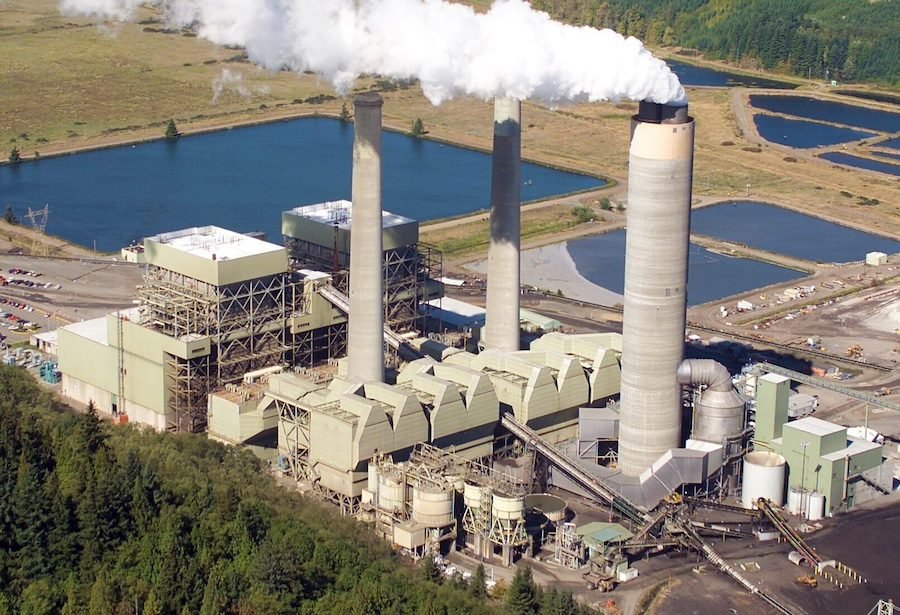

Just days away from a shutdown and a $600 million remake as a gas-fired facility, the Trump administration is ordering a coal-fired power plant owned by an independent power producer in Washington state to stay open until mid-March 2026, and likely longer, setting up a battle with state and company officials. The shutdown of the 730 MW plant, in operation since 1972, was timed to comply with a state law that bans coal-fired power generation in 2026 and beyond.
The Dec. 16 “emergency order” issued by U.S. Energy Secretary Chris Wright under the Federal Energy Act directs owner TransAlta Corp. to ensure that Unit 2 of the Centralia Generating Station in Centralia, Washington, “will be available for operation.” The plant’s 670 MW Unit 1 was closed in 2020.
The order, in effect until at least March 16, 2026 to prevent the claimed risk of winter blackouts, follows two similar orders by Trump this year targeting plants in Michigan and Pennsylvania. Wright cited the country’s “unprecedented increase in demand for electricity,” and said the Energy Department will “continue to take steps to keep America’s coal plants running.”
Washington state officials counter that the power plant is completing the shutdown agreed to in 2011. “Workers have moved on,” they said. “There’s no coal to burn.”
Washington Gov. Bob Ferguson, Attorney General Nick Brown and state Ecology Director Casey Sixkiller released a joint statement condemning the “11th-hour efforts to prevent the TransAlta power plant in Centralia from ceasing coal-fired power.”
They added: “Under the guise of ’emergency powers,’ Wright is trying to force Washington state’s dirtiest power plant to continue burning coal. Let’s be clear: There is no emergency here.” It’s unclear when or if the state will join Michigan and Pennsylvania in filing a federal lawsuit against the shutdown.
Keeping the facility open beyond 2025 provides a reliable supply of energy essential to grid stability in the Northwest, according to Wright. The department directed the Bonneville Power Administration to manage the transmission of power from the Centralia plant. Rate recovery is available through federal regulations governing energy emergencies, according to Wright.
There were already plans to reopen the site as a 700 MW gas-fired power generator in 2028, with Puget Sound Energy agreeing Dec. 9 to buy power from the upgraded facility.
Gas conversion is “priority”
Calgary, Alberta-based TransAlta confirmed in a statement to ENR that it is evaluating the federal directive and will “work with state and federal governments.” But he said “the coal-to-gas conversion project remains a priority for TransAlta.”
The company said it would provide more details on the directive “in due course”.
The Energy Department cited a “resource adequacy report” that says blackouts in the US were on track to potentially increase 100-fold by 2030 if the shutdown continued. The agency also noted a “winter reliability assessment” by North American Electric Reliability Corp. 2025-2026 indicating that the Northwest region is at high risk during periods of extreme weather, such as prolonged cold spells.
The report also said delays threaten the completion of new battery storage and solar and wind power generation projects. But the Trump administration’s policies also make it more difficult to expand and connect these electric projects to transmission systems.
State officials said that rather than helping stabilize Washington’s electricity market, the federal action “is more likely to increase costs and expose Washington communities to more pollution.”
TransAlta’s plan to spend $600 million to convert the facility from coal to natural gas generation and operate it through the end of 2044 is part of the deal with Puget Sound Energy. TransAlta anticipated a final investment decision made after receiving all required approvals in early 2027, including the deal.
John Kousinioris, CEO and president of TransAlta, previously said the conversion to natural gas would “decrease the emissions intensity profile of the facility by approximately 50%.” It also said operating the facility as a gas-fired power plant “will generate long-term contracted cash flow for TransAlta, achieving a full return on capital within the contract term.”
On your website. TransAlta says Centralia is a commercial plant, with costs like environmental improvements not passed on to customers. The company says it has invested more than $300 million in coal pollution control technology at the plant, including scrubbers and low nitrogen dioxide burners.
TransAlta did not confirm the contractor selection status for the gas conversion, but Kousinioris previously said the company “is well positioned to execute this project given our deep technical, operational and engineering experience gained in previous coal-to-gas conversions.”
Washington’s Clean Power Transformation Act requires state utilities to end all coal generation by 2026 as part of a push toward greenhouse gas neutrality by 2030 and zero-emissions grid by 2045.
“federal excess”
“This federal reach is incredibly counterproductive,” Lauren McCloy, director of utilities and regulators for the NW Energy Coalition, a 100-member clean energy, business and civic advocacy group, told ENR.. “Keeping a plant open that is scheduled to close is not helpful or economically feasible. This order takes resources and focus to address the real challenges we face.”
McCloy said the Energy Department is “misinterpreting regional resource sufficiency assessments” that do not indicate an imminent emergency but show the system is adequate to meet short-term demand, even taking into account the long-term planned retirement of the Centralia coal plant.
But the forecasts assume a high level of uncertainty about how much data center load will materialize in the region. “The solution is to continue to plan, acquire and build the new resources and transmission we need to meet this burden as it materializes,” McCloy said.
Christina Wong, interim CEO of Washington Conservation Action, added that burning coal is an expensive way to produce energy, and Patti Goldman, an attorney with Earthjustice, called the federal order a “false emergency.”
At least five coal plants also slated to close by the end of the year in Colorado, Indiana and Louisiana could be the next targets of the DOE’s stay-open orders.
