

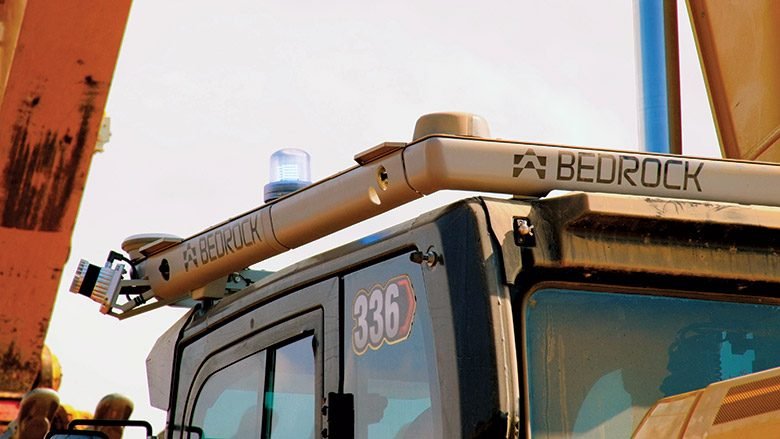
Bedrock Robotics, in partnership with Sundt Construction, is automating heavy civil site preparation excavators for a 130-acre manufacturing facility project in the Southwest that supports home energy production and is already showing results in productivity and coordination.
Bedrock’s autonomous systems have moved more than 65,000 cubic meters of soil and rock by loading human-operated articulated dump trucks in the same workflow as traditional operations, with trucks positioned to be loaded by an excavator taking scoops from a dismantled pile. The successful integration demonstrates the commercial viability of autonomous construction, the technology firm says. The technology is now installed in various models of excavators ranging from 20 to 80 tons on the project site, adapting their systems from compact units to large-scale earthworks.
“They’re one tool in a much bigger toolbox that we have in this,” says Dan Green, Sundt’s senior project manager, noting plans to move about 700,000 cubic yards of rock and soil to the project. “That’s the scale of what we’re moving,” he said. Bedrock excavators “are about 10% of our utilization.”
Bedrock, a San Francisco-based autonomous equipment startup, has Austin Bridge & Road, Maverick Constructors and Haydon Cos. along with Champion Site Prep, Zachry Construction, Capitol Aggregates and Sundt as partners who are testing their add-on kits for stand-alone equipment.
Large, remote jobs that require skilled operators where such workers are not readily available come at a premium and have become a fertile test bed for autonomous teams. Bechtel has used Built Robotics excavators for trenching on solar projects in Texas and has used autonomous balls on other projects. Moog autonomous minicarts were used to deliver solar panels, just in time for installation at a solar project in Western New York. Green says that adding artificial intelligence and machine learning to the process has helped Sundt operators bring their autonomous co-workers on board more quickly.
“We’ve taken very experienced operators and they’re teaching how a human does this task using multiple operators,” explains Green. “It’s getting to feel the difference between them, because each operator is different in how they do it [their job].” With the efficiency of these autonomous systems, “you’re taking that consolidated knowledge from multiple operators and turning it into a single operator, and that’s very powerful,” he adds.

A Caterpillar excavator, powered by Bedrock Robotics technology, loads a Deere dump truck.
Photo courtesy of Bedrock Robotics
Solving challenges
Bedrock was founded by engineers and executives from commercial autonomous vehicle startup Waymo. CEO and co-founder Boris Sofman said that developing Bedrock’s technology on active job sites with real projects and contractors allows the company to scale quickly in the same way Waymo did, solving wayfinding, surveying and other challenges that map-based navigation initially struggled to overcome.
“We’ve been very pleased with the amount of a fairly significant group, a portion of the industry that is accepting the possibility of this,” Sofman says.
He adds that facing challenges, including labor availability, that limit project capacity for contractors, while ensuring that Bedrock uses an intuitive approach that doesn’t harm partners and customers, has allowed the startup to grow quickly.
“Just the availability of labor is a big problem, so a lot of jobs just don’t get done,” Sofman says, noting “a sprawling impact on [construction].”
