

Limestone Ridge Reliability Project
Cities of Wittenberg and Jackson, Missouri.
BEST PROJECT
Presented by Burns and McDonnell
Owner: Wabash Valley Power Alliance
Principal Design Firm, General Contractor, Structural Engineer, Civil Engineer: Burns and McDonnell
Strengthening electric service for more than 25,000 Citizens Electric Corp. members, the Limestone Ridge Reliability Project brings long-awaited resiliency to communities on both sides of the Mississippi River. In partnership with the Wabash Valley Power Alliance, the multisite program added two new 161/69kV substations, rebuilt an abandoned yard and upgraded seven miles of transmission circuits, including a 2,300-foot river that now provides a second high-voltage path to a region previously dependent on a single feed.
The result is a modernized network that reduces the risk of outages for homes, farms and major industrial customers while delivering new regional reliability.
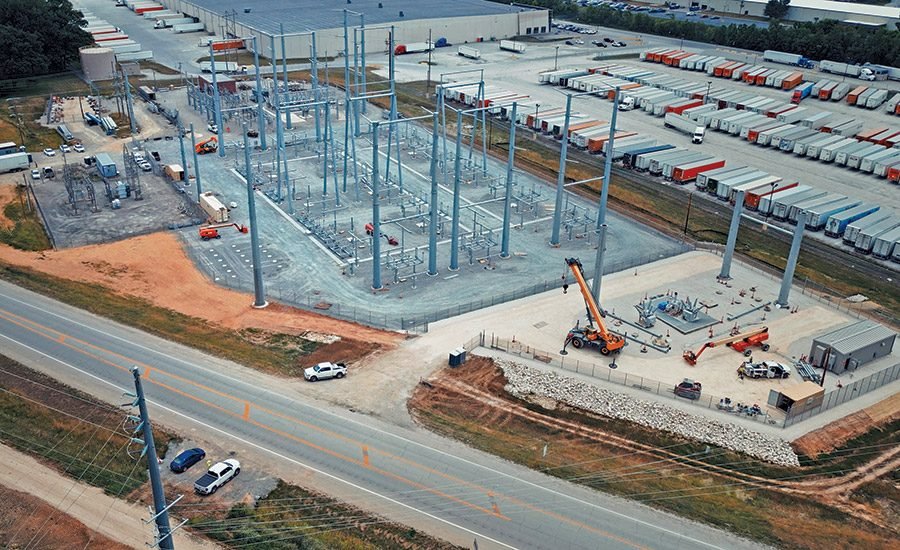
The first project milestone was the Trail of Tears Expansion Substation, which went live in October 2023 with a compact three-and-a-half-bay design that doubled system capacity within the existing yard footprint.

Photo by Burns & McDonnell
Five months later, the Wittenberg substation went online atop a reclaimed hill within a bat habitat buffer zone—its four-breaker bus configuration provides operational flexibility and room for future expansion.
Connecting the two substations, a new 138 kV line crosses the Mississippi River on concrete monopoles designed to withstand flood conditions, with installation requiring helicopters, US Coast Guard coordination and precise aerial chairlift operations.
Delivering the project on time required careful coordination. Lead times for switches and conductors exceeded a year, so critical materials were pre-purchased and stored off-site to maintain momentum. When supply constraints could not be avoided, the team resequenced the schedule, bringing the early tension support of Trail of Tears while waiting for the Wittenberg team to arrive later.
With portions of the route crossing protected wetlands and bat habitats, the project required a wide range of federal, state and local permits. Close communication with these agencies meant that all permits were approved early and impacts on the environment and natural habitats were successfully mitigated.
