

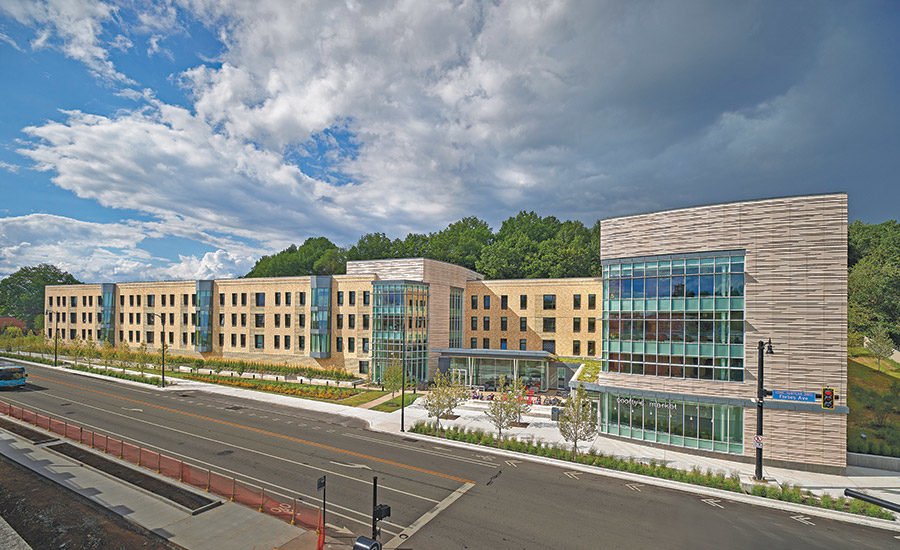
Carnegie Mellon University Forbes & Beeler Residence Hall
Pittsburgh
BEST PROJECT
Sent by: Mosites Construction Co.
Owner: Carnegie Mellon University
Main design company: Goody Clancy
Construction Manager: Mosites Construction Co.
Structural Engineer: RSE Associates Inc.
Civil Engineer: Langan Engineering and Environmental Services Inc.
MEP Engineer: Arup
Lighting design: HLB lighting design
Associate Architect-Interiors | FF&E: IKM architecture
Landscape architect: Klavon Design Associates Inc.
Despite a 10-month delay due to the pandemic, the four-story, $49 million residence was completed three months ahead of schedule and under budget thanks to a proactive design aid effort in the preconstruction phase, strict construction protocols and off-site prefabrication of exterior wall and building system components. The team says it has made the most of the added time. Developed and refined a logistics plan that would minimize disruptions, maintain a secure environment, address budget issues, manage supply chain issues and workforce availability, and fully define roles and responsibilities across team
A just-in-time delivery strategy accommodated site constraints and encouraged material efficiency and waste reduction. The subsoil of the sloping site, which was rich in iron oxides, complicated the construction of the complex foundation system. These conditions required over-excavation followed by the rapid installation of mud mats to prevent erosion.

Photo courtesy of Mosites Construction Co.
The residence hall follows famed architect Henry Hornbostel’s symmetrical Beaux-Arts design with yellow bricks that define other university buildings. Carefully positioned along a well-traveled pedestrian route and set back from the street for privacy, the building’s dynamic entrance provides an inviting space.
In addition to providing 37 amenity-filled apartments to house nearly 270 students, the new residence uses 23% less energy and nearly 30% less water than comparable facilities. The building design incorporates passive elements such as an efficient exterior envelope, glazing and exterior solar protection. The interiors are designed for occupant comfort and health, with features such as occupant-controlled temperature, CO2 sensors, low-VOC finishes, a green cleaning program and a comprehensive air quality management system. indoor air A green roof over the first-floor main lobby helps mitigate stormwater, and drought-resistant native plants eliminated the need to install a full irrigation system.
Furniture and fixtures from the demolished 1950s bedroom that previously occupied the site were donated for reuse to various local non-profit organizations, and 28% of the building materials were locally sourced.
