

Lincoln International
los angeles
BEST PROJECT
Sent by: Clune construction
Owner: Lincoln International
Main design company: Perkins Eastman
General contractor: Clune construction
Structural Engineer: Thorton Tomasetti
MEP Engineer: Simon S Wong Associates
Owner’s representative: Cushman Wakefield
Building management: Silverstein Properties
Subcontractors: Sharpe Interiors; Unison Electric; Milling of Artisans
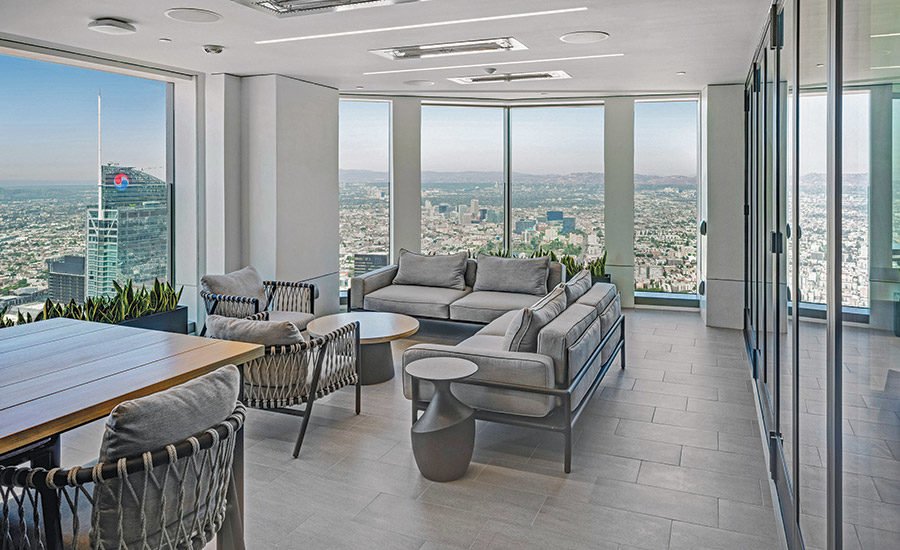
Located on the 66th and 67th floors of the 72-story US Bank Tower in downtown Los Angeles, Lincoln International’s 26,000 square foot Los Angeles office offers stunning views from the ocean to the mountains.
Arriving on the 66th floor, the elevator lobby welcomes guests with a detailed stone and light wood floor. An interconnecting staircase is the focal point of the floor, with light wood steps, dark metal trim and stone-trimmed walls meticulously combined. The 67th floor features additional conference rooms, a café and an outdoor loggia, created by removing the building’s curtain wall and installing a partial-height glass railing to create access to fresh air and panoramic views.

Photo by Marc Weisberg
Several major challenges arose during this renovation and expansion, particularly with the construction of the interconnecting staircase and the 67th floor loggia. The stone for the staircase was commissioned and cut from an east coast quarry, and the original plan was to install the stone walls first, followed by the stairs. But when the stone was delayed, the team had to pivot and install the steel structure of the staircase and scaffolding around it first to install the stone later. This out-of-sequence work required meticulous planning and coordination to ensure the final installation was seamless, with precise alignments between the stone slabs and the staircase structure.
Although the lighting package is often one of the last elements of an interior build to be completed, in this situation, a scissor lift could not be used once the stair structure is built. As a result, the pendant lighting hanging in its center was put in place weeks earlier and crews worked on it carefully.
Another major challenge was installing the loggia on floor 67. Work on this feature began months before the first glass panel was removed and included extensive training with the manufacturer of the existing swing stage. Originally planned with 4-foot glass panels, the loggia design was revised to 5-foot panels for improved comfort, and was also over-engineered to withstand hurricane conditions, ensuring long-term durability.
