

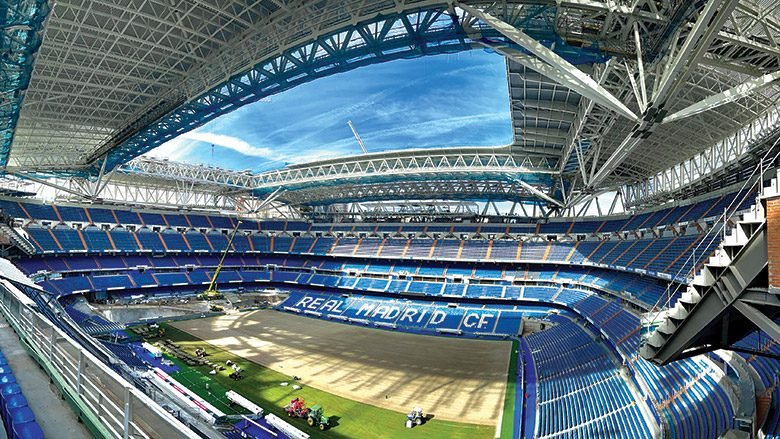

Santiago Bernabéu Stadium
Madrid, Spain
Best Project, Sports/Entertainment
Presented by FCC construction
Owner: Real Madrid C.F
Principal design firm, contractor: FCC construction
Architect: TYPE
Facade engineer: Arup
MEP Engineer: Industrial FCC
The renovation of the iconic Santiago Bernabéu stadium, built in 1948, adds a sophisticated facade of steel shutters and a retractable roof to fully protect its pitch, known as the “field” in Europe. The overhaul includes a patented field storage system that allows the venue to seamlessly change the floor for different sporting events and other functions. The upgrades also include an expanded capacity to 80,000 spectators, modernized architectural finishes and a state-of-the-art operating system that brings it all together.
“Changing times bring new demands and the need for transformation, which is why the Bernabéu has undergone the most ambitious reform in its history to face the future with confidence in an increasingly competitive and challenging industry,” says Julio Tojo, director of infrastructure at Real Madrid, a Spanish professional sports club. “The result is a space that celebrates the history of the region, the passion for sport and the spectator.”
More than 33,000 tons of special steel and hundreds of thousands of screws were used in the construction of the retractable roof, incorporating state-of-the-art materials commonly used in the wind industry, notes Tojo. Upgraded elements of the stadium also include a large 360º video scoreboard, with more than 3,000 square meters of high-definition LED screen.
Key to the innovation is the cavern built under the west side of the stadium more than seven stories deep in which its natural grass field, divided into sections, can be lowered and adjusted into place “within hours” for storage when the facility is used for other events, and to continue to be maintained with specialized lighting and automated irrigation and control systems (see p.
By Emell Adolphus
