

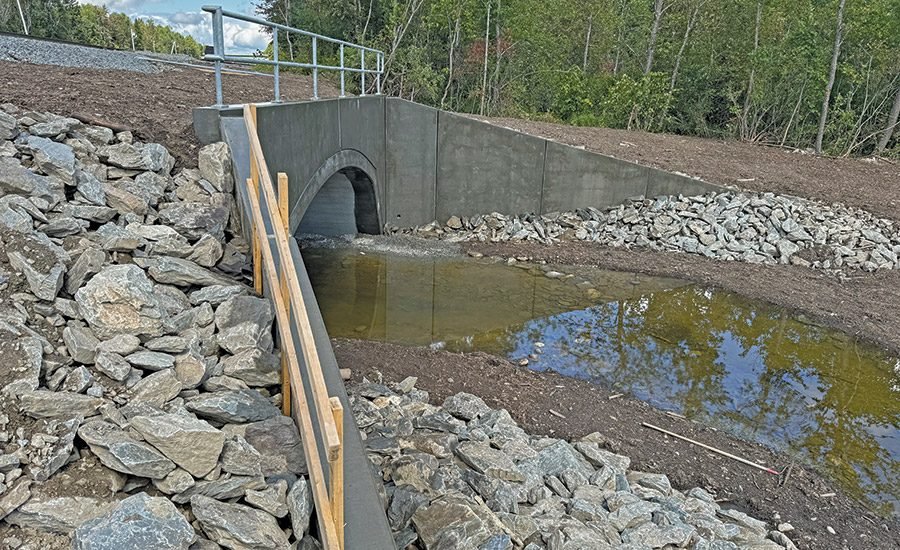
Thomas Brook Rail Bridge Replacement
Oakfia, Maine
BEST PROJECT
Presented by Sergeant Corp.
Owner: Maine Department of Transportation
Principal Design Firm/Civil Engineer: HBV
General contractor: Sergeant Corp.
Structural Engineer: Contech Engineering Solutions
Working within a 14-day window and culminating in a planned 96-hour complete shutdown of train operations, the team successfully replaced a 70-year-old structurally deficient bridge located along a remote section of a critical cross-border freight rail route. To achieve this aggressive schedule, crews working around the clock managed the assembly of 67 precast concrete segments and organized large-scale backfill operations.
Rapid curing concrete that achieved 5,000 psi in as little as 12 hours was critical to the project’s closed window. The team purchased and deployed specialized miniature mixers to accommodate the rapid curing time, ensuring the concrete would not be placed prematurely in conventional trucks. However, when the preferred material was not available, the team sourced an alternative specialty mix, testing and verifying its performance at short notice.
Relocating the new box culvert away from the original design location allowed the old culvert to remain operational and structurally sound throughout construction, allowing rail traffic to continue during the initial stages of the project and reducing downtime.

Photo by Sebastian Bennage, courtesy of Sargent Corp.
To protect habitat for endangered Atlantic salmon, the team built a new channel and diverted water only after careful preparation and regulatory approval, safeguarding wildlife and ecological integrity. A site-specific safety plan addressed the dangers of working alongside active rail lines and operating heavy equipment at all hours.
With crews working continuous shifts, fatigue management and clear communication were critical. Daily safety meetings, shift briefings and on-site vigilant supervision ensured everyone was alert and following safety protocols. In addition, the operations team strategically doubled up work before the 96-hour window, giving day and night crews hands-on experience with site conditions and safety measures before splitting into their respective shifts.
The team’s planning, preparation and quick response to challenges resulted in the extended rail shutdown being completed 13 hours early, with the team completing more than 7,600 hours of work with no recordable injuries or incidents.
