

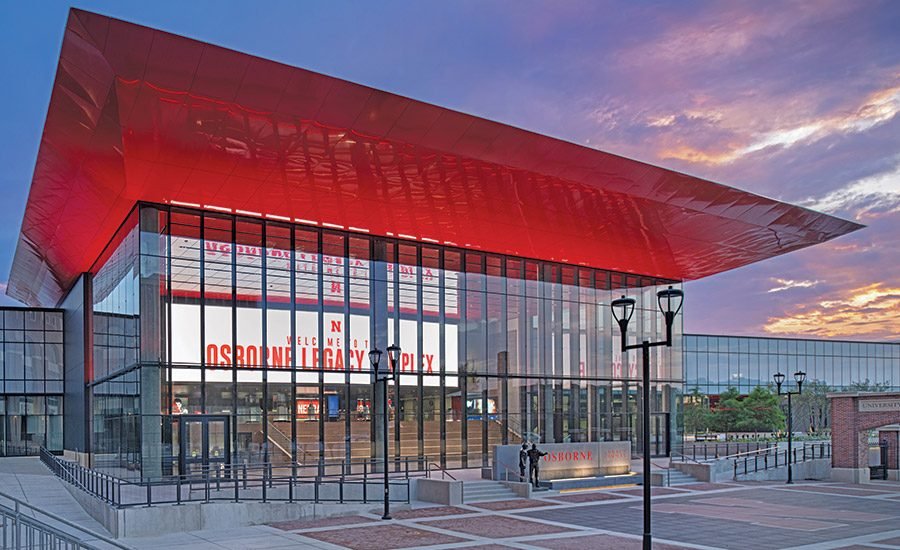
Osborne Legacy Complex
Lincoln Neb.
BEST PROJECT, SPORTS/ENTERtainment and Merit Award, Security
Presented by Hausmann construction
Owner: University of Nebraska-Lincoln
Contractor: Hausmann construction
Main design company: BVH Architecture
Structural Engineer: Hatfield Group Engineering
Civil Engineer: Olson Inc.
MEP Engineer: ME Engineers
Architect: village
Owner’s representative: Rainwood Development Partners LLC
Spanning 315,000 square feet, this $125 million expansion of historic Memorial Stadium has breathed new life into the University of Nebraska football program and its student-athlete facilities through a three-year, two-phase construction effort that balanced modernization with preservation.
The project brought together a new football performance center and comprehensive services for students and athletes under one roof. The first phase added sports medicine, strength and conditioning areas, locker rooms, meeting rooms and football offices.
The second phase provided an academic center, a full-service dining hall, and an experience lobby for visitors and recruits.
Built on a tight, busy site, the project required work to continue during active game days while protecting the university’s iconic “Kissing Columns,” which were relocated to form a new entrance to the stadium.
The construction team faced a number of challenges, including unmapped utilities, hazardous coal-contaminated soils, buried railroad debris, and more than 5,000 design clashes, each resolved using 3D modeling and building information modeling (BIM) tools that saved approximately $500,000 and months of delays.

Photo by Matt Kocourek Photography
Maintaining stadium operations for three football seasons required close coordination with university staff, firefighters and event staff.
When a key stadium gate was blocked, crews built a 30-foot-tall scaffold exit tower with ADA-compliant ramps to preserve crowd access. Additionally, weekly “game day prep” walks ensured safety and code compliance.
With more than 1.2 million logged work hours and a peak workforce of more than 200 workers, the contractor implemented enhanced security measures beyond standard protocols, including pre-event inspections and ongoing public safety monitoring. Despite the change in leadership and material delays, the project remained on schedule.
In a proactive move, the contractor re-sequenced construction to finish the football locker room six months early, aligning with the start of the season and demonstrating the teamwork that defined the stadium’s latest transformation.
