

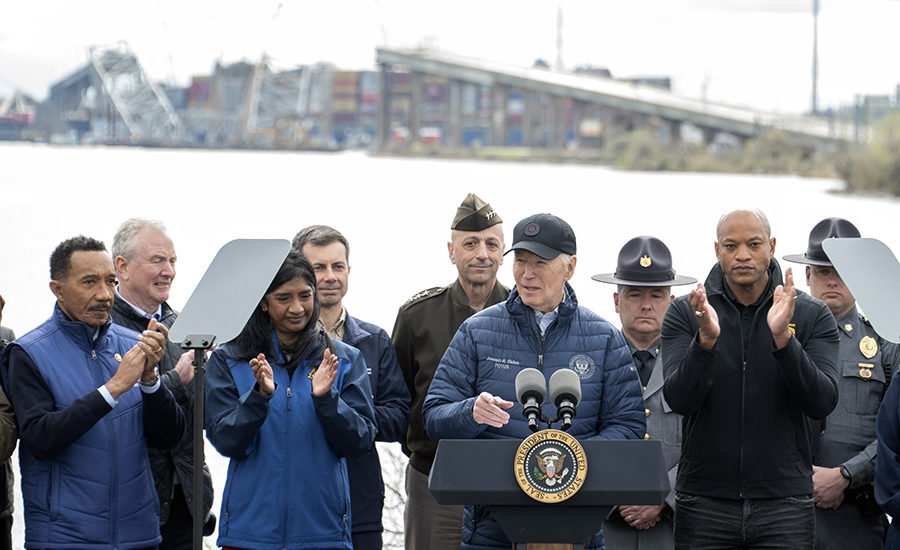
Demolition work continues at the site of the fallen Francis Scott Key Bridge as President Joe Biden reiterated his vow to “move heaven and earth to rebuild this bridge as quickly as humanly possible.”
Speaking on April 5 with the Patapsco River and the collapsed steel skeleton of the Francis Scott Key Bridge in the background, Biden added that the new bridge would be built “with union labor and American steel.”
Biden described the scene in stark terms, saying, “The damage is devastating” and that the bridge “has been torn apart” and that he saw “thousands of tons of shattered steel” that the team would try to remove “so quickly and as safe as possible.”
The bodies of four construction workers remain missing as dangerous conditions continue to hamper the search.
Biden said his administration is “absolutely committed to ensuring that the parties responsible for this tragedy are remedied and held accountable to the fullest extent of the law.”
But Biden also said, “I fully intend … for the federal government to cover the costs of rebuilding this entire bridge, everything.”
He also said the administration would “support Maryland and Baltimore every step of the way to help you rebuild.”
Biden announced that the federal government would contribute $8 million to make infrastructure improvements at nearby Sparrows Point, which is outside the restricted zone, to allow those areas to receive more boats.
The Unified Command overseeing recovery and demolition operations at the bridge site announced on April 5 that crews had recovered the remains of one of the remaining missing construction workers lost in the collapse. The worker, identified as Maynor Yasir Suazo-Sandoval, 38, was one of eight workers on the bridge at the time of the collapse, repairing dents in the concrete deck. Two survived and three bodies have been recovered. Three workers are still missing.
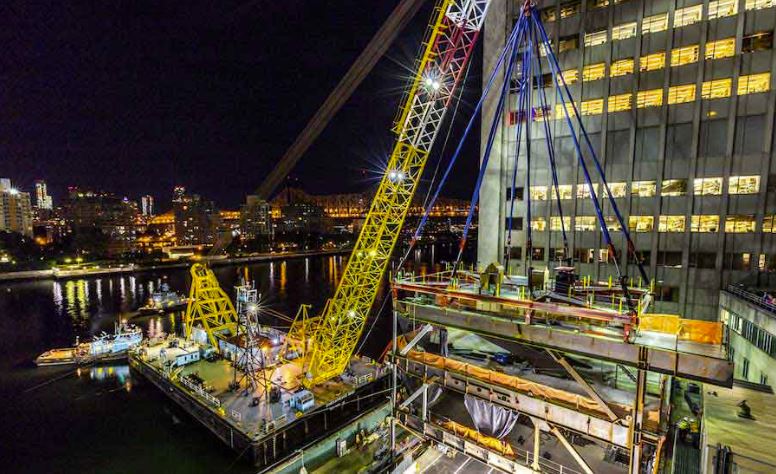
One of the massive cranes removing debris from the Francis Scott Key Bridge has a long and colorful history that begins with the recovery of a Cold War sub-nuclear. In 2017, ENR’s Nadine Post wrote a detailed article about the Chesapeake 1000 crane.
Read the article
On April 4, the U.S. Army Corps of Engineers said in a press release that it expects to open a 280-foot-wide by 35-foot-deep limited access channel in Baltimore Harbor by the end of of April This canal would allow barge container service and some ships moving automobiles and construction and farm equipment there from the port.
The statement said corps engineers aim to reopen the 700-foot-wide x 50-foot-deep permanent federal navigation channel by the end of May, restoring harbor access to normal capacity.
According to a US Release of the Coast Guard, two temporary channels are now open. The temporary channel at Sollers Point has a control depth of 11 feet, a horizontal clearance of 264 feet, and a vertical clearance of 95 feet. The temporary channel at Hawkins Point has a control depth of 14 feet, a horizontal clearance of 280 feet and a vertical clearance of 124 feet U.S. Coast Guard Rear Admiral Shannon Gilreath expressed hope that could open a third channel with a potential controlled depth of up to 25 feet that “should enable us to move almost all of our tug and barge traffic in and out of the Port of Baltimore.”
