

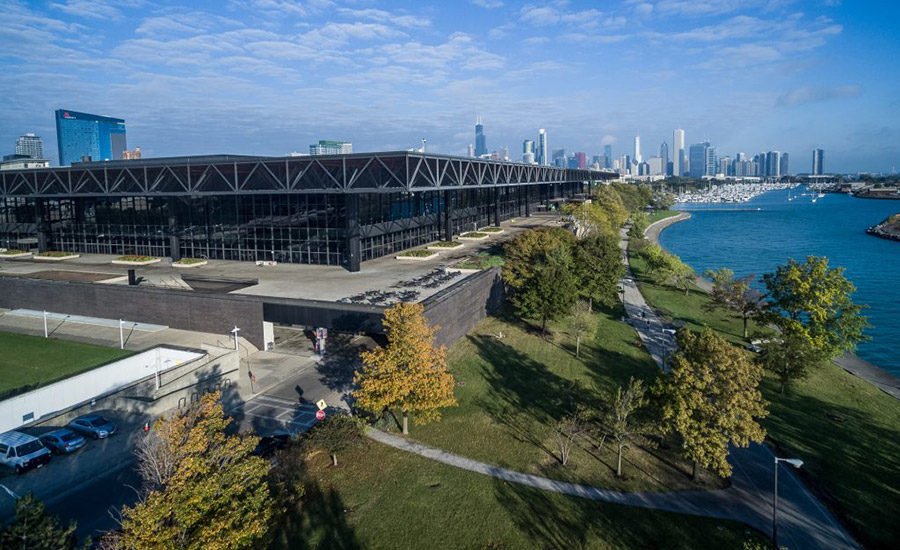
A year after nearly 1,000 migratory birds were killed by crashing glass outside the Lakeside Center, an exhibition space in Chicago’s McCormick Place, a $1.2 million project to install eco-friendly films the birds in windows, curtain walls and other exterior glass covering the size of two football fields have been completed.

Most of the bird kills have occurred on the east and north sides of Lakeside Center, completed in 1971.
Photo by Daryl Coldron, courtesy of the Field Museum
The film was produced by Toronto-based Feather Friendly. The installation, which took three months to complete, was done by NGS Films and Graphics of Canton, Ga. The application, which began in June, required temperatures consistently above 50 degrees for the product to properly adhere to the windows. The installers worked in two shifts, five days a week.
The Metropolitan Pier and Exposition Authority (commonly known as McPier), which manages the center, sought the window film solution to minimize collisions based on recommendations from local, national and international advocacy groups of birds and animals, including the US Fish and Wildlife Service, Chicago Bird Collision Monitors and Never Collide.
“When we heard about the reported mass collision event last year, we knew we needed to make additional improvements quickly to protect local and migratory birds as they passed through McCormick Place,” says Larita Clark, CEO of McPier.
The film, which has a pattern that is not visible at a distance to the human eye, is visible to the birds and helps them distinguish between open air and glass. For new construction, many architects specify a frit pattern that is manufactured with the glass itself.

Birds will be able to see the film applied to the windows at Chicago’s Lakeside Center.
Photo courtesy of the Metropolitan Exposition and Pier Authority.
Brian Smith, deputy regional director of migratory birds for the wildlife service’s Midwest region, commended the expo authority for its response ahead of this year’s fall migratory bird season.
“MPEA leadership was open to suggestions and were transparent with us as they implemented quick and significant changes to their lighting and existing windows to reduce the risk to birds on future migration seasons,” he said
In addition to the window film, McPier also reaffirmed his commitment to the Lights Out Chicago program, which requires buildings to turn off their lights when unoccupied. It also began turning off unnecessary outdoor lights that can attract wildlife and enacted a policy requiring curtains to be closed at night at the Lakeside Center to prevent light from escaping.
Dr. Julian Siggers, president and CEO of Chicago’s Field Museum of Natural History, who has been documenting bird collisions at the Lakeside Center for more than four decades, hopes the film will reduce the number of colli bird lesions.
“Field Museum researchers have documented bird collisions at the Lakeside Center for more than four decades, and we expect to see a measurable reduction in those numbers this fall migration season as a result of the new window treatment and policies which MPEA has enacted,” he said. .
Smith said McPier’s efforts “will provide a model for buildings to reduce bird strikes throughout Chicago and the world.”
