

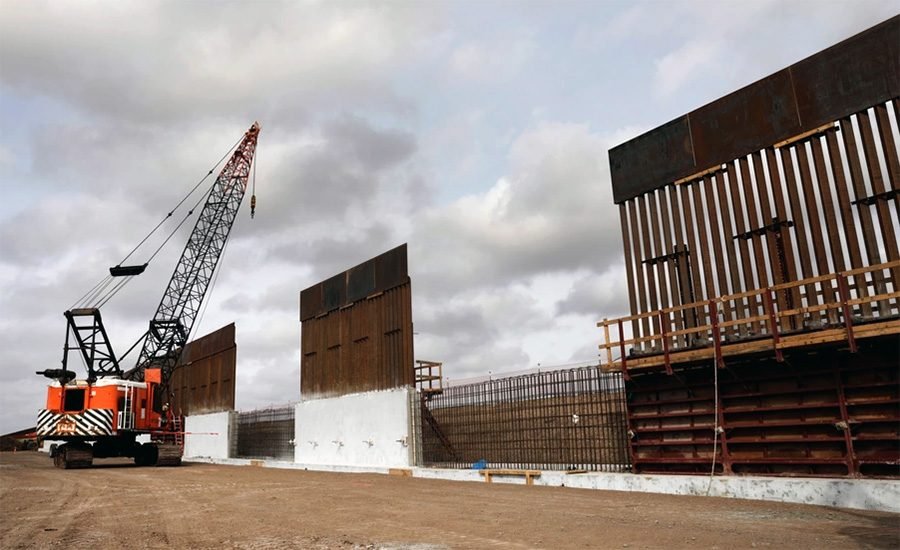
A $2 billion package of border infrastructure work announced this week by Tennessee-based contractor AIS Infrastructure signals a renewed execution phase for construction of the US-Mexico border in Texas, Arizona and California.
The Chattanooga-based heavy civil contractor said Dec. 16 that the U.S. Department of Homeland Security and U.S. Customs and Border Protection have awarded four major design contracts totaling more than $2 billion to BCSS, its unit focused on border and security-related infrastructure work.
The projects are located in the Del Rio sector near Eagle Pass, Texas; the Tucson and Yuma sectors in Arizona; and the San Diego sector near the Marron Valley–Campo de California area, according to the company.
ENR was unable to locate public award notices for the projects on SAM.gov or USASpending.gov by deadline, and the awarding agencies did not respond to requests for comment. Still, the project titles, locations, and scopes described by AIS align with the agencies’ previously published border infrastructure project descriptions for similar industry-based work, suggesting that the awards align with its broader border barrier system program.
AIS said the four projects are being delivered under full design and build contracts, with engineering lead HDR Design and BCSS executing the work through a joint venture with Caddell Construction and Gibraltar. Engineering is underway, and field construction is expected to begin in January and continue for approximately 30 to 36 months.
AIS Infrastructure is a subsidiary of ASRC Industrial, which is ranked 125th in ENR’s Top 400 Contractors list.
The projects combine physical barrier construction with supporting civil infrastructure and integrated systems, reflecting DHS’s use of bundled delivery rather than stand-alone barrier segments.

The map shows the locations and contract values of four border infrastructure projects AIS Infrastructure says have been awarded, spanning the San Diego, Tucson-Yuma and Del Rio sectors along the US-Mexico border.
AI Picture/REC
Two projects in the Del Rio area, valued at $565 million and $364 million, focus on work near Eagle Pass along the Rio Grande. AIS said the areas include vertical barriers, waterborne barriers, patrol and access roads, drainage infrastructure and integrated technical safety systems. Historically, Homeland Security planning documents for Del Rio sector boundary work have emphasized river conditions and floodplain management, which can complicate access and sequencing.
The $483 million San Diego-area project covers mountainous terrain near the communities of Marron Valley and Campo, AIS says. The work includes vertical barriers, mountain access and patrol roads, and advanced security and detection systems. Customs agency environmental planning documents for the San Diego sector have described projects there as heavily weighted toward access roads and system attributes due to rugged topography, limited staging areas and environmental constraints.
RELATED
Final $900M Defense Bill Passes House With Big Changes to Procurement, Infrastructure
The $606 million Arizona project spans the Tucson and Yuma sectors and includes upgrades to existing barrier systems, new vertical barriers, extensive patrol and construction of access roads, drainage work and integrated safety infrastructure, AIS said. Homeland security descriptions of previous projects in the Arizona sector emphasize long stretches of remote desert terrain, flood-prone drainage channels and the need for durable access roads to support year-round operations.
To support the four projects, AIS said it plans to hire 350 to 400 additional workers and deploy nearly 100 new heavy equipment next March. This expansion comes as Southwest contractors continue to compete for skilled labor amid strong highway, water and energy construction activity.
The joint venture structure and joint design-build delivery underscore how contractors manage risk on politically sensitive and logistically complex federal work. Rather than fragmented task orders, projects reflect multi-year execution packages that concentrate delivery responsibility among a limited group of experienced companies.
AIS said an additional $3.7 billion in indefinite-delivery, indefinite-quantity border infrastructure contracts are under review and cited a total program allocation of approximately $39 billion. While future awards and timelines remain subject to federal procurement processes and policy changes, the scale and coordination of announced projects point to a more sustained construction pipeline than the industry has seen in recent years. In 2021, President Joe Biden halted border wall projects that were started in the first Trump administration.
RELATED
First border wall contracts of Trump’s second term awarded in Texas, San Diego
For contractors and designers, the significance lies less in the announcement itself than in what follows: simultaneous execution of design and construction in several sectors, heavy labor and mobilization of equipment from early 2026 and a border infrastructure program moving from planning to the field.
“These are long-term infrastructure projects involving complex roads, bridges and access systems,” AIS Infrastructure president Stephen Christensen said, adding that the work will require a significant increase in skilled manpower.
