

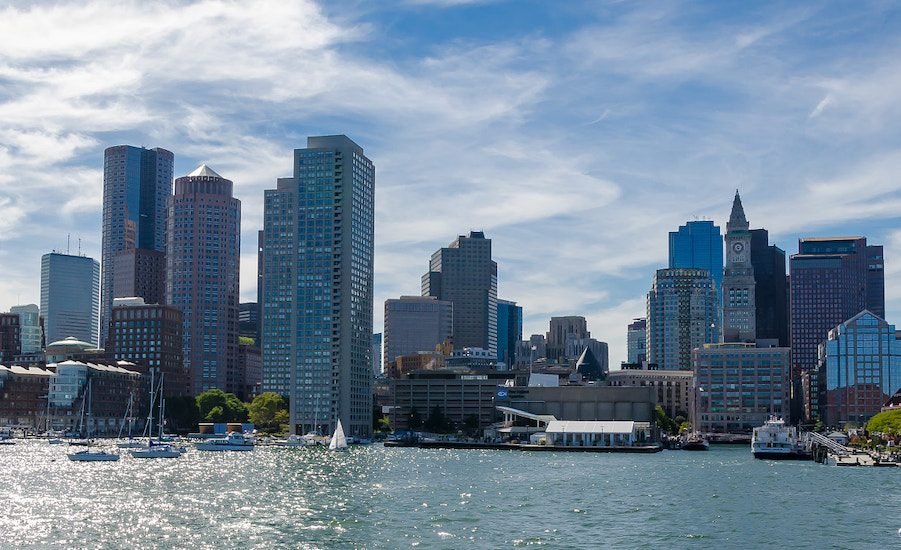

For the first time in 30 years, tBoston’s Zoning Commission has approved a sweeping rezoning plan that will allow 700-foot-tall buildings in one part of downtown Boston to be mostly residential and relax some height limits.
“This updated zoning brings predictability and historic protections to the downtown core, encouraging new housing and investment to continue revitalizing downtown,” Boston Mayor Michelle Wu said in a statement.
The rezoning plan was unanimously approved by the 10-member commission on Oct. 22 and is awaiting Wu’s signature. Meanwhile, Cambridge City Council approved a recommendation for zoning changes along a busy corridor and plaza at an Oct. 21 Planning Board meeting. The vote follows a citywide rezoning that eliminated single-family housing, according to a media report.
Boston officials noted at the Oct. 22 hearing that downtown area which will allow 700-foot towers to be built already has 500-foot tall buildings.
The new zoning will encourage new housing construction and mixed-use development in downtown Boston to help reverse the housing shortage in an area that can support higher density development, a city statement said. While residential uses are now legal in the new zoning districts, “hotel, laboratory and large office use will require additional approval,” he notes.
For the first time, Boston’s zoning code references state shadow laws for the Boston Common and Public Garden and Federal Aviation Administration regulations for flight paths, said Andrew Nahimias, a senior urban designer with the Boston Planning Department, who presented the plan to the hearing. “State shadow law enforcement will in all cases supersede local zoning,” he says. “Previously, the laws were not referenced in the state code; in this way, zoning reaffirms and enforces those shadow laws.”
The rezoning is part of a planned seven-year downtown zoning process that took place between 2018 and 2023, with three zoning drafts, eight months of public comment and 14 stakeholder meetings, Nahimias says.
The plan has critics, including Leslie Adam, board president of Friends of the Public Garden, who pressed the commission to pause and reconsider the building’s heights. In a letter to Boston City Planning Chief Kairos Shen, he writes, “Approving new building heights on the right that jump from 155 feet to [between] 500 and 700 feet upsets the balance established by the state’s shadow laws, which were enacted 35 years ago in alignment with the lowest building heights allowed at the time.”
But the city sees the plan as one that will “strike a balance” between protecting the historic character of downtown while allowing development and housing growth, Nahimias says.
Plan Downtown, relaunched in 2022, created a vision that responds to the post-pandemic world where many work remotely and pedestrian traffic has decreased, Shen says. Along with the city’s Office to Residential Conversion Program, the new zoning will “maximize our options for reinvesting downtown and create the vibrancy that is critical to its long-term success,” he adds.
“The adoption of new downtown zoning is a key moment in the neighborhood’s necessary adaptation to the post-pandemic ‘new normal’ and will usher in a transformative era of investment and improvement,” he said. Michael J. Nichols, president of the Downtown Boston Alliance.
Through the Charles
Across the Charles River in Cambridge, the rezoning effort is designed to encourage the opening of ground-floor businesses with dining and night spots. For the Massachusetts Avenue corridor petition, the main additions allowed under the rezoning would include hotels, craft retail food courts, food vendors and theaters, a media report notes.
The petition would also relax height limits for residential-only buildings up to eight stories. For mixed-use projects with active floor plans, such as daycare centers, libraries, dentists or law offices, the rezoning would allow up to 12 stories. The request does not include changes to height or density limits for non-residential buildings.
Although both requests are similar, the request for the Cambridge Street corridor allows residential height to be increased to eight stories from six in some districts and up to 15 stories in others, all with the requirement for an active ground floor, the report noted. These larger height margins are primarily concentrated in the plazas at each end of the roughly 2-mile-long corridor.
