

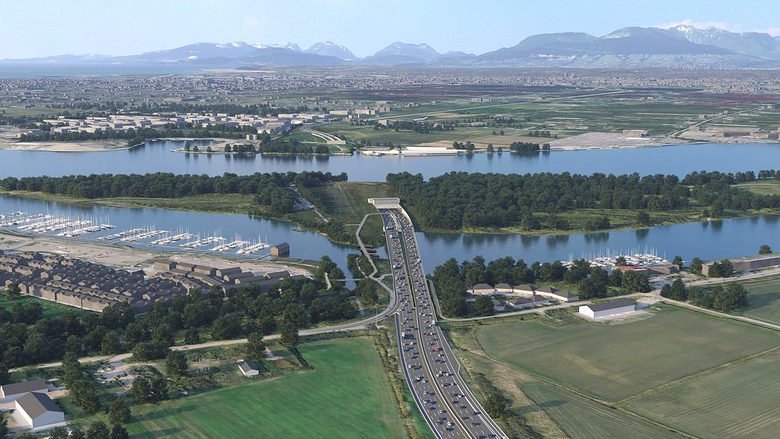

Plans to replace the George Massey Tunnel under the Fraser River in British Columbia are moving forward with the selection of the Ministry of Transport and Infrastructure’s Cross Fraser Partnership to assist in the development leading to a design-build agreement for the estimated $3 billion project.
Cross Fraser Partnership is a team of Bouygues Construction Canada Inc., Fomento de Construcciones y Contratas Canada Ltd., Pomerleau BC Inc. and Arcadis Canada Inc. It beat two other teams that had been shortlisted to submit proposals for the new river crossing.
The plan is to build a 2,625-foot-long, eight-lane submerged tube tunnel to replace the current four-lane George Massey Tunnel that carries British Columbia Highway 99 under the Fraser River between Deas Island and Richmond, BC , which is immediately south of Vancouver. The contractor would also be responsible for replacing the Deas Slough Bridge between Deas Island and Delta, BC.
Officials say the project is needed because the Massey Tunnel is a bottleneck where traffic flow slows to an average of 30 km per hour. They hope to increase this average speed to 80 km per hour with the new tunnel, which will also have dedicated public transport lanes in each direction and a separate path for cyclists and pedestrians. The new tunnel would also meet modern seismic performance standards, unlike the current tunnel that opened in 1959.
“With this team in place, we can finalize the design of the project and get it ready for construction, helping us improve travel for people traveling on Highway 99 between Richmond and Delta,” said Rob Fleming, Minister of Transport and Infrastructure, in a statement.
An environmental assessment is currently being carried out. British Columbia officials aim to begin major construction in 2026 for completion in 2030.
Meanwhile, work continued on a related project near Highway 99. Flatiron Constructors Canada Ltd. is spearheading the $63.5 million Steveston Interchange project, which aims to improve traffic flow on Highway 99 and add transit connections. Last month, crews began erecting 21 concrete beams for the first half of the new interchange, and officials say the work is scheduled to be completed next year.
