

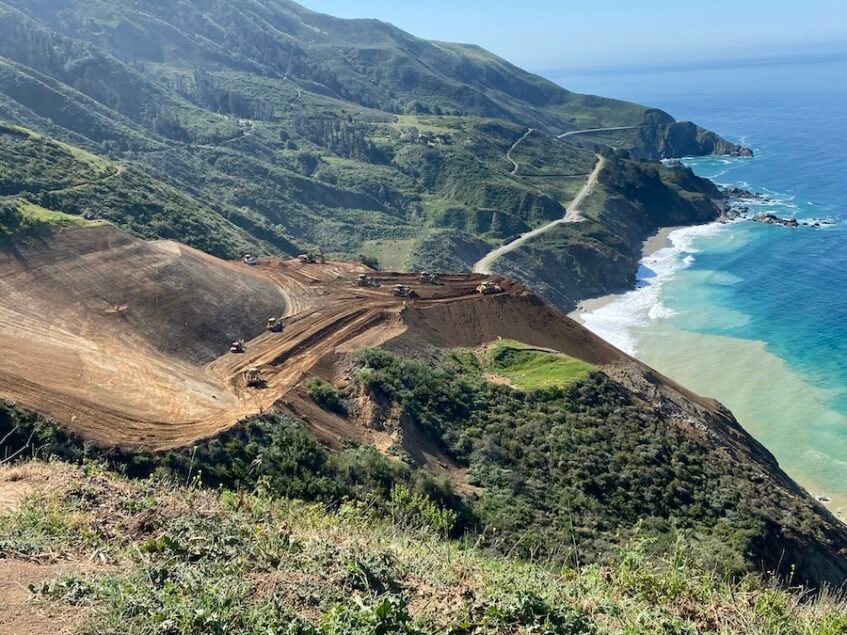
Since mid -May, the crews of the iconic road 1 in the north of California have installed shear’s more than 60 feet in the slide area of the regent, near Big Sur to stabilize the land. Then they will resume the elimination assisted by the technology of the slide material that has closed the area since February 9, 2024.
This is the first time that the California Department of District 5 of the transport has used excavators and excavators controlled remotely in production to eliminate the slide material, according to officials.
Despite several months of initial stabilization and slide removal efforts, a new slide surrounded the regent slide repair place in August 2024, with a movement calculated more than 1 feet a day.
In March, District 5 of Calerans began to use two distance controlled excavators and two distance controlled excavators to increase productivity while protecting workers from the challenges associated with the height, slope and instability of the slide area. The remotely operated team was used together with excavators and excavators.
Remote controlled machines are run by an operator sitting at a control center above the slide. Equipment with on board operators push the material to remote control machines, which carry out the dangerous task of pushing material on the edge.
The effort for a month was initially successful, but regular monitoring identified a new movement, responding to excavation activities and environmental effects, and a new area that was immediately cracking above the project area. The crews stopped the work of heavy equipment to focus on the stabilization of the slope above the area through the installation of additional shear dowry.
In mid -June, about 750 shear dumps have been installed. Caltrans reports that the measures indicate that where these skills have been installed, they have their intended effect by providing resistance to the shear and stopping the advance of the slide activity.
Kevin Drabinski, a spokesman for Calerans, says that “there is an incredible control range” in the slide area with crews with various teams. “We need to understand absolutely how it moves and where, to what extent and at what angle for the safety of our crew,” says Drabinski. Daily geological evaluations are also performed. There have been no injuries since the work began, the agency reports.
Surface mounted prisms are used to control slide motion, incorporate newer technology such as form, sloping sloping, surface comparisons of three -dimensional drones, and vibrant thread piezometers. According to Caltrans, the data collected by the control instruments is used with visual observations of the conditions of the site and the measures of surface to make informed decisions and adjust the evaluations of the design.
When a slide movement took place at the northern end of the site, the team had to constantly readjust the strategy. The workers “do this loading dance and then retreat as cracking accelerates,” says Drabinski. “We are now trying to install shear skills as we move along the slope as we continue with the excavation activity and the sliding material of the cleaning and lower the bench and continue to install dowels of shear as needed.”
The number of Dowels installed will depend on the area created with this new slope. The Dowel installation is expected to continue for a couple more weeks before the distance controlled excavation will be resumed.

A section of road 1 has been closed for more than a year due to slide activity.
Photo courtesy of caltrans
CREWS Hotrans works with Caterpillar Inc. And other contracting partners to incorporate innovative technology. Geoff Pirro, a senior product consultant and Catherpillar applications specialist, emphasizes that this is the first time that his remote control team has been used for a landslide.
Pirro says that every slide has different geological formations and operators must understand the particular slide application. One of the advantages of distance controlled equipment is to keep the operators safe. Working the remote controls of a distant installation, reduce the risk of soft tissue damage or other severe injuries, he says.
Virtual training
Caterpillar carries out the formation of remote control, either in one of its facilities or in a place of the project. The team has “screen mirror”, which means that many functions on board “outside the plate” can be used through remote controls.
CAT D8 excavators and excavators in traditional conditions are formed to operate the same equipment by remote control, stands out Drabinski.
A trail of C train, which is usually used in the mining industry, moved to the site. It serves as a mobile office building where operators sit in specially equipped chairs that resemble games similar to games about 1,000 feet from the team. The operators have controls on the arms, a harness of the shoulders and the controls on the feet. They receive information from screens and four cameras that show the front, rear and both parties. External microphones are mounted on heavy equipment.
There is a joystick and a foot pedal; It’s like being in a virtual cabin. Pirro generally adds operators with configuration within 24 to 48 hours.
The remote controlled equipment works with an encrypted Wi-Fi network. Each machine has an encrypted IP address and runs from a network of machines that can manage several equipment, says Pirro.
Once the site is excavated, the crews will install a metal drapery on the inclination, which will help prevent people from falling. Workers will drill and make points where they can join the metal drapery, which is similar to a network system. In addition, the answers are parked at the bottom, at half and the top of the inclination to visually control any slide activity. Spotters are in constant communication.
“We really are throwing everything in the regent slide,” says Drabinski.
The worries of the corerans in the area is in the long term due to the landslides inherent in the mountains of Santa Lucia, a natural occurrence obvious even before the road was built in the 1930’s. The mountain range is never more than 11 kilometers from the coast and forms the strongest coastal slope in the contiguous United States. In a geological survey, the 75 miles south of the Carmel River was killed, 1,500 slides were identified.
It has been suggested that a range of engineering options are proposed to preserve traffic through. The state has explored some, including the construction of a tunnel. This would be a delicate operation, complicated by the fact that the Earth does not belong to the State, says the spokesman for Catrans. Another concern is where the tunnel would end, possibly in another location prone to sliding activity. Preventive measures are taken throughout the year.
But this does not mean that there is a time line for when the repair work will be completed at the regent slide. At least, Catrans claims that the regent’s Slide Area on road 1 will close this summer. An updated estimate will reach a later date.
