

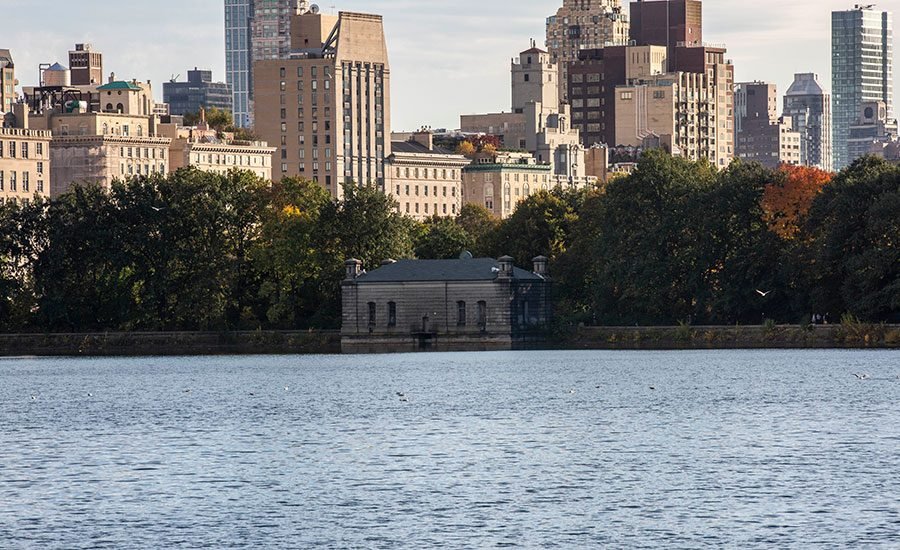
Parts of the Central Park Reservoir, which has been there since the 1800s, will soon be replaced.
The New York City Department of Environmental Protection is currently accepting bids from contractors to renovate the former drinking water source and bring it up to current safety standards. Bids are due by 2:00 p.m. March 17 for the reservoir portion of a larger $24.6 million rehabilitation contract.

The Central Park Reservoir is contained by an earthen embankment that has a storage capacity of 1.04 billion gallons. The CPR served to store and supply drinking water to Manhattan until 1993, when it was decommissioned.
Photo courtesy of the New York City Department of Environmental Protection
Built between 1858 and 1864, the reservoir, sometimes called the Jacqueline Kennedy Onassis Reservoir, was at the receiving end of the first major aqueduct built by New York City. Although it stopped providing drinking water in 1993, some of the original infrastructure, such as the pipes and valves required for the withdrawal, is still in place.
The approximately 1 billion-gallon, 106-acre reservoir has been considered Hazard Class C, or “high hazard,” by the Department of Environmental Conservation since the Federal Emergency Management Agency first released safety standards for the dam in 1983. The safety standards also state that 90 percent of the water impounded below the spillway crest must be extract in 14 days. While the Central Park Reservoir may meet these standards, “this depends on the use of the original infrastructure … which may not be reliable in an emergency,” according to a Department of Environmental Protection spokesman.
The agency aims to ensure the drawdowns proceed as planned by replacing sluice gates, valves and check valves; sewer lining; and, in general, upgrade the mechanical systems of the doors.

In addition to mechanical and structural renovations to the Central Park Reservoir Houses, New York City is looking to seal the water pipes at each location.
Photo courtesy of the New York City Department of Environmental Protection
The structural aspects will also attract attention. Trees and root systems have grown into the embankment over the years, so the contractor will have to pull them down and make stone and grout repairs, the spokesman said, with a likely addition for partition wall repairs. The work will also include structural restoration at all three lodges, such as window and door security renovations. Last spring, the department asked the public for ideas on how two of the three cabins could be turned into reservoir and water systems education sites, noting that the upgrades would have to be “faithful” restorations. A representative for the Central Park Conservancy, the nonprofit organization charged with caring for the park, said he had no additional comment on the planned work.

The Central Park Reservoir is all that remains today of the Manhattan Conservation Basins that provided drinking water until 1993 from the Croton Aqueduct. It was preceded by the structure between 79th and 86th streets, which was completed in 1842.
Photo courtesy DEP/NYC Water flickr
The department “received and reviewed the responses to the RFI and is developing next steps,” the spokesman said.
Arcadis is the engineer of record for the project, while Gannett Fleming and Dewberry jointly serve as construction manager overseeing the rehabilitation of Central Park Reservoir and Silver Lake Reservoir. Also a unique holding basin for New York City water, the latter reservoir on Staten Island is undergoing similar upgrades.
Construction in Manhattan is scheduled to begin in the winter of 2026 and last four years.
