

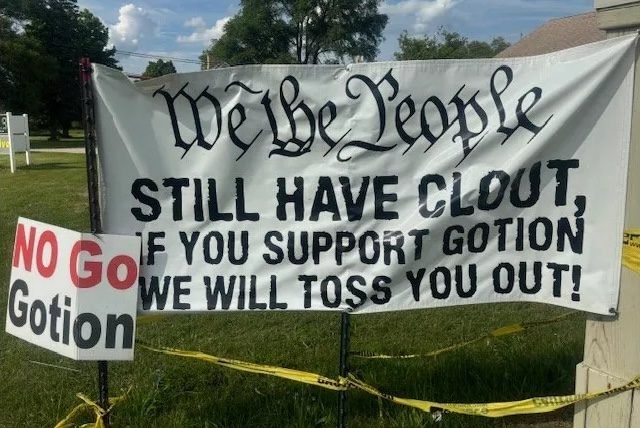

With its once enthusiastically received plan to build a $2.4 billion electric vehicle battery plant now scrapped in Michigan, Chinese-owned battery company Gotion Inc., which had sought to build a factory on nearly 300 acres near Big Rapids, is rejecting a demand to reimburse nearly $24 million for the state purchase.
The money was awarded to Gotion, the U.S. subsidiary of China-based Gotion High Tech, in 2023 even as local opposition to the proposed factory in northern Michigan mounted, with opponents citing Gotion’s alleged ties to the Chinese Communist Party (CCP) and other concerns, including the potential for fires at the proposed lithium battery plant and that its industrial community would be unsuitable.
The uproar over the factory that would have produced cathodes and anodes for use in electric vehicle batteries led to a recall election in November 2023. Five city officials who supported the project were dismissed and two others resigned.
The factory was expected to have six buildings of 2 million square feet and would have created 2,350 jobs, Gotion said.
The repayment call for tthe Office of the Attorney General of the State of Michigan was issued after the Michigan Economic Development Corporation sent a default notice to Gotion in September 2025 noting that no construction or development activity had occurred at the site for more than 120 consecutive days.
The Jan. 30 letter signed by Assistant Attorney General James Ziehmer informed Gotion that it is acting as a debt collector to recover funds on behalf of the Michigan Strategic Fund, which promotes economic development in the state.
“… The Michigan Strategic Fund notified you of multiple events of default” and “you were provided 30 days to cure the events of default,” Ziehmer wrote.
The funds came from the Strategic Site Preparation Program (SSRP), used to prepare large-scale sites for development.
Attorney Mark Heusel, representing Gotion, responded to the letter on Feb. 10, alleging that Green Charter Township, where the factory would have been located, is violating a development agreement with Gotion and that the company has suffered hundreds of millions of dollars in damages because of it.
Calling it the only “equitable solution,” Heusel wrote that “some of these damages may be mitigated if Green Charter Township buys the land or the state reclaims the land for its developable site inventory and waives the repayment obligation it is seeking.”
In a lawsuit pending in the U.S. District Court for the Western District of Michigan and the Court of Appeals for the Sixth Circuit, Gotion is seeking to enforce a development agreement, which it says the township breached after the new township’s management rescinded support for extending municipal water lines to pump 715,000 gallons of water a day to the factory.
An opponent of the plant, Lori Brock, a real estate agent who owns a horse farm about a half-mile from the site and has organized demonstrations against the factory, alleges the development agreement is invalid because it was signed by the previous township supervisor but never voted on by the township board.
“He just signed it without bringing it back to the board. So we don’t think there was ever a development agreement to begin with. If you think there was one, it was based on lies,” he says.
Heusel contends that the project “was subject to an onslaught of attacks, threats, unfounded accusations and anti-China sentiment. That a substantial project like this, which had the full support of local and state officials, could be blocked by a vocal minority of dissenters should stifle the appetite of anyone seeking to develop in the state.”
Brock alleges that Gotion lied about matters such as how many jobs the factory would create, how much those jobs would pay, and about the company’s ties to the CCP. He says it’s a David vs. Goliath case and the township, which has a population of about 3,600 people, is now in debt because of the legal case.
“And now we’re stuck with a $500,000 bill for lawyers against them and we never wanted it to start,” he says.
