

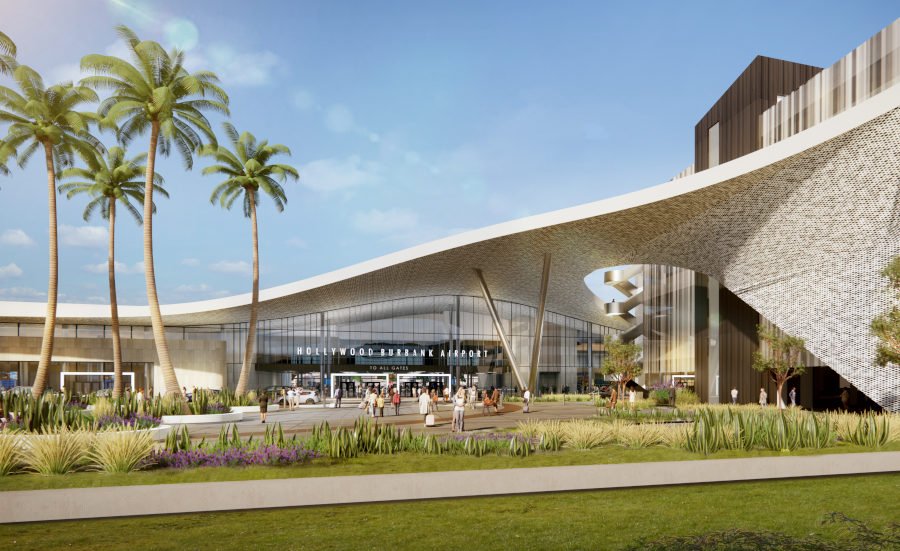

The Burbank-Glendale-Pasadena Airport Authority (BGPAA) on January 25 broke ground on a new $1.5 billion terminal at Hollywood Burbank Airport.
the new 355,000 square meter facility with 14 doors
will be located in the northeast quadrant of the Burbank airport, across the airfield from the existing 94-year-old terminal it will replace. The Elevate BUR Project”. it is needed to meet federal standards and state building requirements, while improving the overall passenger experience with new features and amenities.
The existing terminal, which is approximately 245,000 square feet, does not meet current seismic standards and is not compliant with the Americans with Disabilities Act. The new terminal is expected to open in October 2026, and demolition of the old terminal is scheduled to be completed in December 2027.
The design and construction team is led by Holder, Pankow, TEC Joint Venture (HPTJV), with Corgan providing architectural services in association with CannonDesign. Jacobs provides project management services.
“The main driver for building the new terminal is safety,” says Jacobs program executive Roger Johnson, who serves as the airport’s program executive. He says parts of the existing terminal and a parking garage are so close to the runways that they actually fall within the airport’s current runway safety area; at the gates, when the planes are pushed and pulled with tugs, they cross into these protection zones.
“For years, the Federal Aviation Administration has told Burbank they have to do something, and the airport has been trying to build a new terminal for years,” Johnson says. “And the challenge has been that it has taken the airport more than 20 years to finally get an agreement with the City of Burbank to allow them to build a new terminal.”
As part of the new deal with the city of Burbank, which voters approved in 2016, the airport can build a new terminal, but it must have the same number of gates – 14 – as the old one and cannot exceed the 355,000 square meters. “The idea is that you can build a replacement terminal, but you can’t expand it or grow the airport,” Johnson says.
The new facility’s design adds distance between the airport’s runways and the terminal building, and includes upgrades to meet current earthquake design and ADA accessibility standards. Project features include a 45,900 square meter aircraft parking area for boarding and disembarking, a new electric vehicle charging parking structure, a new airport access road, options shopping and dining, upgraded restrooms, new ticketing hall and baggage screening system, and an upgraded TSA checkpoint.
In addition, the new terminal is designed to reduce the airport’s overall emissions and achieve a minimum of LEED Silver certification. Sustainable features include electric vehicle charging, electric ground service equipment, reduced water consumption and connections to the regional transit network.
The project will be delivered using progressive design construction, which “allows you to accelerate construction,” Johnson says. “By building a progressive design, we went from scratch to design development drawings in about a year. This is the fastest work I’ve personally ever done, and I’ve done a lot of airport terminals.”
Elevate BUR will be funded through a combination of applicable federal airport improvement grants, revenue from passenger facility charges, Airport Authority funds, and the Authority’s issuance of bonds ‘general airport revenue to be supported by an airport revenue pledge.
