

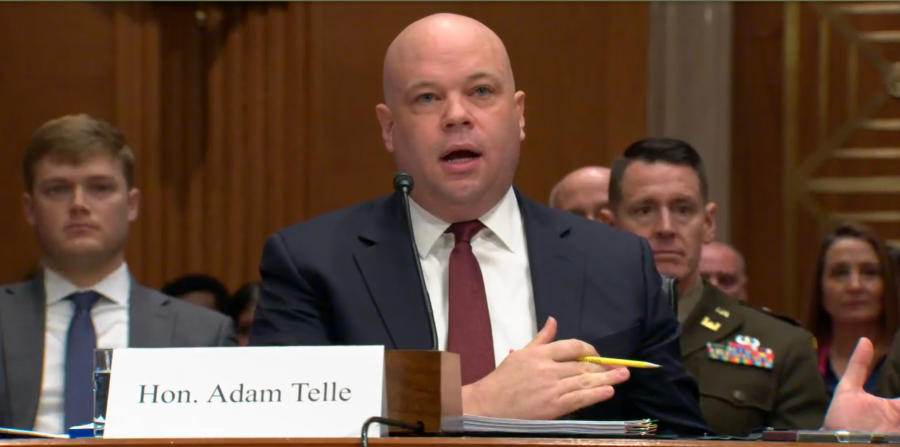

As lawmakers began the legislative process to draft the 2026 version of the biennial Water Resources Development Act, U.S. Army Corps of Engineers officials outlined a new initiative to return the agency’s focus to core mission areas.
While few specifics and details about the plan have been made public, Army Civil Works Assistant Secretary Adam Telle told lawmakers in two separate congressional hearings last week that the “Build Infrastructure, Not Red tape” initiative would give more attention to the U.S. Army Corps of Engineers’ core civil works missions while minimizing non-core ones. It would also direct funding to the projects that would bring the most benefits and shorten the authorization periods. A spokesman for the body said more details would be provided “soon”.
The new program “will enable the U.S. Army Corps of Engineers to deliver nation-critical projects and programs more efficiently, sooner and at less cost than current ways of doing business,” Telle said. “This will eliminate bureaucratic delays and provide quick and clear decisions needed to save lives and boost our economy.”
Core missions include dredging, flood and storm damage reduction, restoration of aquatic ecosystems, and hydroelectric dams.
Democrats on both the Senate Environment and Public Works Committee and a House Transportation and Infrastructure Committee subcommittee pointed to the agency’s sizable backlog, currently estimated at $100 billion to $200 billion.
In his opening statement, Rick Larsen (D-WA), ranking member of the House Transportation and Infrastructure Committee, noted that the current administration has only formally implemented three provisions of the $10.7 billion 2024 WRDA, enacted in January 2025. he said.
Ensuring the Corps addresses the backlog is the Associated General Contractors of America’s top priority for WRDA 2026, according to the association’s director of federal/heavy infrastructure and utilities divisions, John Chambers.
Looking for quick answers on construction and engineering topics?
Try Ask ENR, our new intelligent AI search tool.
Ask ENR →
“We want to try to make sure that the Corps improves the backlog … with its industry partners … to streamline work in ports and inland waterways, to make sure they can move forward in a timely manner,” Chambers told ENR.
In addition, AGC will push the Corps to work with private industry companies rather than compete with them, Chambers said. In some cases, Corps of Engineers districts have used public dollars to purchase dredges and related equipment instead of working with private sector companies for dredging activities. Private companies “can do it at a much more efficient rate, in terms of costs, labor and overall capabilities,” he said.
Corps leaders “want to stay away from the mission,” Ed Fleming, who led two corps districts and is a former executive director of Civil Works and Emergency Operations, said in an interview with ENR. “There may be some emphasis on core mission areas at the expense of things that maybe were somebody’s favorite project that, but didn’t necessarily fit into the sweet spot of the Corps of Engineers’ areas of focus.”
However, Fleming, now a senior adviser at the environmental permitting firm Dawson & Associates, noted that Congress bears some responsibility for the slow pace at which some projects are delivered, as well as the higher costs.
“There are many members of Congress on both sides of the aisle who will say, ‘Why did the project in my district take so long?’ Well, OK, let’s tell you the whole story, Fleming said, pointing to the lack of full funding for authorized projects as a major factor.
Lawmakers hope to pass the 2026 WRDA bill before the end of the year.
